

The Hidden Power of Cold: Harnessing Stress for Health and Resilience
Golden Hook & Introduction
SECTION
Nova: What if the very thing you instinctively avoid—discomfort, that chilling cold, the feeling of being pushed to your limits—is actually the hidden key to unlocking a more powerful, resilient, and profoundly effective version of yourself?
Atlas: Whoa. That's a bold claim, Nova. My immediate, primal instinct is to say, "No, thank you, I'll take the warm blanket and the comfy chair." We're hardwired to avoid pain, aren't we? Strategically, in problem-solving, we're always looking for the path of least resistance, the most efficient solution, not the one that makes us shiver.
Nova: Exactly, Atlas! And that's precisely the "blind spot" our discussion today is going to illuminate. We're diving into a fascinating concept, spurred by the insights in "The Hidden Power of Cold: Harnessing Stress for Health and Resilience."
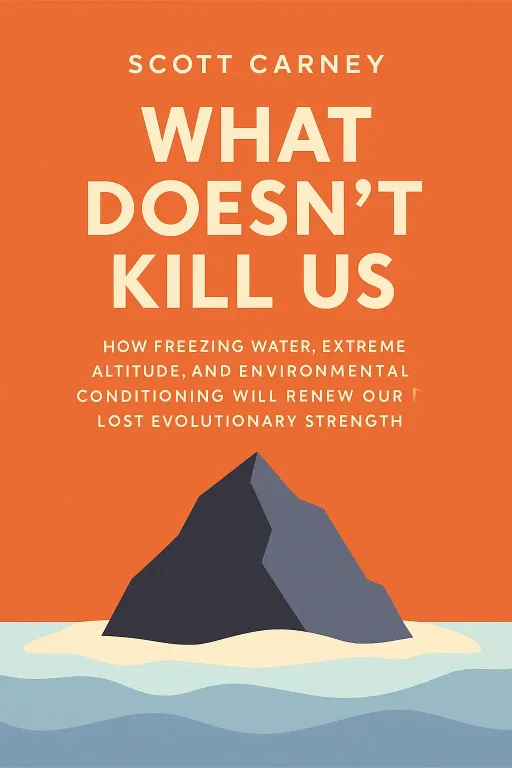
Atlas: Ah, so this isn't just about enduring a cold shower for bragging rights, then? It sounds like we're talking about a fundamental re-evaluation of how we perceive stress itself, much like what Scott Carney explores with the Wim Hof Method.
Nova: Precisely. This book, and the broader movement it represents, challenges that deeply ingrained human instinct to eliminate all discomfort. It's about showing how that very instinct, while seemingly protective, might actually be holding us back from accessing ancient, powerful physiological and psychological benefits. It's a profound shift in perspective.
The Blind Spot & Ancient Wisdom
SECTION
Atlas: So, you're saying our relentless pursuit of comfort, our desire to smooth out every wrinkle, every challenge, is actually a strategic disadvantage? That's a fascinating thought for someone who thrives on building solutions and optimizing systems.
Nova: In many ways, yes. Think about it: we've built these incredible, climate-controlled bubbles around ourselves. Our homes, our cars, our offices—they're all designed to keep us at a perfect 72 degrees, always fed, always entertained. And while that's wonderful in many respects, it's also created a kind of biological atrophy. We've lost touch with what the book calls our "ancient biological responses."
Atlas: But isn't comfort a sign of progress? Why would we to deliberately seek out something our biology, our very survival instinct, tells us to avoid? What's the strategic advantage in feeling uncomfortable, especially when we're trying to perform at our peak?
Nova: That's the core question, isn't it? The strategic advantage lies in awakening dormant systems. When you deliberately expose yourself to controlled cold, for example, your body doesn't just shiver. It triggers a cascade of adaptive responses. Your blood vessels constrict, sending warmth to your core. Your body activates brown adipose tissue—brown fat—which is basically a metabolic furnace designed to generate heat. Your immune system gets a jolt, becoming more vigilant.
Atlas: So, it's not just about not getting sick? How does this manifest beyond just physical health? Does this translate to mental clarity or resilience when you're, say, navigating a complex strategic decision or a high-pressure negotiation?
Nova: Absolutely. Think of it like this: your body's "inner warrior" wakes up. When you consciously step into a cold environment, you're sending a powerful signal to your nervous system. It's a controlled stressor, not a threat to your survival, but enough to say, "Hey, wake up! Be present!" This heightened state of awareness, this forced presence, directly impacts your mental landscape. It's a potent form of stress inoculation.
The Strategic Shift – From Avoiding to Activating
SECTION
Atlas: Stress inoculation. I like that. So, it's almost like a controlled simulation, a low-stakes training ground for high-stakes mental challenges? If you can master the cold, maybe you can master the chaos of a complex business strategy or the pressure of a tight deadline?
Nova: Precisely. That's "The Shift" we're talking about. Scott Carney, in his exploration of the Wim Hof Method, shows how combining controlled cold exposure with specific breathing techniques isn't just about physical benefits. It's a powerful tool for increasing mental resilience. When you're in that cold water, your mind screams at you to get out, to resist. But by consciously choosing to stay, to control your breath, you're training your prefrontal cortex—the part of your brain responsible for executive function and decision-making—to override primal fear and discomfort.
Atlas: That's fascinating. For someone who's constantly breaking down complex problems and building solutions, how does this deliberate introduction of physical stress directly enhance problem-solving or cognitive capacity? Is it just a 'toughness' thing, or is there a deeper cognitive benefit beyond just feeling stoic?
Nova: It's far more than just toughness. It's about building a robust mental toolkit. When you consistently face and overcome this controlled physical stressor, you're building self-efficacy, a profound belief in your own ability to handle difficult situations. This translates directly to other areas of your life. That feeling of "I can handle this" carries over. Your focus improves because you're training your mind to be intensely present. Your mood often elevates due to the release of endorphins and norepinephrine. It’s like a reset button for your brain.
Atlas: So, it's not just about enduring it, it's about actively with it, and that engagement builds a kind of mental muscle memory for dealing with other forms of stress. It's a proactive strategy for human optimization, truly. You're not just surviving; you're actively upgrading your operating system to better handle the complexities of modern life and the nuanced challenges of, say, market analysis or team leadership.
Synthesis & Takeaways
SECTION
Nova: Exactly. It's about consciously choosing growth over comfort. The cold, in this context, becomes a metaphor for any challenge we might otherwise avoid. Whether it's a difficult conversation, a daunting project, or a new skill, the principles learned from embracing cold can be applied. It teaches us that discomfort isn't a signal to retreat, but often an invitation to adapt and strengthen.
Atlas: So, to answer that deep question we posed earlier, about how deliberately introducing controlled physical stressors enhances overall resilience and problem-solving capacity... it sounds like it fundamentally rewires our entire system, physically and mentally, to be more adaptable, less reactive, and ultimately, more capable of strategic, clear-headed action even under duress. It’s a proactive investment in one's own cognitive and emotional infrastructure.
Nova: It is. Resilience isn't passive endurance; it's an active, cultivated state. It's about training your body and mind to thrive not just in spite of challenges, but often of them. It's about finding that hidden power, not just in cold, but in any challenge we choose to face with intention.
Atlas: And that, for me, is the lasting contribution of this idea. It's a way to become a more robust, more capable version of ourselves, ready to tackle whatever comes next. It's about intentionally adding beneficial stress to create a stronger, more adaptable self.
Nova: Indeed. So, we encourage all our listeners to reflect: where might you intentionally introduce a bit of "beneficial discomfort" into your routine? A cold shower, a challenging new project, a difficult conversation you've been avoiding? You might be surprised at the hidden power waiting to be unlocked.
Nova: This is Aibrary. Congratulations on your growth!









