

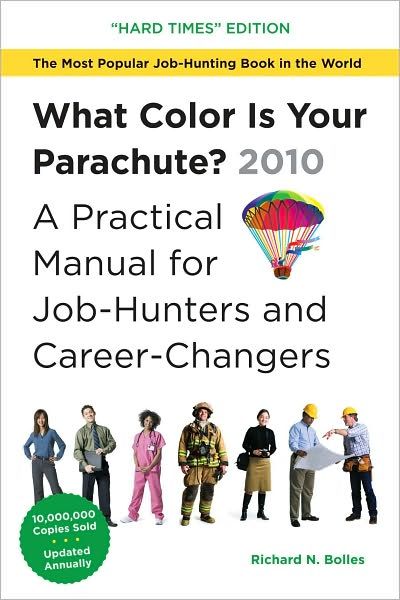
What color is your parachute?
Introduction: Why We Still Need a Parachute
Introduction: Why We Still Need a Parachute
Nova: Welcome to the show! Imagine you're falling from a great height, and someone hands you a parachute, but it’s not colored blue or green—it’s a color only can see. That’s the central, enduring metaphor of Richard N. Bolles’ career bible, "What Color Is Your Parachute?" This book has been in print since 1970, selling over ten million copies, yet it’s still being updated annually.
Nova: : That longevity is what gets me, Nova. In a world where job descriptions change quarterly and entire industries vanish overnight, how can a book from the Nixon era still be the go-to guide? It sounds almost quaint, like advice on using a rotary phone.
Nova: That’s the brilliant misdirection! The title makes you think it’s about finding the next job listing, but the core message isn't about the parachute itself—it’s about knowing what you’re made of you jump. Bolles insisted that true career satisfaction comes not from chasing titles, but from a deep, almost surgical self-assessment. He flipped the script on job hunting entirely.
Nova: : So, it’s less a manual for filling out applications and more a manual for self-discovery? If I’m listening right now and thinking, “I just need a job, I don’t have time for soul-searching,” why should I care about this decades-old classic?
Nova: Because the soul-searching is the shortcut! Bolles argued that the people who struggle the most are the ones who haven't defined what they actually to do. They are looking for parachute, hoping it’s the right color. This episode, we’re diving deep into the methodology that has guided millions toward meaningful work, focusing on the legendary 'Flower Exercise.' Get ready to map your own career flower.
Nova: : I’m intrigued. Let’s pull back the curtain on this career classic. Where did this whole philosophy begin, and how did it manage to stay relevant for over fifty years?
The Enduring Legacy of Self-Assessment
The Philosophy Shift: From Job Hunting to Career Planning
Nova: The book’s initial impact, especially back in 1970, was revolutionary because it fundamentally rejected the prevailing wisdom. Most career advice at the time focused on what employers needed. Bolles flipped that to focus on what the needed. He shifted the paradigm from reactive job hunting to proactive career planning.
Nova: : That makes sense. It’s the difference between asking, “What job is available?” and asking, “What kind of work environment allows me to thrive?” I read that he was a minister and an Episcopal priest, which probably informed that focus on purpose and vocation, right?
Nova: Exactly. His background gave him a unique lens. He saw the search for work as a search for meaning. And the book’s structure reflects that. It’s not just a list of tips; it’s a staged process. The research shows that the book breaks the job search into three key stages, moving from self-inventory to research to the actual job hunt. The self-inventory is always stage one, the foundation.
Nova: : I’ve heard that Bolles was quite skeptical of the traditional resume early on. Is that still a core tenet? Because today, if you don't have a LinkedIn profile and a tailored resume, you barely exist in the digital hiring pool.
Nova: That’s where the annual updates are crucial. Bolles wasn't against tools; he was against solely on tools that didn't reflect your true self. He famously advocated for the 'Garden of Forking Paths' approach, where you identify your ideal job first, and you figure out how to market that specific profile. The resume becomes a marketing document for the self you’ve already defined, not a historical record of every job you’ve ever held.
Nova: : So, the resume is the step, not the first. That’s a huge mental shift. It implies that if you’ve done the internal work correctly, the external search becomes much more targeted and less soul-crushing.
Nova: Precisely. And the sheer volume of people who have found success validates this. We’re talking over ten million copies sold. Career counselors worldwide have relied on this framework for decades. It’s the bedrock. But the real magic, the part that forces that deep introspection, is the central exercise.
Nova: : Ah, the centerpiece. The one that sounds like it belongs in a botany textbook rather than a career guide. Tell us about the Flower Exercise. What is it, and why is it so powerful?
The Seven Dimensions of Ideal Work
Deciphering the Parachute: The Flower Exercise Explained
Nova: The Flower Exercise is Richard Bolles’ signature diagnostic tool. It’s a visual, diagrammatic self-inventory designed to force you to articulate, in concrete terms, what your ideal work environment looks like. It’s not vague; it’s specific. It’s structured around seven key dimensions, each represented as a petal on a flower.
Nova: : Seven petals. That sounds manageable, but I imagine each petal requires some serious digging. What are these dimensions? Are they just skills and interests?
Nova: They are much deeper than that. The dimensions cover the entire ecosystem of your work life. The first petal, which is often the most crucial, is. This isn't just what you do, but what you doing. Bolles pushes you to list your transferable skills—the ones you’ve used in hobbies, volunteering, or past jobs—and then rank them by how much you love using them.
Nova: : So, if I’m great at organizing spreadsheets but absolutely despise it, that skill doesn't make the cut for the 'preferred' list. It’s about mastery enjoyment.
Nova: Exactly. Then you move to the second petal:. This is about the you want to work with. Do you want to work with historical data, renewable energy sources, or early childhood education materials? This defines the 'what' of your work content.
Nova: : Okay, so we have the and the. What about the environment? Because I know plenty of people who are brilliant at their job but miserable because of the office culture.
Nova: That brings us to the third and fourth petals, which address the environment. Petal three is. What kind of people do you want to work? Do you prefer leading a team, collaborating closely, working independently, or perhaps teaching others? Petal four is. This defines the you want to interact with—do you prefer working with raw materials, complex financial data, or perhaps abstract concepts?
Nova: : This is incredibly granular. It forces you to confront the reality of your day-to-day interactions. I can see how someone might realize they love the of being a CEO, but the reality of managing people or dealing with quarterly financial reports is actually their nightmare.
Nova: Precisely. And the exercise doesn't stop there. The final three petals deal with the context:,, and perhaps most importantly,. Bolles insists you define your non-negotiables here, so you don't compromise on them later.
Nova: : So, by the time you finish mapping this flower, you have a highly detailed profile of your ideal job—a profile that is entirely based on your own preferences, not on job market trends. It sounds like a blueprint for a custom-built career.
The Three-Step Process for Each Dimension
Mapping Your Ideal Job: From Petals to Profile
Nova: To truly appreciate the depth, we need to look at how Bolles structures the work for each petal. It’s a three-step process repeated seven times. Step one is brainstorming—generating as many ideas as possible for that dimension without judgment. This is the 'quantity over quality' phase.
Nova: : That’s where people often get stuck, right? They self-edit before they even start listing things. They think, “I’m not qualified to list that skill.”
Nova: Exactly. Bolles is adamant: list everything. If you enjoy fixing broken toasters, list it under skills. If you love reading obscure 19th-century poetry, list it under knowledge. Step two is filtering and refining. You look at your massive list and start circling the items that truly resonate, the ones that give you energy.
Nova: : And I assume this is where the 'transferable' aspect comes in. If I listed 'fixing toasters' in step one, in step two I might translate that into the transferable skill: 'complex mechanical troubleshooting and repair.'
Nova: You nailed it. That translation is the key to bridging self-discovery with marketability. Then comes step three, which is the most critical for the final output: describing your preferences in detail. For the Skills petal, for instance, you don't just list 'troubleshooting.' You write a detailed paragraph describing you like to troubleshoot, the complexity level you prefer, and the satisfaction you derive from solving that specific type of problem.
Nova: : So, by the time you’ve done this for all seven petals, you haven't just made a list; you’ve created a narrative description of your perfect job. How does this narrative then translate into the actual job search? Because the book has to connect this introspection to the real world of applications and interviews.
Nova: That’s the final stage of the book, which leverages this profile. Once you have this detailed description—your ideal skills, knowledge, people, setting, etc.—you use it as a filter. You only research organizations and roles that match the majority of your petals. This is why the book is so effective against the modern problem of 'spray and pray' applications. If a job description doesn't align with your Flower Profile, you discard it, no matter how good the salary looks.
Nova: : It sounds like a massive amount of upfront work. If a listener is looking at this seven-petal diagram for the first time, they might feel overwhelmed by the commitment required for this level of introspection.
Nova: It is an investment, but Bolles frames it as the only investment that guarantees a return on happiness. Think about it: how many hours do people waste applying for jobs they hate? That wasted time is far more costly than the time spent defining what you actually want. The research shows that this detailed profile is what allows job seekers to confidently answer the tough interview question: 'Why do you want job?' Because they can point directly to the petals that align with the role.
Adapting the Classic Framework for Today's Market
Staying Airborne: Modern Relevance in the Digital Age
Nova: Let’s address the elephant in the room: technology. The book started when the internet didn't exist. How does a book that emphasizes informational interviewing and networking in person adapt to a world dominated by LinkedIn, AI screening, and remote work?
Nova: : That’s where the annual revisions come into play. I saw references to the book being updated yearly to reflect the latest job market realities, including the impact of things like COVID-19 and the rise of AI. Bolles, or the team maintaining the book, clearly understands that the change, but the for meaningful work does not.
Nova: Exactly. The core principles—self-assessment, targeted research, and networking—are timeless. What changes is the execution. For instance, the networking section now heavily incorporates digital strategies, but the underlying principle remains: you must talk to people who are actually doing the job you want. The book guides you on how to conduct those digital informational interviews effectively.
Nova: : And what about the skills section? In the age of automation, are the skills we value changing? Are there new 'petals' we should be considering, perhaps related to digital literacy or adaptability?
Nova: The book addresses this by emphasizing skills, which is more important than ever. If your core skills are problem-solving, communication, and project management—skills that AI can’t easily replicate—you are future-proofed, regardless of the specific software platform. The modern editions often highlight skills like critical thinking and emotional intelligence as high-value assets.
Nova: : That’s reassuring. It suggests that the book isn't just preserving old methods; it’s validating the enduring human elements of work. But I wonder if there’s any criticism. Is the Flower Exercise too much work for the average person who just needs to pay rent next month?
Nova: That’s the main critique—the perceived time commitment. Some find the deep dive into seven dimensions too slow for an immediate job search crisis. However, the counter-argument, supported by decades of anecdotal evidence, is that the time saved by taking the wrong job far outweighs the initial effort. Furthermore, the book offers strategies for a 'quick-start' approach for those in immediate need, while still encouraging the full Flower Exercise for long-term career clarity.
Nova: : So, it’s flexible. It can serve as a short-term tactical guide or a long-term strategic roadmap. It sounds like the book’s genius lies in its insistence that you must know your parachute’s color before you trust it to save you.
Conclusion: Your Personalized Career Blueprint
Conclusion: Your Personalized Career Blueprint
Nova: We’ve covered a lot of ground today, from the book’s 1970 origins to its modern, digitally-aware updates. The central takeaway, the one that has kept this book relevant for over half a century, is the power of the Flower Exercise.
Nova: : It’s a powerful framework because it forces accountability. You can’t blame the market or a bad boss if you haven’t clearly defined the parameters of your own success. The seven petals—Skills, Knowledge, People, Data, Purpose, Setting, and Compensation—create a holistic, personalized blueprint for what work look like for you.
Nova: And the actionable takeaway for our listeners today is simple: stop looking at job boards for inspiration. Go find a blank sheet of paper—or better yet, find the actual Flower Exercise diagram online—and start brainstorming for just one petal. Start with your Preferred Skills. What tasks do you do that make you lose track of time?
Nova: : That’s a perfect entry point. Don't try to map the whole garden at once. Just focus on one area where you feel genuine enjoyment. If you can identify just one skill you love using, you’ve already started building your parachute in the right color.
Nova: Exactly. Bolles’ ultimate message is that you are not defined by the jobs you’ve held, but by the unique combination of talents and desires you bring to the table. Discovering that combination is the key to unlocking a lifetime of meaningful work, not just a temporary job.
Nova: : It’s a reminder that career planning is an ongoing process of self-discovery, not a one-time transaction. It’s about designing a life, not just filling a vacancy.
Nova: Well said. If you’re feeling adrift in your career, remember the title: you don't need just parachute; you need to know the color of. This book provides the map to find it.
Nova: : A fantastic deep dive into a true career classic. Thank you, Nova, for guiding us through the petals of self-discovery.
Nova: My pleasure. This is Aibrary. Congratulations on your growth!