

Unpacking UK Law: From Abstract Principles to Practical Understanding
Golden Hook & Introduction
SECTION
Nova: Law. Not. Just. For. Lawyers.
Atlas: Justice. For. All. Maybe? Hopefully?
Nova: That's a perfect five-word review, Atlas, especially for what we're diving into today: the often-intimidating, yet utterly foundational world of UK law. We're unpacking it not just for legal buffs, but for anyone who wants to understand the invisible architecture governing our daily lives.
Atlas: Oh, I love that – "invisible architecture." Because honestly, for a lot of us, law feels more like an impenetrable fortress than a guiding structure. I'm imagining our listeners who are strategic explorers, cultural architects, and practical learners, thinking, "How does this actually help me navigate my world?"
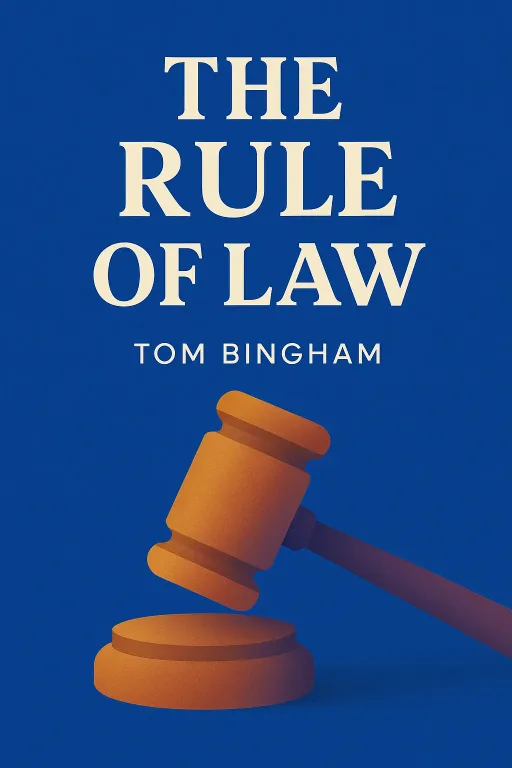
Nova: Exactly! And to unravel this, we're leaning on two remarkable books. First, "The Rule of Law" by the late, great Tom Bingham. Bingham wasn't just an academic; he was a titan of the British judiciary, serving as Lord Chief Justice and then as the Senior Law Lord. His unparalleled career gave him this incredible vantage point to articulate why the rule of law isn't just a lofty ideal, but a living, breathing necessity. His insights resonated deeply, earning widespread acclaim for making such abstract concepts so accessible.
Atlas: And then, for the practical "how-to," we've got "What About Law?" by Catherine Barnard, Janet O'Sullivan, and Graham Virgo. That title alone screams accessibility, which is exactly what we need to bridge the gap from Bingham's profound principles to the nuts and bolts of the English legal system.
Nova: Absolutely. Because understanding the 'why' of law, as Bingham lays it out, is crucial before we even touch the 'how.' It's about knowing the bedrock principles that ensure fairness, transparency, and accountability, even when you're just grabbing a coffee.
The 'Why' of Law: Rule of Law as a Foundation
SECTION
Atlas: Okay, so "bedrock principles." That sounds incredibly important, but also a bit… academic. What exactly is this 'Rule of Law,' and why should someone who's focused on, say, professional development or cultural immersion care about it?
Nova: That’s a fantastic question, Atlas. Bingham argues that the Rule of Law is the supreme principle, meaning everyone, including the government itself, is bound by the law. It’s not about specific laws, but the law is made and applied. He distills it into eight key components, and they’re surprisingly intuitive.
Atlas: Eight components? Lay them on me. I'm imagining a legal superhero with eight different powers.
Nova: You're not far off! First, the law must be accessible and, so far as possible, intelligible, clear, and predictable. You can't obey a law you don't know or understand. Second, it's about equality before the law – everyone, rich or poor, powerful or not, is subject to the same laws.
Atlas: Wait, hold on. Equality before the law. I imagine a lot of our listeners might feel skeptical about that. Isn’t that more of an ideal than a reality sometimes? We see headlines all the time where it feels like the powerful get preferential treatment.
Nova: That’s a critical challenge, and Bingham himself acknowledges the aspiration versus reality. He argues that while imperfections exist, the itself demands constant striving towards that equality. It’s a standard against which we can measure our society. Other components include human rights protection, fair adjudication, and public officials exercising powers reasonably and in good faith.
Atlas: Okay, fair enough. It’s the framework, even if the building isn’t always perfectly constructed. But can you give me a real-world example? How does this 'equality before the law' actually make a difference to someone on the ground?
Nova: Let's consider a hypothetical scenario, but one rooted in very real principles. Imagine a small, independent coffee shop owner in a vibrant London neighborhood. They’ve poured their life savings into this place. Suddenly, the local council starts issuing them a barrage of fines for minor, almost nitpicky infractions – a sandwich board slightly too far out, a bin moved an inch. Meanwhile, a huge, corporate chain coffee shop right next door, with identical minor issues, seems to get a complete pass.
Atlas: Oh, I know that feeling! That's going to resonate with anyone who's ever felt unfairly targeted by bureaucratic power.
Nova: Exactly. Now, the coffee shop owner initially feels helpless. It's a classic David and Goliath. But let's say our owner has a basic understanding of Bingham's Rule of Law. They remember that principle of 'equality before the law.' They also recall 'fair adjudication,' meaning decisions should be made without bias and with due process.
Atlas: So they don't just roll over?
Nova: Not at all. Armed with this knowledge, they start documenting everything: photographs of their infractions, photos of the chain's identical infractions, copies of the council's notices. They seek initial, perhaps pro bono, legal advice, where they're encouraged to formally challenge the council's actions. The lawyer explains that the council's discretionary powers must be exercised reasonably and without discrimination. The owner then presents their case, highlighting the clear disparity in treatment.
Atlas: And what happens? Do the giants always win?
Nova: In this case, no. Because the Rule of Law provides a framework for challenge. Faced with documented evidence of unequal treatment and the legal principle that their decisions must be fair and consistent, the council is forced to retract the fines and reassess their approach. The coffee shop owner, empowered by understanding foundational legal principles, successfully pushed back against arbitrary power. It wasn't about knowing every specific bylaw, but about understanding the underlying 'why' of justice.
Atlas: Wow, that’s actually really inspiring. It shows that these abstract principles aren't just for dusty law books; they're tools for empowerment. That makes me wonder, how does understanding these principles empower individuals in their own professional spheres, especially for those looking for professional development?
Nova: It’s transformative. It allows you to critically assess decisions, understand your rights and responsibilities, and even predict how certain actions might be legally interpreted. It shifts your mindset from simply reacting to proactively understanding the rules of the game, whether in business, community, or personal life.
Navigating the English Legal System: History, Institutions, and Practicality
SECTION
Atlas: So, if the Rule of Law is the 'why' – the ethical and principled foundation – how does the English legal system provide the 'how' for all this to actually happen? It sounds incredibly complex, especially for someone who isn't a lawyer.
Nova: That’s where a book like "What About Law?" becomes invaluable. It demystifies the actual machinery. The English legal system is unique, largely uncodified, meaning it's not all neatly written down in one big book like some civil law systems. It's evolved over centuries, a fascinating tapestry of common law, statute law, and European influences.
Atlas: Uncodified? That sounds like a recipe for confusion! How does that even work compared to, say, a system where everything is written down in a code?
Nova: That’s a great comparative law question! In a civil law system, typically found in Europe, judges primarily apply existing codes. In English common law, judges play a much more active role in developing law through their rulings, creating precedents that future courts must follow. It’s a dynamic, evolving system, shaped by centuries of judicial decisions.
Atlas: Fascinating. So the institutions themselves become incredibly important.
Nova: Absolutely. The key players are Parliament, which makes the laws; the courts, which interpret and apply them; and the judiciary, the judges themselves. Understanding how these institutions interact is like having a compass for navigating any legal issue.
Atlas: Can you give us an example? Let's say we have a budding entrepreneur, someone innovative, maybe in tech, and they need to protect their ideas or understand their agreements. How does this 'system' actually guide them?
Nova: Perfect. Let's take our entrepreneur, let's call her Priya, based in Manchester. Priya has developed a groundbreaking new piece of software. Her first thought might be, "How do I protect this?" This immediately brings her into contact with intellectual property law, an area covered within the English legal system. She consults a solicitor, who guides her through the process of patenting her invention or copyrighting her code. This is her interacting with the legal profession, a key part of the system.
Atlas: So, she's not just making it up as she goes along. There's a clear path.
Nova: Precisely. Next, Priya wants to partner with someone to scale her business. She needs a contract. Understanding contract law is vital here – what makes a contract legally binding, what are the terms, what happens if someone breaches it? This is where the principles of business law, again, part of the broader English legal system, come into play. She works with her solicitor to draft a robust agreement.
Atlas: And if something goes wrong? Say, a partner doesn't uphold their end of the deal?
Nova: That’s when she interacts directly with the court system. Depending on the value and nature of the dispute, she might find herself in a county court or, for a larger commercial dispute, potentially the High Court. "What About Law?" would explain the different tiers of courts, what each one handles, and the general process of litigation. It’s about knowing which door to knock on and what to expect when you get there.
Atlas: Ah, so it’s not just one big "law machine" you throw your problem into. There are specific pathways, specific institutions for specific issues. That's a huge shift from feeling completely lost to having a mental map. For someone keen on cultural immersion, understanding this legal framework is like understanding the society's operating system.
Nova: It truly is. It moves beyond just knowing bits of information to understanding the interconnectedness. From protecting her intellectual property, to forming partnerships, to hiring her first employees and understanding employment law – Priya is constantly engaging with and navigating the English legal system. This understanding provides her not just legal protection, but also strategic foresight in her professional growth.
Synthesis & Takeaways
SECTION
Nova: So, what we've really explored today is this incredible journey from the abstract, universal ideals of the Rule of Law, as articulated by Tom Bingham, to the concrete, practical mechanisms of the English legal system, which "What About Law?" helps us navigate. It’s about seeing how the 'why' informs the 'how.'
Atlas: It's like building a house. Bingham gives you the architectural principles – the blueprints for stability and fairness. And Barnard, O'Sullivan, and Virgo give you the instruction manual for the tools and techniques to actually construct and maintain it within a specific cultural context.
Nova: That’s a brilliant analogy. And for anyone, especially those who prioritize practical learning and professional development, understanding this isn't about becoming a lawyer. It's about becoming a more informed citizen, a more empowered professional, and a more engaged participant in society. It’s about recognizing that law isn't a distant, immutable force, but a dynamic system that we can, and should, understand and engage with.
Atlas: Absolutely. It transforms the intimidating into the understandable, and the theoretical into the tangible. It gives you that legal compass for your own strategic exploration.
Nova: Exactly. How might a deeper understanding of these legal foundations change the way you approach a challenge or decision in your own life this week?
Nova: This is Aibrary.
Atlas: Congratulations on your growth!