

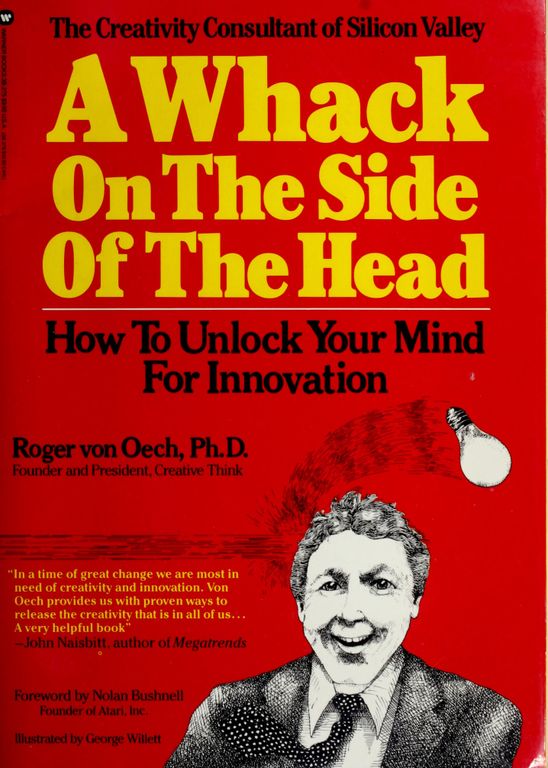
Whack On the Side of the Head
Introduction
Nova: Think back to when you were in elementary school. Your teacher walks up to the chalkboard, picks up a piece of white chalk, and draws a single, small dot right in the center. Then they turn around and ask the class, What is this?
Nova: Exactly. And that is what almost every college student says when they are asked that question. But when Roger von Oech, the author of the book we are diving into today, asked a group of kindergartners that same question, they went wild. They saw a floor waxer's eyeball, a squashed bug, the top of a cigar, or even a star from a long way off.
Nova: That is the core of what we are talking about today. The book is called A Whack on the Side of the Head: How You Can Be More Creative. It was written by Roger von Oech, a guy who basically invented the field of creativity consulting. He has worked with everyone from Apple and Disney to NASA and Google.
Nova: It is! But von Oech argues that most of us are stuck in mental ruts. We have these mental locks that keep us from being creative, and sometimes, to get out of those ruts, we need a metaphorical whack on the side of the head to jolt us into a new way of seeing things.
Nova: Precisely. We are going to look at the ten mental locks he identifies and, more importantly, how to pick them. By the end of this, you might start seeing floor waxer eyeballs everywhere instead of just chalk dots.
Key Insight 1
The Trap of the Right Answer
Nova: Let's start with the very first mental lock von Oech talks about, which is the search for The Right Answer. From the time we start school, we are taught that for every problem, there is one correct solution. You fill in the bubble on the test, you get the grade, you move on.
Nova: Almost never. Von Oech points out that the real world is much more complex. If you stop at the first right answer you find, you might miss the second, third, or tenth right answer, which could be much better. He says that the best way to get a good idea is to get a lot of ideas.
Nova: And that is exactly when you need the whack! He suggests a technique called the Second Right Answer. Whenever you find a solution, instead of stopping, you ask yourself, What is the second right answer? It forces your brain to keep searching past the obvious.
Nova: Logic is great for the later stages of the creative process, what he calls hard thinking. It is essential for evaluating and implementing ideas. But in the early stages, what he calls soft thinking, logic can be a total buzzkill. Soft thinking is about metaphors, dreams, humor, and play. If you apply logic too early, you kill the baby idea before it even has a chance to grow.
Nova: Perfect analogy. He uses the example of a scientist. If a scientist only used logic, they would never form a hypothesis based on a hunch or a weird observation. They need that soft thinking to make the leap, and then the hard logic to prove it. The lock happens when we think logic is the only way to think.
Key Insight 2
Breaking the Rules and Being Impractical
Nova: This brings us to a big one: Follow the Rules. We are surrounded by rules, Leo. Some are great, like don't drive on the wrong side of the road. But others are just leftovers from a different era that don't make sense anymore.
Nova: Exactly! We are still using a layout designed to be inefficient because it is the rule. Von Oech says that creative people are rule-breakers. They look at a situation and ask, Why are we doing it this way? He calls this creative whacking. You have to challenge the assumptions that everyone else takes for granted.
Nova: Well, he isn't saying to be a rebel for no reason. He is saying to be an internal revolutionary. You have to know the rules well enough to know when they are hindering progress. This ties into the next lock: Be Practical. We are often told to be practical, to stay grounded. But being too practical too early is the death of innovation.
Nova: That is the Practicality Police in action. Von Oech suggests using what-if questions to bypass this. Instead of saying that won't work, ask, What if we had an unlimited budget? or What if gravity didn't exist? It allows you to explore the edges of a problem without the weight of reality crushing the idea immediately.
Nova: Most people do! Ambiguity is uncomfortable. But in that grey area where things aren't clear, that is where the new connections happen. If everything is perfectly defined, there is no room for something new to emerge. He encourages us to embrace the ambiguity, to look at things from multiple angles, and to realize that a situation can mean two different things at the same time.
Key Insight 3
The Necessity of Failure and Play
Nova: Now we get to the one that scares people the most: To Err is Wrong. We are terrified of making mistakes. But von Oech argues that if you aren't failing, you aren't trying anything new.
Nova: It does. But he shares a great story about Thomas Watson, the founder of IBM. A young executive made a mistake that cost the company ten million dollars. When Watson called him into his office, the executive said, I guess you want my resignation. Watson replied, Are you kidding? We just spent ten million dollars educating you!
Nova: Exactly. Mistakes are just signposts telling you which way not to go. If you view them as data points instead of personal failures, you become much more creative. This leads into the lock Play is Frivolous. We tend to separate work and play, right? Work is serious, play is for kids.
Nova: But von Oech says that play is the soil that ideas grow in. When you play, you are relaxed, you are making weird connections, you are experimenting without the fear of consequences. Some of the biggest breakthroughs in history happened when people were just messing around. He actually suggests that companies should have playrooms or encourage hobbies that have nothing to do with the job.
Nova: And that ties into the lock That's Not My Area. We get so specialized in our jobs that we stop looking outside our own little bubble. A marketing person thinks they shouldn't care about engineering, and an engineer thinks they shouldn't care about art. But von Oech says the best ideas come from cross-pollination. You take an idea from one field and whack it into another.
Key Insight 4
The Fool and the Creative Identity
Nova: We are nearing the end of the locks, and these last two are very psychological. First, Don't Be Foolish. We are so worried about looking silly in front of our peers.
Nova: But the Fool has a very important role in history and in creativity. The Fool was the only one in the king's court who could tell the truth or suggest something crazy without getting their head chopped off. Von Oech says we need to play the Fool sometimes. We need to intentionally say the ridiculous thing because it might be the catalyst for someone else's brilliant idea.
Nova: In a way, yes! It is about lowering the social barriers that keep us from sharing raw, unpolished thoughts. And that leads to the final, most dangerous lock of all: I'm Not Creative.
Nova: And that is a self-fulfilling prophecy. If you believe you aren't creative, you won't even try to be. You will just look for the one right answer and follow the rules. Von Oech insists that creativity is a skill, not a gift. It is something you practice. It is like a muscle; if you don't use it, it withers, but if you start whacking yourself on the side of the head and picking these locks, it gets stronger.
Nova: Exactly. He even suggests that we should change our self-image. Instead of saying I'm not creative, start saying I am a person who looks for second right answers. It is a small shift, but it changes how you approach every problem you face.
Conclusion
Nova: We have covered a lot of ground today. From the trap of the one right answer to the importance of playing the fool and embracing our mistakes. Roger von Oech's A Whack on the Side of the Head is really a call to wake up our dormant creativity.
Nova: That is the goal! The next time you feel stuck, remember that you might just be locked. Ask yourself which of the ten locks is holding you back. Are you being too logical? Are you afraid of looking foolish? Are you following a rule that doesn't exist anymore?
Nova: Or just look at a chalk dot and try to see something else. Creativity isn't about finding something new; it is about seeing what is already there with fresh eyes. Go out there and start picking those locks.
Nova: This is Aibrary. Congratulations on your growth!