

The Ethical Blind Spot: Why Good Intentions Aren't Enough in EdTech AI.
Golden Hook & Introduction
SECTION
Nova: What if the very AI you're building to revolutionize education, with the best intentions, is secretly amplifying inequality? It's not a bug; it's a feature of our blind spots.
Atlas: Whoa, Nova. That's a bold statement right out of the gate. I mean, most people I talk to in EdTech are driven by a genuine desire to improve outcomes, to democratize access. How can something built with such good intentions possibly be a vehicle for harm?
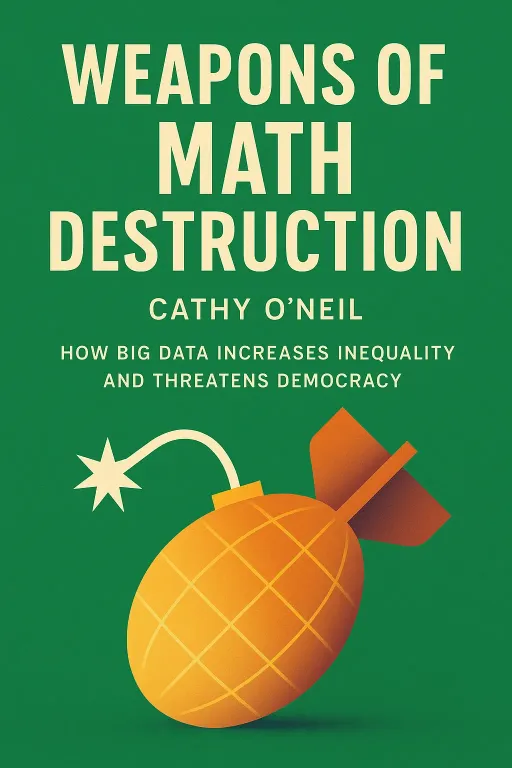
Nova: That's the ethical blind spot, Atlas, and it's precisely what we're diving into today. Our insights come from two absolutely groundbreaking books. First, we have Cathy O'Neil's "Weapons of Math Destruction," written by a former academic mathematician who left Wall Street to expose the hidden dangers of algorithms.
Atlas: "Weapons of Math Destruction"? I guess that sounds pretty dramatic for algorithms, which many of us see as purely objective tools. How does pure math become a weapon?
Nova: Exactly! And then we have Caroline Criado Perez's "Invisible Women," a book that, since its release, has been widely acclaimed for systematically revealing how our world, from product design to policy, is built on a foundation of male-centric data, leaving half the population literally invisible. It won the Royal Society Science Book Prize, among other accolades, for its vital contribution.
Atlas: Okay, so biased algorithms and invisible women. How do these two seemingly different threads weave into the fabric of EdTech AI and help us understand this "blind spot" you're talking about?
Deep Dive into Algorithmic Bias (Weapons of Math Destruction)
SECTION
Nova: They're two sides of the same coin, Atlas. O'Neil’s core argument in "Weapons of Math Destruction" is that algorithms, when they're opaque, scalable, and unfair, can become deeply damaging. Imagine an EdTech AI system designed to identify "at-risk" students. The intention is noble: intervene early, provide support, ensure no one falls through the cracks.
Atlas: Sounds like a dream for an educator, right? Targeted, efficient support.
Nova: On the surface, absolutely. But what if this algorithm is trained on historical data sets where certain student demographics—perhaps those from lower socioeconomic backgrounds, or specific racial groups—were disproportionately labeled "at-risk" in the past due to systemic biases, not necessarily their individual academic potential?
Atlas: Hold on, so the algorithm isn't creating the bias, it's just learning it from existing human biases in the data, then replicating it at scale?
Nova: Precisely. The algorithm sees patterns in the historical data: "Students from X zip code, with Y characteristics, are often labeled 'at-risk'." It then learns to predict that future students with those same characteristics are also "at-risk." This isn't about malicious intent in the code; it’s about the inherent bias in the data it's fed.
Atlas: That's a massive challenge for anyone building scalable EdTech solutions. If I'm trying to optimize for efficiency and reach, I'm relying on these algorithms. But if they're amplifying existing inequalities, I could be inadvertently harming the very students I'm trying to help. And then you have the "black box" problem, where the algorithm's logic is so complex, even its creators might not fully understand it made a particular decision.
Nova: Exactly. O'Neil calls this the "feedback loop." If the algorithm flags certain students as "at-risk," they might be channeled into less challenging academic pathways, or given different resources, which then limits their opportunities. This reinforces the initial "prediction" and creates a self-fulfilling prophecy, making it harder for those students to break out of the "at-risk" label. It's a system that, in a sense, eats its own tail, becoming more entrenched and harder to detect.
Atlas: So, for our architect listeners, how do you even begin to untangle that, especially when the algorithm's logic is opaque? It sounds like you'd need to audit not just the outcome, but the inputs and the process itself.
Deep Dive into The Data Gap (Invisible Women)
SECTION
Nova: You're absolutely right, Atlas. And that notion of "unseen harm" brings us perfectly to Caroline Criado Perez's "Invisible Women," which shows us another critical blind spot: the data gap. Her central thesis is that because men have historically been seen as the default human, and data has largely been collected by and about men, women have become "invisible" in countless areas—from medical research to urban planning.
Atlas: I've heard about that. Like how car crash test dummies were historically modeled on male physiology, leading to higher injury rates for women in accidents.
Nova: Exactly! It's a perfect example. Now, apply that thinking to EdTech AI. Imagine an AI learning platform primarily trained on data from a specific demographic: say, neurotypical students in a Western context, predominantly male. It might optimize learning paths, content recommendations, or even assessment methods that are highly effective for specific group.
Atlas: I can see where this is going. It means it could inadvertently be detrimental or simply ineffective for other groups. Female students, students from different cultural backgrounds, neurodiverse learners... their needs might not be prioritized or even recognized by the system.
Nova: Precisely. The AI isn't excluding them; it simply hasn't "seen" them enough in its training data. So, the personalized learning experience it creates is only truly personalized for a segment of the student population. The "male default" becomes an "average student default" that overlooks critical variations. This is not about bad intentions, but about an invisible "default" in the data that shapes the AI's understanding of "the student."
Atlas: That's a powerful point. So it's not just about data, but data. For EdTech leaders aiming for personalized learning for, this could mean we're building incredibly effective systems for, say, half the population, and just assuming it works for the other half. How do we, as architects of these systems, even begin to see what we're not seeing? It’s hard to fix a problem you don't even know exists.
Synthesis & Takeaways
SECTION
Nova: That's the million-dollar question, Atlas, and it’s where the insights from O'Neil and Criado Perez converge to offer a powerful solution. O'Neil shows us how algorithms existing biases, amplifying them at scale. Criado Perez reveals how our data itself fundamental gaps, leading to systems that fail to serve diverse populations. Together, they form a critical lens for ethical oversight.
Atlas: So, for our listeners who are navigating this future of EdTech—the architects, the navigators, the futurists—what's the pragmatic takeaway? How do we build AI that truly leads, not just responds, and ensures responsible, impactful integration, instead of inadvertently perpetuating disparities?
Nova: It starts with three critical questions. First,: Are you aware of the historical biases embedded? Are there significant data gaps for certain demographics? Second,: Is your 'universal' solution truly universal, or is it optimized for a specific default? And third,: Diverse perspectives are crucial to identify both algorithmic biases and data gaps before they become embedded.
Atlas: It's about proactive ethical design, then, not reactive damage control. It's about seeing the future of education not just as technologically advanced, but fundamentally equitable. Because, as an architect of the future, you have to build for.
Nova: Exactly. Good intentions are the starting line, not the finish line. True impact comes from rigorously examining our blind spots and building AI that genuinely serves all students.
Atlas: Shaping the future of education means shaping it for.
Nova: This is Aibrary. Congratulations on your growth!