The 'Art of Seeing': Unlock Hidden Meanings in Everyday Life
Golden Hook & Introduction
SECTION
Nova: What if I told you that most of what you 'see' every day isn't actually seen by, but rather interpreted for you by invisible forces?
Atlas: Whoa, hold on. Are you saying my own eyes are lying to me, or that there's some grand puppeteer behind every image I consume? That sounds a bit out there, but you've definitely got my attention.
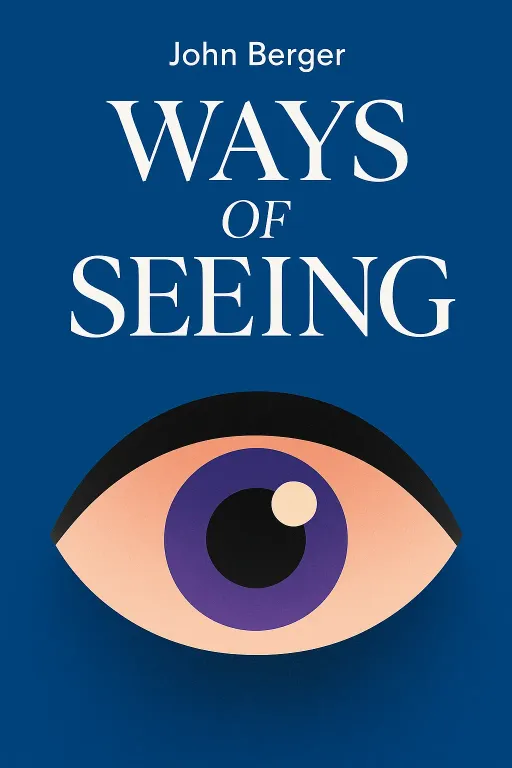
Nova: Not a puppeteer, Atlas, but rather deeply embedded systems of meaning and power. Today, we're unlocking the 'Art of Seeing' through the lenses of two incredibly influential thinkers: John Berger's seminal work,, and Marshall McLuhan's prophetic.
Atlas: Okay, so these aren't just academic texts, they're like decoding manuals for reality? I'm curious.
Nova: Exactly! Berger's book, which started as a groundbreaking BBC series, completely revolutionized how art was discussed, moving it from the elite gallery to everyday life. He made us question the very act of looking. And McLuhan, often called the 'prophet of the internet' decades before it existed, foresaw how the medium would reshape human thought, not just the message it carried.
Atlas: That’s a fascinating pair. So, we're talking about not just we see, but we see it, and what's influencing that 'how'?
Nova: Precisely. And that brings us directly to our first big idea: the unsettling reality of our cultural blind spots.
The Unseen Influence: Decoding Our Cultural Blind Spots
SECTION
Nova: We often look at art, advertising, news, even social media, and believe we're seeing it objectively. But the truth is, images are rarely neutral. They're loaded with biases, historical contexts, and power structures that we, the viewers, often completely miss.
Atlas: I mean, for someone who prides themselves on critical thinking, like a historian or a philosopher, aren't we already aware of bias? You know, you read a primary source, you question the author's intent. Is this really so profound when it comes to images?
Nova: It's more insidious than just conscious bias, Atlas. Think about how a luxury car advertisement is framed. It’s not just selling a car; it’s selling a lifestyle, a status, an aspiration. The polished chrome, the sprawling mansion in the background, the confident, successful person driving it – these elements aren't accidentally placed. They subtly tell you that car is a symbol of kind of success.
Atlas: Right, like, it's not just transportation, it's an identity marker. I can see that. But how does that operate on a deeper, more unconscious level? Give me a subtle example that even a 'challenger' might miss.
Nova: Consider news photography. Two different newspapers might cover the same protest. One image might focus on a lone demonstrator holding a sign, emphasizing their individual conviction. Another might show a wide shot of a chaotic crowd, highlighting disorder. Both are 'true' images, but their framing, composition, and selection subtly steer your emotional and political interpretation of the event, without you even realizing you're being guided. The 'blind spot' is not knowing that the frame a frame.
Atlas: Wow, that’s actually really insightful. It’s not just the facts, it’s the the image evokes, and that feeling can be manipulated. So, what's the actual cost of this 'blind spot'? What are we missing out on by not truly 'seeing'?
Nova: The cost is immense. We miss deeper meanings in everything from a Renaissance painting to a viral meme. We absorb narratives without questioning their origin or purpose. Our perspectives become narrower, shaped by external forces rather than our own active interpretation. It's like living in a world of echoes instead of original sound.
The Paradigm Shift: Tools for Conscious Seeing
SECTION
Nova: And that's precisely where thinkers like John Berger and Marshall McLuhan offer not just diagnosis, but a profound prescription. They give us the tools to move beyond these blind spots. Berger, in, famously argued that images are not mere reflections of reality; they are constructs. They carry the weight of history, power, and ideology.
Atlas: Okay, so Berger gives us the lens to question is showing us what, and. Like, why is this particular image of a powerful man posed like? What historical lineage of power is he tapping into? But how does McLuhan fit in? He talks about the 'medium is the message,' which sounds a bit abstract for everyday 'seeing.'
Nova: That’s a great question because they complement each other beautifully. If Berger teaches us to dissect the image itself, McLuhan makes us aware of the container the image arrives in. Think about it: a photograph of a sunset on Instagram versus seeing that same sunset in person. The Instagram medium, with its filters, likes, and curated feed, fundamentally changes your experience and perception of that sunset. It's not just the sunset image, it’s the entire digital ecosystem that shapes your brain’s response.
Atlas: Oh, I get it! It's like how a historical account written on a scroll feels different from one presented in a VR experience. The scroll demands a certain kind of focus, a slower pace, whereas VR is immersive and immediate. The medium itself is influencing my very thought process.
Nova: Exactly! McLuhan foresaw that the medium would extend our senses and reshape our neural pathways. So, it's not just we see in a TikTok video, but the rapid-fire, attention-grabbing nature of TikTok that influences how we process information, regardless of the content. The medium isn't just a conduit; it's an active participant in shaping meaning.
Atlas: So, if Berger helps us decode the and the —the power dynamics within the image—McLuhan helps us understand how the is already pre-packaging our perception. Is that too simplistic?
Nova: No, that’s a perfect synthesis! Together, they provide an incredibly powerful framework. Berger empowers us to question the inherent biases and social narratives within the image, asking 'Whose gaze is this?' and 'What story is it telling?' McLuhan then adds another layer: 'And how is the format, the technology, the very way this image is presented, altering my perception and beliefs?' It's a dual-lens approach to truly conscious seeing. Imagine analyzing a political campaign ad: Berger helps you deconstruct the symbolism and messaging, while McLuhan helps you understand how its placement on a specific social media platform or TV channel impacts its reception and influence.
Synthesis & Takeaways
SECTION
Nova: This isn’t just academic theory; it's a fundamental shift in how you engage with all visual and cultural information. It moves you beyond passive consumption to active, informed interpretation. It’s about owning your perspective, rather than having it subtly dictated to you.
Atlas: It sounds like going from passively watching a movie to understanding the director's cut, the studio's agenda, and even how the screen size changes the experience. So, for our intellectually curious listeners, what’s the one deep question they should carry forward after this?
Nova: The question is this, Atlas, and it’s one that requires constant introspection: How have the images you consume daily subtly shaped your beliefs without you realizing the full extent of their power? Once you start asking that, you begin to truly see.
Atlas: That’s a powerful challenge. It means we have to be vigilant, always questioning, always digging deeper. And that’s a quest for truth I can definitely get behind.
Nova: This is Aibrary. Congratulations on your growth!