[Your specific and compelling title, e.g., 'Mastering the Art of Decision-Making: A CEO's Guide to Cognitive Biases']
Golden Hook & Introduction
SECTION
Orion: Imagine you're asked what you want to be when you grow up. You open your mouth and say, "A draftsman." But at the same time, your left hand—acting with a mind of its own—grabs a set of letter cards and spells out "RACING DRIVER." This isn't science fiction. This is the documented reality of a split-brain patient, a person whose consciousness has been literally divided with a knife. It raises a terrifying and exhilarating question: who, or what, are? Is the unified 'self' we feel every day just a convenient fiction? And if it is, what does that mean for the society we've built upon it?
rory: It's a question that sits right at the intersection of the brain and the social world, Orion. It’s one thing to talk about the self in philosophy, but it's another to see it physically cleaved in two.
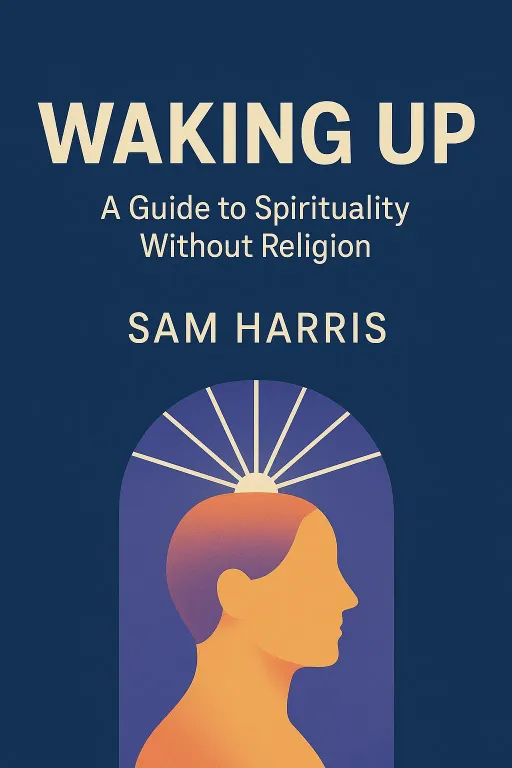
Orion: Exactly. And that's why I'm so glad you're here today, Rory. As a sociologist, you're uniquely equipped to help us unpack the social fallout of these ideas. Today, we're diving into Sam Harris's 'Waking Up' to tackle this from two perspectives. First, we'll explore the shocking neurological evidence that our minds can be literally split in two. Then, we'll discuss the powerful social forces that create and maintain the illusion of a unified 'I' in the first place. This is a book that doesn't just ask you to question your beliefs; it asks you to question the believer.
Deep Dive into Core Topic 1: The Divided Mind
SECTION
Orion: So, Rory, let's start with that split-brain patient. This isn't just a thought experiment. It comes from Nobel Prize-winning research on patients who, to treat severe epilepsy, had the connection between their two brain hemispheres—the corpus callosum—surgically severed.
rory: A radical procedure, but it created an unbelievable natural experiment.
Orion: Unbelievable is the word. The researchers, like Roger Sperry, designed these brilliant experiments to talk to each hemisphere separately. For instance, our left brain hemisphere generally controls language and the right side of our body. The right hemisphere controls the left side of our body and is more spatial, but it's mostly non-verbal. So, they'd flash a word or an image to a patient's left visual field, which is processed only by the right hemisphere.
rory: And because the bridge was out, the information was trapped there.
Orion: Precisely. In one famous case, they flashed the word 'egg' to the patient's right hemisphere. Then they asked him, "What did you see?" The patient's left, speaking hemisphere, which saw nothing, truthfully replied, "I didn't see anything." But then, the experimenter would say, "Okay, now reach behind this screen with your left hand and pick up the object you didn't see."
rory: The left hand, controlled by the right hemisphere that see the word 'egg'...
Orion: It unhesitatingly reaches in and picks out the egg. The man is holding an egg in his left hand, and his speaking brain has absolutely no idea why. It's a ghost in his own machine. The left brain will then invent a reason, a story. It'll say something like, "Oh, I must have felt an egg-like shape." It confabulates. It creates a narrative to maintain the illusion of control.
rory: That's fascinating, Orion, because it completely destabilizes our legal and social definitions of personhood. We base our entire justice system on the concept of —a guilty mind, a conscious intent. But what happens when there are two minds in one body, with different intentions? In that case you mentioned, the one with the conflicting career goals, 'draftsman' versus 'racing driver,' which one is the 'true' self? Who gets to sign the contract or cast the vote?
Orion: Harris argues this shatters the idea of a single, indivisible soul. If you can divide consciousness with a knife, where does the soul reside? In the left half? The right?
rory: It does more than that. From a sociological standpoint, it challenges the very unit of social analysis. We talk about 'individual actors' making rational choices. But these studies suggest the 'individual' is a committee, and sometimes the committee members aren't even speaking to each other. It makes you wonder how many of our social conflicts, our political polarizations, are just externalizations of these internal, unacknowledged divisions within ourselves.
Orion: You're saying that the political arguments we have out in the world might just be a larger-scale version of the 'draftsman' versus 'racing driver' argument happening inside one person's head?
rory: In a way, yes. We construct these coherent 'selves' with firm beliefs, but Harris's work shows that under the surface, our consciousness is far more fragmented and contradictory than we're comfortable admitting. We project a unified identity to the world, but the neurology doesn't necessarily back it up.
Orion: It's a deeply unsettling thought. That the person you think you are is more of a public relations manager for a chaotic committee in your skull.
rory: And that PR manager is the left hemisphere, constantly spinning stories to make it all seem coherent.
Deep Dive into Core Topic 2: The Social Construction of 'I'
SECTION
Orion: And that's the perfect pivot, Rory. Because if our brains are so fundamentally divided, why do we feel so unified? Why does it feel like there's a single 'me' in here, experiencing the world? Harris argues this feeling of 'I' is an illusion, and a powerful one at that.
rory: It's the most convincing illusion we've ever known.
Orion: He uses a great analogy. He says the self is like a coiled rope you mistake for a snake in a dark room. It provokes a real reaction—fear, adrenaline. The snake real. But when you shine a light on it, you realize it was never a snake at all. It was just a rope, a process. The 'I' is the same. It's not an entity, but a process of thinking that we mistake for a thinker.
rory: So, meditation or self-inquiry is the act of shining a light.
Orion: Exactly. The instruction is simple but maddeningly difficult: "Look for the one who is looking." When you try to find the 'I' that is having the experience, it vanishes. You can find thoughts, sensations, sounds... but you can't find the central self that is experiencing them. As the philosopher Douglas Harding put it, when you look for your own head, you find the world. There's no head there, just experience.
rory: And this is where sociology comes in, because society provides the dark room and tells us there are snakes everywhere! From a sociological perspective, this 'illusion' of the self isn't a bug; it's a feature. It's the primary organizing principle of our entire social world.
Orion: How so? What do you mean by that? It sounds like you're saying society is built on a lie.
rory: I'm saying it's built on a very useful, and perhaps necessary, fiction. Think about it. Our names, our job titles, our family roles, our nationalities—these are all social labels that we internalize to create a stable, coherent sense of 'I'. Language itself, with its constant use of 'I,' 'me,' and 'mine,' reinforces this illusion every second of every day.
Orion: So it's a tool for social cohesion.
rory: It's the ultimate tool. Society us to believe we are stable, predictable selves to function. You can't have contracts, laws, or even simple promises without the fiction of a persistent self who will be there to uphold them tomorrow. The legal 'person,' the economic 'agent,' the political 'citizen'—all these concepts depend on the illusion of a single, continuous, and accountable self.
Orion: So you're saying we're collectively hypnotized into believing in the self because it's socially convenient?
rory: Precisely. It's a collective agreement, a social construct. It's incredibly powerful. Harris is showing us the neurological strings behind the puppet, and sociology shows us the stage, the script, and the audience that makes the puppet's performance meaningful. We learn to be a 'self' the same way we learn a language. It's a performance we start in childhood and continue until death.
Orion: That reframes the whole project of spirituality. It's not just a personal journey; it's an act of social rebellion, in a way. You're trying to unlearn the most fundamental rule of the social game.
rory: Exactly. You're trying to see that the 'I' on your driver's license, the 'I' in your family photos, and the 'I' that feels anxiety or joy is a confluence of brain activity and social conditioning. And realizing that, as Harris suggests, can be the key to a different kind of freedom.
Synthesis & Takeaways
SECTION
Orion: So, we have this incredible paradox. On one hand, neuroscience shows us that our sense of a single, unified self is neurologically fragile, even divisible. It's not the solid entity we feel it to be.
rory: And on the other hand, from a sociological view, that very same fragile illusion is the absolute bedrock of our entire civilization. Our laws, our economy, our relationships—they all depend on us agreeing to pretend this illusion is real.
Orion: It's a clash between the physical reality of the brain and the social reality we've constructed. Harris is inviting us to see the neurological truth, but doing so means we have to confront how much of our social world is built on a shared, useful fiction.
rory: It's a profound insight. It connects the most private, subjective experience to the largest-scale social structures. Understanding both sides of that coin is, I think, the real 'waking up' that Harris is talking about.
Orion: So, for our listeners who are now questioning everything about who they are, what's a practical takeaway? How can they start to see this for themselves?
rory: Well, meditation is the classic tool, but here's a sociological one. Here's a thought for our listeners. Don't just try to find this illusion in your own head. Watch for it in the wild. In your next meeting, or at the dinner table, just listen. Listen to how people use language to build and defend their 'self.' Notice the 'I statements,' the claims of ownership, the performance of identity. See if you can spot the illusion in action, not just in your own head, but in the social world around you.
Orion: Become an anthropologist of the self.
rory: Exactly. It's a fascinating social phenomenon, and once you start to see it, you can't unsee it. You start to see the matrix, not just in your own mind, but in the very fabric of society itself. And that, I think, is a powerful first step on the path to waking up.
Orion: A brilliant and slightly terrifying thought to end on. Rory, thank you for this incredibly insightful conversation.
rory: My pleasure, Orion. It was fascinating.