

The Biophysical Blueprint for Sustainable High Performance
Golden Hook & Introduction
SECTION
Nova: The most expensive piece of technology you own is currently running on outdated firmware, and you are trying to overclock it without understanding the hardware specs.
Atlas: That sounds like a disaster waiting to happen. I am guessing you are not talking about my laptop, are you?
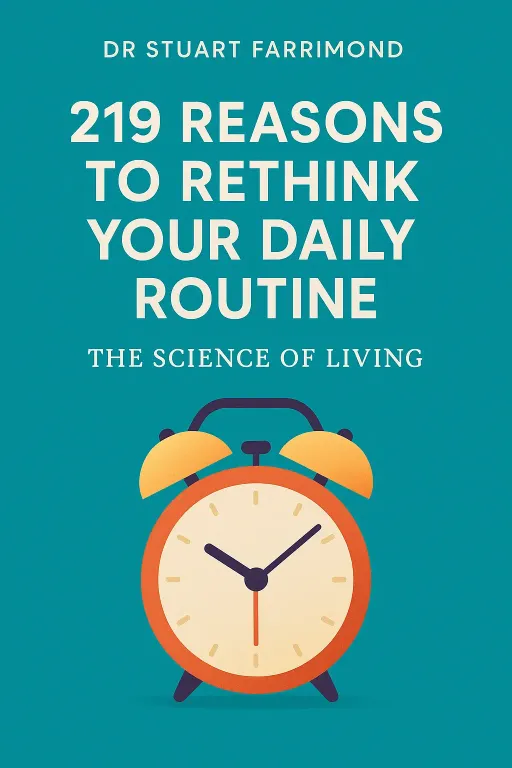
Nova: Not even close. I am talking about your biology. Today, we are looking at how to build a biophysical blueprint for high performance, moving away from generic self-help and into the actual science of how we function. We are diving into The Science of Living by Dr. Stuart Farrimond, a fascinating look at how our circadian rhythms actually dictate our capacity for work, and pairing that with Everyday Vitality by Dr. Samantha Boardman, which completely reframes how we build resilience.
Atlas: I like the sound of that. Most people I know, especially the ones building teams and trying to innovate, treat their health as something to deal with only when it breaks. It is always a reactive fix, never a proactive strategy.
Nova: Exactly. Dr. Farrimond, who is a medical doctor and a scientist, essentially treats the human body like a machine that requires specific inputs at specific times. He spent years synthesizing vast amounts of data to debunk the myths we tell ourselves about sleep, caffeine, and even screen time. And then, Dr. Boardman takes that physical foundation and adds the psychological layer. She argues that resilience isn't about hunkering down and protecting yourself from stress; it is about active, outward engagement.
Atlas: This feels like it is hitting the sweet spot for anyone who values structure. We are looking at the mechanics of the body and the mechanics of the mind. Let’s start with the biology. If I am a strategist trying to optimize my day, where does the firmware update actually start?
The Biological Operating System
SECTION
Nova: It starts with the circadian rhythm, which is the master clock of your body. Most people view sleep as a passive state, something that just happens when we are tired. Farrimond’s work shows us that sleep is actually an active, hourly optimization process. He points out that your body temperature, hormone levels, and cognitive function fluctuate in predictable, hourly cycles.
Atlas: That makes sense, but how does that translate to a daily schedule? I see people trying to force deep work at 2:00 PM when their energy is naturally dipping, and then they wonder why they are burning out.
Nova: That is the classic productivity trap. The science suggests that your peak analytical performance, the time when you are most capable of complex problem-solving, is usually in the mid-morning. Farrimond’s data implies that if you push your hardest, most cognitively demanding tasks to the evening, you are working against your own biology. You are essentially trying to run high-end software on a processor that is throttling down to save battery.
Atlas: I have definitely felt that wall. But what about the caffeine? That is the go-to tool for every builder I know. Is that just a crutch, or is there a way to use it strategically?
Nova: It is about timing. The common mistake is having that cup of coffee the moment you wake up. Your cortisol levels, the hormone that naturally wakes you up, are already at their peak right then. If you add caffeine on top of that, you are just blunting the effect and increasing your tolerance. Farrimond suggests waiting ninety minutes to two hours after waking. Let your body do the work first, then use the caffeine to sustain that energy when it naturally starts to plateau.
Atlas: That is a game-changer. It is not about you use the tool, it is about you deploy it. But what about the evening? I know plenty of people who wind down by scrolling, thinking they are relaxing, but the science seems to say otherwise.
Nova: The screen time issue is about more than just eye strain. It is about blue light signaling to your brain that it is still daytime. When you stare at a screen, you are suppressing melatonin, which is the chemical signal for sleep. If you are a strategist, you need to think of your evening wind-down as a system shutdown sequence. You wouldn't just pull the plug on a server mid-process, right? You would run the shutdown protocols.
Atlas: I love that analogy. A system shutdown. So, if I am trying to build a schedule, I should be looking at my day not as a list of tasks to complete, but as a sequence of biological states to manage.
Nova: Precisely. You align the heavy, deep-work tasks with your peak alertness periods. You schedule the administrative, low-energy tasks for the mid-afternoon dip. And you protect your sleep like you protect your most valuable intellectual property. It is not about doing more; it is about doing the right things when your body is actually built to handle them.
The Energy of Vitality
SECTION
Atlas: Okay, I am on board with the hardware optimization. But let’s talk about the software—the mindset. I have noticed that even when people have their sleep and caffeine dialed in, they still feel drained. That is where Dr. Boardman’s work on vitality comes in, right? It seems to be about more than just not being tired.
Nova: That is the crucial distinction. Boardman argues that we have fallen into a trap of passive self-absorption. We treat wellness as if it is something we do in isolation—meditating alone, managing stress by withdrawing, or trying to achieve a state of perfect calm. She suggests that true vitality is built through outward engagement. It is about positive, relational energy.
Atlas: That is interesting. In a tech or strategy environment, we often talk about burnout as if it is a lack of rest. What you are describing sounds like burnout is actually a lack of meaningful connection or contribution.
Nova: Think of it as the difference between a battery that is sitting on a shelf and a battery that is part of a circuit. If you are just trying to "manage your stress," you are sitting on the shelf. You are trying to conserve energy. But if you are actively engaging with your team, solving problems, and creating micro-actions that provide a sense of progress, you are generating energy.
Atlas: I can see that. It is the difference between a retreat and an advance. So, what are these "micro-actions"? How does a high-performer actually put this into practice without adding ten more things to their to-do list?
Nova: The beauty of Boardman’s approach is that these are not grand gestures. They are small, intentional choices. It could be as simple as shifting your focus in a meeting from "How is this person annoying me?" to "What is one thing I can do to make this person’s job easier?" That sounds like a small shift, but it changes your entire nervous system from a defensive posture to an active, creative one.
Atlas: That makes perfect sense. It is shifting from a scarcity mindset to an abundance mindset, but framed as an energy management strategy. If I am a leader and I am constantly in defensive mode, my team feels that. They mirror that stress. But if I am in an active, supportive mode, that becomes the team culture.
Nova: Exactly. You are modeling the energy you want to see. Boardman’s research shows that vitality is contagious. When you engage in these small, outward-looking actions, you are not just helping yourself; you are building a more resilient team. You are creating a buffer against the inevitable stress of high-stakes work.
Atlas: I am thinking about the Strategist profile we are talking to. They care about building something meaningful. If they view their daily interactions as energy-generation opportunities rather than energy-draining obligations, that changes everything. It turns the "soft skills" into a hard strategy.
Nova: That is the breakthrough. You stop viewing your team as a source of stress to be managed and start viewing them as the primary source of the energy you need to do your best work. When you help someone else succeed, you feel a hit of dopamine and a sense of competence that you just don't get from staring at a screen trying to "relax."
Synthesis & Takeaways
SECTION
Atlas: So, if I am summarizing this for our listeners, we have two layers. First, we have the biological layer: the circadian rhythm. You optimize your hardware by aligning your schedule with your biology. You stop fighting the clock.
Nova: Correct. You stop fighting the clock and start working with it.
Atlas: And second, we have the psychological layer: vitality. You optimize your software by shifting from passive stress-management to active, outward engagement. You don't just protect your energy; you generate it through connection.
Nova: That is the synthesis. And here is the kicker: these two things feed each other. When you are biologically optimized, you have the capacity to be more outward-looking. When you are engaged and vital, you have the motivation to protect your sleep and your rhythms. It is a virtuous cycle.
Atlas: It really is. And for the strategist, the builder, the person listening who feels like they are running on fumes, the takeaway is clear. This is not about adding more to your plate. It is about changing how you carry the plate. It is about realizing that your impact—the thing you care about building—depends entirely on the machine that is doing the building.
Nova: Well said. And the final thought I want to leave everyone with is this: high performance is not a straight line of constant output. It is a rhythm. It is a pulse. It is an expansion and a contraction. If you are always pushing, you will snap. If you are always resting, you will rust. The goal is to find the frequency where you are neither rusting nor snapping, but instead, humming with energy.
Atlas: That is a perfect way to put it. I am going to try the ninety-minute caffeine delay tomorrow morning. That seems like the easiest, highest-leverage place to start.
Nova: Let us know how it goes. And for everyone listening, take one of these micro-actions today. Reach out, solve a problem for a colleague, or just align your next deep-work session with your natural peak energy. It is time to stop managing your burnout and start building your vitality. This is Aibrary. Congratulations on your growth!









