

High-Performance Well-being: Reclaiming Vitality
Golden Hook & Introduction
SECTION
Nova: Here is a statistic that should stop everyone in their tracks. The average professional spends roughly four hours a day in a state of stress-induced buffering, where they are technically resting but not actually recovering. They are scrolling, they are zoning out, they are waiting for the next task to start, but the cortisol is still spiking in their system.
Atlas: That hits a little too close to home. I definitely recognize that state. It is that weird, hollow feeling where you finish a workday, you are exhausted, but you also feel like you have accomplished absolutely nothing of value. It is like trying to charge a phone with a frayed cable. The battery indicator is on, but the percentage never actually goes up.
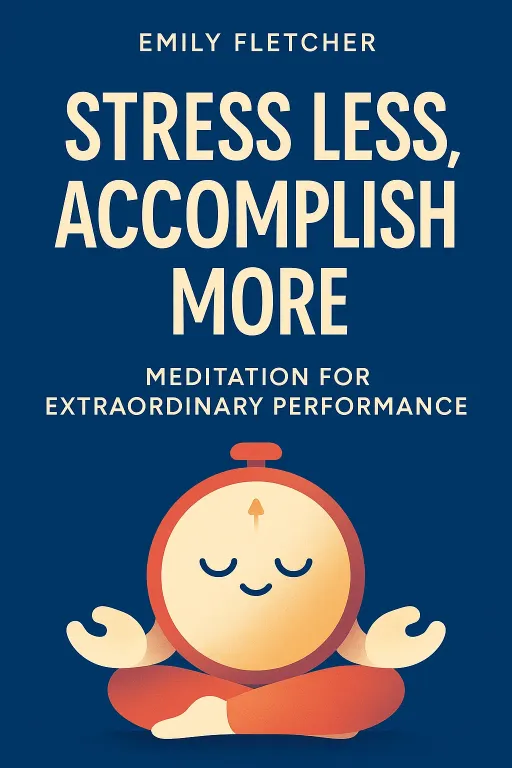
Nova: Exactly. That is the fundamental problem we are tackling today. We are looking at two brilliant approaches to reclaiming your vitality. We are diving into the Ziva technique from Emily Fletcher’s Stress Less, Accomplish More, and we are balancing that with Samantha Boardman’s concept of the positive prescription from her book, Everyday Vitality.
Atlas: I have heard the name Emily Fletcher tossed around in high-performance circles. She has this fascinating background, right? She wasn’t always a meditation guru.
Nova: She was a Broadway performer for ten years. She was working in a high-pressure environment where every single night was a live, high-stakes performance. She realized that she couldn't just rely on willpower to manage that level of stress. She had to build a system. Her approach, the Ziva technique, is specifically designed for people who think they don't have time to meditate. It combines mindfulness, meditation, and manifesting to essentially clear out the stress of the past so you can be present for the future.
Atlas: And then you have Samantha Boardman, who takes a slightly different angle. She is a psychiatrist, so her work feels much more grounded in clinical observation. She argues that we are looking for vitality in all the wrong places. We think it comes from some massive, transformative retreat, but she suggests it is actually found in the small, everyday, meaningful connections we make.
Nova: It is the perfect duality. Fletcher gives you the internal engine to clear the noise, and Boardman gives you the external fuel to keep the machine running. Let’s break down how to actually build this into a life that demands high output without burning out.
The Internal Engine: Ziva and Stress Management
SECTION
Atlas: So, let’s start with the internal engine. I have to be honest, when I hear the word meditation, I immediately think of sitting in a quiet room for an hour, which is a luxury I do not have. How does Fletcher’s Ziva technique actually fit into a schedule that is packed with back-to-back meetings and strategic decisions?
Nova: That is the most common objection, and it is exactly why Fletcher’s approach is so effective for the high-performing professional. She makes a crucial distinction between mindfulness, meditation, and manifesting. Most people think they are the same thing, but they are actually distinct tools. Mindfulness is about being present in the here and now. It is a great tool for focus, but it is not a stress-release tool. Meditation, as she defines it, is the tool for stress release.
Atlas: Wait, pause there. You are saying mindfulness is not for stress release? That feels counterintuitive. I thought focusing on the breath was the ultimate stress reliever.
Nova: Think of it this way. If your mind is a messy room, mindfulness is like tidying up the items on the desk. It helps you focus on the current task. But meditation, in the Ziva framework, is like deep cleaning the entire house. It is about accessing a level of rest that is deeper than sleep. When you are in that state, your body can finally process the stress that has been accumulating in your nervous system for weeks, months, or even years.
Atlas: That makes sense. It is the difference between organizing a pile of paper and actually shredding the documents you don't need anymore.
Nova: Precisely. And the reason this works for the busy professional is that you don't need an hour. Fletcher advocates for a specific, repeatable practice that fits into the gaps of a workday. It is about using those moments where you might otherwise be mindlessly checking emails to instead reset your nervous system.
Atlas: I can see the utility there. But let’s talk about the third component she mentions: manifesting. That word usually makes people in high-stakes fields roll their eyes. How does she frame that so it doesn't sound like wishful thinking?
Nova: She reframes manifesting as a way to clarify your intent. It is not about sitting on a couch and waiting for the universe to hand you a promotion. It is about priming your brain to see the opportunities that align with your goals. When you are in that deep, post-meditative state, your brain is more plastic, more open to new connections. By consciously thinking about what you want to achieve, you are essentially setting the GPS for your subconscious.
Atlas: That is a much more structural way to look at it. It is less about magic and more about cognitive priming. It is like telling your brain, "This is the target, ignore the noise."
Nova: Exactly. And the result is that you spend less energy fighting your own internal resistance. You stop wasting cognitive resources on stress, and you start allocating them toward the outcomes you are actually trying to reach.
The External Fuel: Everyday Vitality and Connection
SECTION
Atlas: Okay, I am on board with the internal reset. But even if I am perfectly calibrated, I still live in the real world. I have to deal with people, projects, and the inevitable friction of daily life. This is where Boardman’s work comes in, right?
Nova: It is. This is where we move from the internal to the relational. Boardman’s concept of the positive prescription is a massive shift from how we usually treat burnout. Most people think recovery is about isolation. We finish a hard day, and we think, "I just need to go home, shut the door, put on a show, and be left alone."
Atlas: I am guilty of that. It is the "leave me alone, I am recharging" mode.
Nova: We all do it. But Boardman argues that this isolation is actually draining our vitality, not restoring it. She suggests that we are social creatures, and our energy is inextricably linked to the quality of our interactions. Her research shows that we often feel most alive when we are engaged in something that matters to us, especially when that something involves other people.
Atlas: So, she is saying that the best way to recover from a high-stress day isn't to disengage, but to engage in a different way?
Nova: That is the core of it. It is about finding meaningful connections. It doesn't have to be a grand gesture. It could be a conversation with a colleague about something other than work, or helping a team member solve a problem, or even just a brief, genuine interaction with a barista. It is about shifting from being a passive consumer of rest to being an active participant in your own life.
Atlas: That feels like a heavy lift when you are already exhausted. If I am drained, the last thing I want to do is go have a meaningful conversation. How do you bridge that gap?
Nova: That is the beauty of the "prescription" analogy. You don't need to run a marathon to get the benefits of exercise. You just need a short, brisk walk. Similarly, you don't need to host a dinner party to get the benefits of connection. You just need to look for what Boardman calls "vitality boosters"—these are small, daily actions that bring you closer to people or to things you care about.
Atlas: Give me an example. What does a "vitality booster" look like in a high-stakes, professional environment?
Nova: Think about how you handle feedback. Most people view it as a transaction or a critique. A vitality booster would be to turn that feedback session into a collaborative problem-solving exercise where you actually listen, ask questions, and build a bridge with that person. You leave that interaction feeling like you’ve built something, rather than just defended your position.
Atlas: I see. So it is about reframing the interaction from being a drain to being a source of energy. It is about agency.
Nova: That is the perfect word for it. Agency. You are choosing to extract meaning from the situation rather than letting the situation extract energy from you. Boardman’s work is essentially a call to stop waiting for your life to feel vibrant and to start actively injecting vitality into your daily routines.
Synthesis & Takeaways
SECTION
Atlas: I am starting to see how these two pieces fit together. You use Fletcher’s technique to clear the mental clutter, to lower the stress floor so you aren't constantly operating in a state of fight-or-flight. And then, once you have that baseline of calm, you use Boardman’s positive prescriptions to fill that space with engagement and meaningful action.
Nova: You have nailed the synthesis. It is a two-part strategy. One part is about subtraction—removing the stress that is clouding your judgment and draining your cognitive resources. The other part is about addition—adding the connections and small actions that provide the energy to keep going.
Atlas: It really changes the goal of "work-life balance." It is not about finding a perfect 50-50 split between working and resting. It is about how you show up in both places.
Nova: And that is the most important takeaway for anyone building a career they care about. High-performance well-being is not a luxury you earn after you succeed. It is the fuel that allows you to succeed in the first place.
Atlas: If I am listening to this and I want to start tomorrow, what is the one thing I should do?
Nova: Start with the "stress bucket." Fletcher would tell you to find twenty minutes in your day, and instead of using them to scroll or check notifications, use them to reset. And then, for Boardman’s part, identify one interaction you have tomorrow—just one—and make it a point to be fully present for it. Don't just go through the motions. Ask a better question, listen a little deeper, and see how that changes your energy level for the rest of the day.
Atlas: That is a very actionable blueprint. It moves us away from the passive, isolated recovery we are all used to and toward a more active, intentional, and frankly, more human way of working.
Nova: It is about reclaiming your vitality by being the architect of your own internal and external state. You have the tools to discern the noise from the signal, and you have the power to create the conditions for your own success.
Atlas: This has been a great conversation. It really makes me rethink how I spend my "downtime."
Nova: That is the goal. Remember, the way you spend your time between the big moments is what defines the quality of your life. Keep building, keep learning, and keep engaging.
Atlas: This is Aibrary. Congratulations on your growth!









