

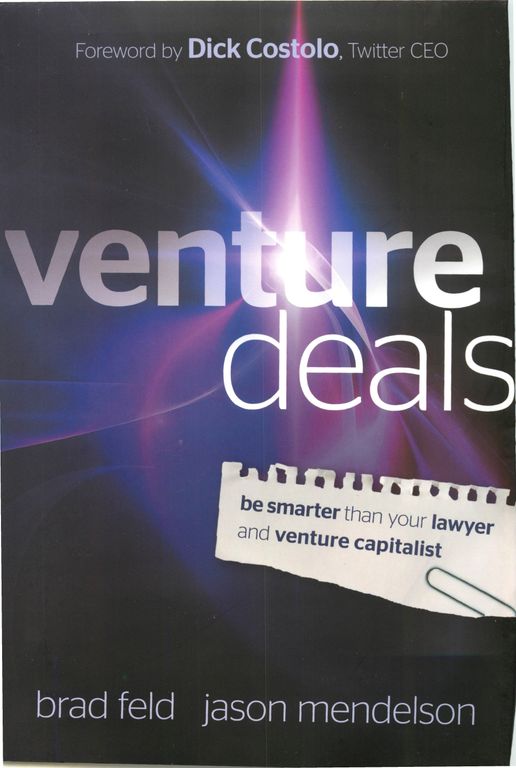
Venture deals
Introduction: Decoding the VC Black Box
Introduction: Decoding the VC Black Box
Nova: Welcome to the show. We're diving into the one book that every founder dreads needing but absolutely must read: Venture Deals by Brad Feld and Jason Mendelson. Did you know that for many entrepreneurs, the term sheet negotiation is scarier than the actual product launch?
Nova: : That’s absolutely true, Nova. It feels like walking into a high-stakes poker game where the other players wrote the rulebook. I always pictured venture capital as this glamorous, fast-paced world, but the reality, as Feld and Mendelson paint it, is a dense legal document full of jargon designed to protect the investor.
Nova: Exactly. The book’s subtitle is 'Be Smarter Than Your Lawyer and Venture Capitalist,' which tells you everything. It’s about transparency. They argue that if you don't understand the terms, you're essentially gambling your company away. So, what’s the first big revelation for a first-time founder reading this?
Nova: : The biggest one, I think, is realizing that the term sheet isn't the final contract. It’s a non-binding letter of intent. It sets the stage, but the real battle is over the specific economic and control terms buried within it. It’s a roadmap, not the destination.
Nova: A roadmap with some seriously tricky detours. Feld and Mendelson have decades of experience on both sides—founder and investor—and they use that to strip away the intimidation factor. They turn the black box into a set of understandable levers. Let’s start by looking at the document itself.
Nova: : I’m ready. Let’s pull apart that term sheet and see what’s really under the hood.
Key Insight 1: Deconstructing the Document
The Anatomy of the Term Sheet: Intent vs. Contract
Nova: Chapter one in our deep dive has to be about the term sheet itself. Feld stresses that while most of it is non-binding, certain sections are absolutely critical and binding from day one, like confidentiality and exclusivity clauses. Why is that distinction so important?
Nova: : Because exclusivity can kill your momentum. If you sign a term sheet with a VC that includes a 45-day exclusivity period, you can’t talk to any other investor during that time. If the deal falls apart, you’ve lost valuable time in the market. It’s a control mechanism disguised as a procedural step.
Nova: That’s a perfect example of being 'smarter.' The book emphasizes that founders often focus only on the valuation number and miss these procedural traps. What other non-economic terms should founders scrutinize immediately?
Nova: : Board composition is huge. Who gets the seats? If you start with three seats, and the VC demands two, suddenly you’re a minority shareholder on your own board. Feld talks about maintaining founder control over strategic decisions, even when taking outside money.
Nova: And that ties directly into veto rights. Investors want protection, but too many vetoes mean the founder can’t actually run the company without a committee meeting. What’s the common ground they suggest for board control?
Nova: : They often advise founders to push for a structure where the board is initially founder-friendly, perhaps two founders and one investor, with the understanding that this balance will shift as more money comes in. The key is negotiating and that control shifts, not just it shifts.
Nova: It sounds like the whole document is a negotiation about power, not just money. It’s about setting the precedent for the entire investor-founder relationship.
Nova: : Precisely. If you let them steamroll you on the procedural stuff, they know they can steamroll you on the economics later. It’s about establishing credibility as a tough but fair negotiator right out of the gate.
Key Insight 2: The Math of Money
The Valuation Dance: Price Per Share vs. Dilution
Nova: Let’s move to the number everyone obsesses over: valuation. The book breaks down pre-money and post-money valuation. For our listeners who might be intimidated by the math, can you simplify why the difference matters so much?
Nova: : The difference is everything! Pre-money is what the company is worth the VC writes the check. Post-money is that value plus the investment amount. If you negotiate a $10 million pre-money valuation and take a $2 million investment, your post-money is $12 million. The VC owns 16.6%.
Nova: But what happens if a founder mistakenly negotiates based on the post-money figure they? Say they think $12 million is the right valuation, but they negotiate based on that being the figure?
Nova: : Then they’ve just given away more equity than they intended! If the pre-money was $12 million and the VC invests $2 million, the post-money is $14 million. The VC now owns $2M/$14M, which is about 14.3%. Wait, that’s actually dilution for the founder. Let me rephrase the trap.
Nova: Ah, the trap is often in the. If the VC insists on a low price per share, it means they get more shares for their money, which increases dilution for the existing shareholders—the founders and employees.
Nova: : Exactly. The valuation number is just a proxy for the price per share. Feld and Mendelson really hammer home that you must understand the share count implications. A seemingly small difference in valuation can translate to giving up an extra percentage point or two of your company.
Nova: And that extra percentage point might seem small now, but when you’re selling for $100 million, that 1% is $1 million walking out the door. It’s compounding interest, but for dilution.
Nova: : It is. And the book points out that VCs are masters at using stock options pools to mask dilution. They might agree to your valuation, but then insist on setting aside a large option pool the investment closes, effectively lowering the pre-money value for the founders retroactively. It’s subtle, but devastating.
Key Insight 3: Protecting the Downside
The Hidden Traps: Liquidation Preferences
Nova: We have to talk about the economic terms that can truly sink a founder’s exit, even if the company sells for a decent amount. I’m talking about Liquidation Preferences. This is where the VC gets paid back first.
Nova: : This is the single most important concept to grasp after valuation. A standard term, which Cooley data suggests is common, is a 1x non-participating liquidation preference. That means if the company sells, the investor gets their money back first, and then they convert their preferred shares to common stock and share the rest pro-rata.
Nova: But what happens when the term sheet says 'participating'? That sounds much more aggressive, right?
Nova: : It is aggressive. Participating means the investor gets their money back, AND they still get to share in the remaining proceeds as if they converted to common stock. They get paid twice, essentially.
Nova: So, if a VC puts in $5 million, and the company sells for $15 million, with a 1x participating preference, they take their $5 million off the top, and then they take their percentage cut of the remaining $10 million. That can wipe out the founders entirely if the exit multiple isn't high enough.
Nova: : Exactly. Feld and Mendelson advise founders to fight tooth and nail against participating preferences, especially in early rounds. They argue that if the company is successful enough to sell for a big multiple, the investor’s upside is already secured through their equity percentage. The preference is downside protection.
Nova: And what about the multiple? Sometimes it’s 2x or 3x preference? That means they get 2 or 3 times their investment back before anyone else sees a dime.
Nova: : That’s a massive red flag. A 2x or 3x preference is usually reserved for very risky, very early-stage deals, or perhaps a distressed situation. If you’re raising a Series A and see a 2x preference, you need to understand why the investor lacks confidence in achieving a high exit multiple.
Key Insight 4: Beyond the Dollars
The Partnership: Choosing Your VC and Vesting
Nova: We’ve covered the legal and economic terms, but Feld and Mendelson dedicate significant space to the human element. They argue that choosing the right partner is more important than optimizing every single term.
Nova: : That’s the core philosophy. They treat venture capital as a long-term marriage, often lasting ten years or more. If you don't trust your partner or if their values clash with yours, the negotiation stress is just the appetizer for the operational misery to come.
Nova: They talk about 'smart money' versus 'dumb money.' What defines 'smart' in this context?
Nova: : Smart money brings expertise, network access, and operational guidance without being overly controlling. Dumb money just brings a check and demands constant updates or tries to micromanage strategy. Feld’s advice is to check references not just on the firm, but on the specific partner who will sit on your board.
Nova: Another critical operational point they cover is founder equity vesting. Why is it standard practice for founders to have their shares vest over four years, even if they already own 100% of the company pre-funding?
Nova: : It aligns incentives for the long haul. If a founder leaves after six months with 50% of the company, that’s a disaster for the investors who just put in millions. Vesting ensures that founders earn their equity by sticking around and building value. If you leave early, the company buys back the unvested portion, usually at the original low price.
Nova: So, the investor is protecting their investment from founder flight, but it also protects the company from a founder who loses motivation after the initial excitement wears off. It’s a mutual protection mechanism, even if it feels punitive to the founder initially.
Nova: : Absolutely. It’s about commitment. The book is a masterclass in understanding that every clause is about managing risk and aligning incentives. If an incentive isn't aligned, the term sheet will address it, usually at the founder's expense.
Conclusion: Transparency as Your Best Defense
Conclusion: Transparency as Your Best Defense
Nova: We’ve covered a lot of ground today, from the non-binding nature of the term sheet to the terrifying specifics of participating liquidation preferences. If you had to distill Brad Feld and Jason Mendelson’s core message into one sentence, what would it be?
Nova: : Understand the terms so thoroughly that you can explain them back to the investor better than they can. Knowledge is the ultimate leverage in a VC negotiation.
Nova: That’s powerful. For our listeners who are about to enter the fundraising arena, what’s the single most actionable takeaway from Venture Deals?
Nova: : Don't just hire a lawyer to the term sheet; hire one to every single line until you can debate it intelligently. And always negotiate the economic terms—valuation, liquidation—before you negotiate the control terms, because the economics are harder to change later.
Nova: It’s about moving from being a passive recipient of a deal to being an active participant in structuring your company’s future. Venture Deals really is the essential survival guide for the modern entrepreneur.
Nova: : It shifts the power dynamic by simply illuminating the shadows. It teaches you that the goal isn't just to get the money, but to get the money under the terms.
Nova: A fantastic roadmap for navigating the complexities of startup financing. Thank you for joining me on this deep dive into Venture Deals. This is Aibrary. Congratulations on your growth!