The Stoic Path to Emotional Autonomy
Golden Hook & Introduction
SECTION
Nova: Anger is the most expensive emotion you can afford. It is a massive tax on your mental bandwidth that yields zero return on investment. Today, we are looking at the strategic advantage of being unoffendable and how to regulate your emotional autonomy in a world designed to trigger you.
Atlas: That is a bold opening statement. Most people treat anger as a badge of honor. They think if they are not angry about something, they simply do not care enough. You are suggesting that this is a flaw in our operating system.
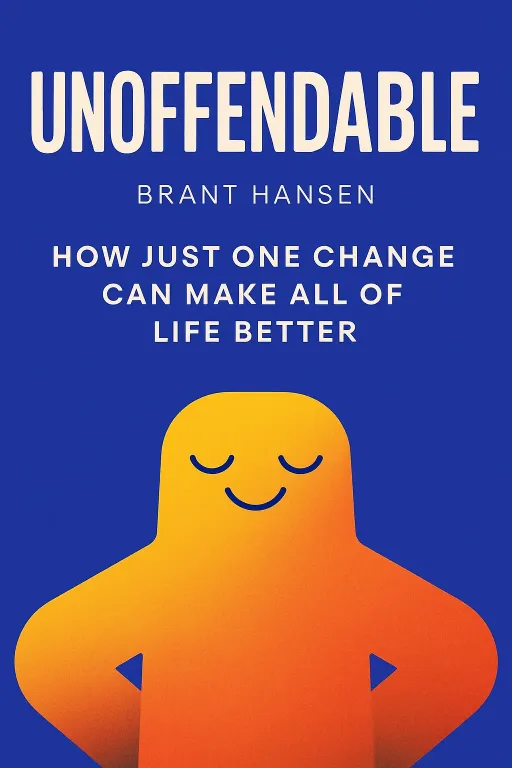
Nova: Exactly. We are diving into two distinct but complementary frameworks today. First, we have Unoffendable by Brant Hansen. Brant is a radio personality who spent his career observing human behavior, and he brings a uniquely sharp, often humorous, and counter-cultural perspective to why we cling to our right to be angry. Then, we are pairing that with Anxious for Nothing by Max Lucado. Lucado is a veteran author known for his ability to translate complex emotional landscapes into practical, bite-sized steps for everyday people.
Atlas: I know Lucado. He has a way of making heavy topics feel manageable. And Hansen is usually the guy who points out the absurdity in things we take for granted. This combination feels like a masterclass in emotional regulation.
Nova: It is. We are going to explore why your anger is a strategic liability and how to use the C. A. L. M. framework to reclaim your focus. Let us start with the idea that being offended is actually a choice, not an involuntary reflex.
The Strategic Choice of Unoffendability
SECTION
Atlas: Okay, let us break that down immediately. When someone cuts me off in traffic or sends a passive-aggressive email, my blood pressure spikes. That feels involuntary. Are you saying that is a choice?
Nova: It feels automatic, but the decision to hold onto that feeling is where the strategy comes in. Hansen argues that we cling to our right to be angry because we think it gives us moral superiority. We think, I have a right to be mad because this person was wrong. But look at the cost. When you are offended, your brain enters a state of hyper-arousal. You lose access to your prefrontal cortex, which is the part of your brain responsible for complex decision-making, strategic planning, and emotional regulation.
Atlas: So, you are saying that by choosing to be offended, I am effectively lowering my own IQ.
Nova: That is a great way to put it. You are sacrificing your cognitive bandwidth for a feeling of righteous indignation. Think about it like a high-performance computer. If you have fifty background processes running, all of them dedicated to replaying an argument or stewing over a perceived slight, your primary application, which is your work or your life, is going to lag.
Atlas: I see the parallel. In a business context, if a leader spends all day focused on how they were slighted by a competitor, they are not focused on market disruption or product innovation. They are stuck in a loop.
Nova: Exactly. And Hansen’s point is that this loop is a trap. He suggests that giving up the right to be offended is not a sign of weakness. It is a supreme strategic advantage. It frees up that massive amount of cognitive energy to focus on what actually matters. When you decide that you are not going to be offended, you are deciding that your long-term goals are more important than your short-term emotional reaction.
Atlas: I am playing devil’s advocate here. Does this mean we become doormats? If I stop being offended, does that mean I just accept bad behavior from everyone?
Nova: That is the common misconception. Being unoffendable does not mean you lack boundaries. It means your boundaries are based on objective reality and strategic necessity, not on emotional reactivity. If someone is doing something genuinely wrong, you address it with a cold, clear head. You do not need to be angry to enforce a boundary. In fact, you enforce it much better when you are calm. Anger makes you sloppy. Calm makes you precise.
Atlas: That is a sharp distinction. Anger is messy and reactive. Precision is calculated and proactive.
Nova: Think about a surgeon. If a surgeon gets offended by a nurse who hands them the wrong tool, do they throw a fit? No. They correct the situation instantly and move on. Their focus is on the patient, not their own ego. We need to treat our daily lives with the same level of professional detachment. When you are offended, you are making it about you. When you are strategic, you are making it about the outcome.
Atlas: That makes perfect sense. I have noticed that the people I admire most in business are rarely the ones who get angry. They are the ones who get quiet. They stop, they assess, and they move.
Nova: That is the key. They have cultivated the ability to disconnect their personal value from the external stimuli. Someone being rude to you is not a reflection of your worth. It is a reflection of their state of mind. Why would you give them control over your emotional state?
Atlas: It is a massive power shift. When I am offended, I am giving the other person a remote control to my mood. They press a button, and I react. By choosing not to be offended, I am taking that remote back.
Nova: You just hit the nail on the head. You are reclaiming your sovereignty. And this is not just about being a nice person. It is about efficiency. You have a finite amount of energy each day. Why spend it on resentment? Resentment is like drinking poison and hoping the other person dies. It only hurts you.
Atlas: That is a classic, but it is true. I am curious, though. How do we actually do this? You are in the middle of a high-pressure situation, someone is being difficult, and you feel that surge of heat in your chest. How do you pivot from that heat to this strategic detachment?
The C.A.L.M. Framework for Emotional Autonomy
SECTION
Nova: That is where the second part of our discussion comes in. Max Lucado provides a very practical framework for this exact moment. He calls it C. A. L. M. It stands for Celebrate, Ask, Leave, and Meditate. It is designed to act as a circuit breaker for that surge of anxiety or frustration you are feeling.
Atlas: Let us walk through that. Celebrate, Ask, Leave, Meditate. That sounds a bit counterintuitive. When I am stressed, the last thing I want to do is celebrate.
Nova: I know. It sounds strange, but think of it as a cognitive reframe. The first step, Celebrate, is about gratitude. When you are anxious or angry, your brain is locked into a pattern of scarcity. You are focused on what is going wrong. By forcing yourself to acknowledge one thing that is going right, you are physically shifting your focus. You are proving to your brain that the entire world is not on fire.
Atlas: So, it is not about being happy. It is about broadening the scope of my attention.
Nova: Exactly. It is a reality check. If I am fuming because a project is delayed, I might pause and celebrate the fact that I have a team that is capable of fixing it, or the fact that the project is even happening. It anchors me in the present reality rather than the perceived threat.
Atlas: Okay, that is manageable. What about the next step? Ask?
Nova: Ask is about replacing your internal narrative. We often tell ourselves stories that exacerbate our stress. We say things like, "This always happens to me," or "They are trying to sabotage me." Instead, you ask yourself: What is the truth here? What is the actual, objective reality of this situation? What can I control? What can I not control?
Atlas: That is the stoic foundation right there. Distinguishing between what is in my control and what is not. Most of our anxiety comes from trying to control the uncontrollable.
Nova: Precisely. By asking these questions, you are moving from an emotional state to an analytical state. You are engaging your prefrontal cortex again. You are asking, is this anger serving my long-term focus, or is it draining my strategic energy? If the answer is that it is draining energy, you have the data you need to pivot.
Atlas: That brings us to Leave. Does that mean I just walk away from the situation?
Nova: Sometimes, yes. It can mean literally leaving the room to cool down. But more importantly, it means leaving your worries in the right hands. Lucado talks about this from a spiritual perspective, which is about surrendering the burden of the outcome. In a secular, strategic context, it means leaving the things you cannot control behind. You have done your part. You have assessed the situation. Now, you let it go. You do not carry the mental weight of the outcome.
Atlas: That is the hardest part. I am a builder. I want to control the outcome. But I see the wisdom in that. Carrying the weight of the outcome does not actually influence the outcome. It just makes me tired.
Nova: It makes you ineffective. The final step is Meditate. This is not necessarily about sitting on a cushion for an hour. It is about focus. It is about choosing what you are going to think about. If you leave your mind empty, it will fill with anxiety. You have to occupy your mind with thoughts that are productive, positive, and strategic.
Atlas: It sounds like a mental hygiene routine. If I do not clean my room, it gets messy. If I do not curate my thoughts, they get anxious.
Nova: That is a perfect analogy. We are very careful about what we eat, and we are usually careful about our physical environments, but we are incredibly reckless with our mental environments. We let anyone and anything throw garbage into our minds. The C. A. L. M. framework is about putting a lock on that door.
Atlas: I want to push back on the Meditation part. In a high-stakes work environment, meditation sounds like something you do on a retreat, not in the middle of a crisis. How do I apply this when I have five minutes before a board meeting?
Nova: You do not need to be in a cave. Meditation can be as simple as taking ten seconds to breathe and visualize the desired outcome of the meeting. It is about setting your intention. If you walk into that meeting already anxious and defensive because you are holding onto an offense from earlier, you have already lost. If you walk in having spent ten seconds grounding yourself, you are in control.
Atlas: That is very actionable. I could see myself doing that in the elevator. It is a reset button.
Nova: And that is the point. These are not grand, life-changing events. They are tiny, consistent habits. Brant Hansen talks about the "tiny step." The next time you feel that surge, you pause. You do not react. You give yourself those ten seconds. That ten-second gap is where your freedom lives.
Atlas: I am thinking about how this connects to the broader vision of being a strategic architect. A strategic architect builds systems. This is a system for personal emotional regulation.
Nova: You have it. Most people think emotional regulation is about willpower. It is not. It is about systems. If you have to rely on willpower every time you get angry, you will eventually fail. But if you have a system—like the C. A. L. M. framework—you do not need willpower. You just need to follow the steps.
Atlas: And the system removes the variability. It makes the response consistent.
Nova: Exactly. And consistency is the hallmark of high performance. When you are consistent, you are predictable. When you are predictable, you are reliable. When you are reliable, you are valuable.
Synthesis & Takeaways
SECTION
Atlas: This has been a fascinating journey. We started with the idea of being unoffendable, which felt like a philosophical stance, and we ended with a very concrete, tactical framework for emotional control. It is really about moving from a state of reacting to the world to a state of operating within it.
Nova: That is the core of it. We are not designed to be victims of our own emotions. We are designed to be the masters of them. The combination of Hansen’s perspective on unoffendability and Lucado’s C. A. L. M. framework gives you both the mindset and the tools.
Atlas: If I had to distill this into one actionable takeaway for our listeners, it would be this: The next time you feel that surge of frustration, do not try to suppress it. Instead, treat it as a signal. It is a signal that you are losing your focus. Pause. Celebrate one thing that is working. Ask yourself if this is worth your cognitive bandwidth. Leave the uncontrollable behind. And meditate on your next, most productive step.
Nova: That is perfect. Ten seconds is all it takes to reclaim your autonomy. You are not a prisoner of your reactions. You are the architect of your focus. And that, in the long run, is what builds a life that is both successful and meaningful.
Atlas: I am definitely going to be using that ten-second pause this week. It feels like a small shift, but I suspect the compounding effect will be massive.
Nova: It will be. And that is the beauty of it. Thank you for joining us in this exploration of emotional autonomy. We hope this gives you the edge you need to build your future with clarity and calm.
Atlas: This is Aibrary. Congratulations on your growth!