

We Become What We Behold
Introduction
Narrator: What if the most powerful force shaping our lives isn't the information we consume, but the very technology we use to consume it? Imagine an electric lightbulb. It has no content, no story to tell, no argument to make. And yet, by its very existence, it abolishes the division between night and day, fundamentally restructuring work, leisure, and society itself. The lightbulb is pure information, a medium whose message is not what it says, but what it does. This revolutionary idea is the key to unlocking Marshall McLuhan’s groundbreaking 1964 work, Understanding Media: The Extensions of Man. The book argues that we are so focused on the content of our media—the TV show, the news article, the radio song—that we remain completely blind to the profound psychic and social consequences of the technologies themselves.
The Medium Is the Message
Key Insight 1
Narrator: At the heart of McLuhan's work is his most famous and disruptive declaration: the medium is the message. He argues that the true impact of any technology lies not in the content it carries, but in the change of scale, pace, or pattern it introduces into human affairs. The content of a medium, he explains, is like the juicy piece of meat a burglar carries to distract the watchdog of the mind. While we are busy debating the movie's plot or the news report's bias, the medium itself is quietly rewiring our senses and restructuring our world.
The clearest example is the electric light. It is a medium that has no content, unless it is used to spell out an advertisement. Yet its "message" is a total transformation of society. It allows for brain surgery and night baseball, it turns buildings into glass skyscrapers that don't need windows, and it makes the 24-hour city possible. The railway provides another powerful illustration. The message of the railway was not the coal, wheat, or passengers it carried. Its message was a new scale of human life, creating new kinds of cities, new forms of work, and new concepts of leisure. The airplane accelerated this further, dissolving the railway-shaped city and creating a new global landscape. In every case, the technology itself, by extending our human functions, is the primary force of change.
The Global Village and the Electric Implosion
Key Insight 2
Narrator: For centuries, Western civilization was defined by what McLuhan calls an "explosion." Mechanical technologies, like the printing press and the wheel, extended our bodies in space, fragmenting tasks and fostering individualism. This was the age of expansion, specialization, and the detached, literate individual. However, the electric age brought a dramatic reversal. Technologies like the telegraph, radio, and television did not extend a physical body part, but the central nervous system itself.
McLuhan argues that this created a global "implosion." By abolishing the constraints of space and time, electric media wrap the entire globe in a single, instantaneous network. We now live in a "global village," where we are all deeply and immediately involved in each other's lives. The detached role of the literate Westerner is no longer possible. We necessarily participate, in depth, in the consequences of every action, from a stock market crash in Tokyo to a political crisis in Washington. This constant, total-field awareness, he suggests, is the source of the modern "Age of Anxiety," a time when humanity is forced into a new, tribal-like state of interconnectedness.
Hot and Cool Media
Key Insight 3
Narrator: To analyze how different technologies shape us, McLuhan introduces the concepts of "hot" and "cool" media. This distinction has nothing to do with how much we like a medium, but with the density of the data it provides and the level of participation it demands.
A "hot" medium, like radio or print, is high-definition and data-rich. It extends a single sense and leaves little for the audience to fill in. It requires low participation. A lecture or a book presents a complete argument, asking the audience to absorb it. Hot media tend to be intense, specialist, and fragmenting.
A "cool" medium, by contrast, is low-definition. It provides a fuzzy, incomplete signal that demands high participation from the audience to make sense of it. The telephone is a cool medium; because it offers so little data, the listener must actively supply the rest. Television, with its mosaic of millions of dots from which the viewer can only grasp a few dozen at a time, is the ultimate cool medium. It requires a constant, convulsive act of sensory completion. This is why TV favors "cool" personalities and "cool" issues. In the 1960 presidential debates, Richard Nixon’s sharp, high-definition image made him a "hot" personality, perfect for radio. But on "cool" television, he appeared intense and shifty. John F. Kennedy, with his blurry, casual, and low-definition image, invited the audience to participate in creating his persona, a far more successful strategy for the TV medium.
Technology as an Extension of Man: The Narcissus Narcosis
Key Insight 4
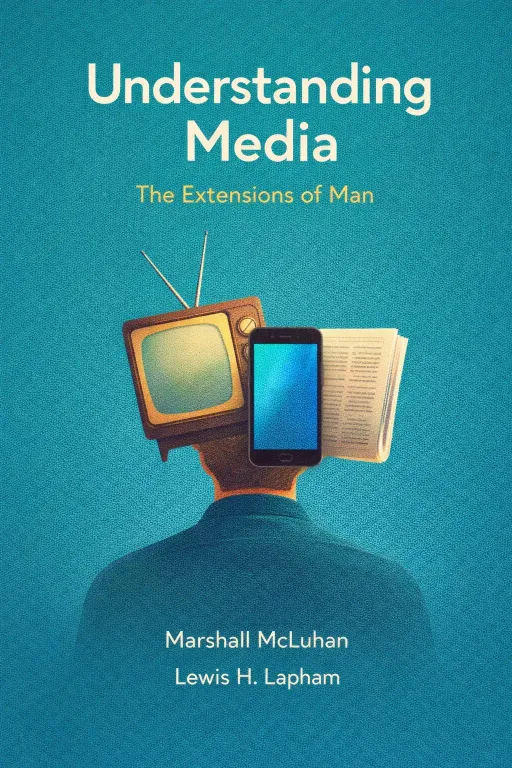
Narrator: McLuhan posits that all technologies are extensions of our own bodies, senses, and nerves. The wheel is an extension of the foot, the book is an extension of the eye, and clothing is an extension of the skin. However, we are often dangerously unaware of this fact. He uses the Greek myth of Narcissus to explain this blindness. Narcissus did not fall in love with himself; he fell in love with an extension of himself—his reflection in the water—which he mistook for another person. This fascination with his own extended image numbed his perceptions, a state McLuhan calls "narcosis," or numbness.
This is the trap of all technology. When we invent an extension of ourselves, we must numb the extended faculty to cope with the new intensity. The stress of an overloaded central nervous system leads to a kind of "autoamputation," where we push the source of irritation outside ourselves in the form of a new invention. But in doing so, we become fascinated by this new gadget and numb to its true effects, becoming servomechanisms to our own creations. We become what we behold.
The Architect of Modern Man: The Printed Word
Key Insight 5
Narrator: To understand the power of a medium, McLuhan analyzes the most influential technology of the mechanical age: the phonetic alphabet, amplified by the printing press. He argues that print is the architect of Western individualism and nationalism. Unlike ideographic writing systems that convey a holistic idea, the phonetic alphabet fragments sound into meaningless visual symbols. This process fostered a new way of thinking: linear, sequential, and uniform.
This visual stress created the detached, "civilized" individual, free from the "tribal trance of resonating word magic." The repeatability and uniformity of print created the possibility of mass markets, citizen armies, and universal education. It homogenized diverse regions, turning vernacular languages into powerful tools for national unity. The myth of Cadmus, who sowed dragon's teeth that sprang up as armed men, is presented as a metaphor for the alphabet's power to create uniform and aggressive armies that could be controlled from a distance. Print culture gave us an "eye for an ear," fundamentally reshaping our psyche and our society.
The Reversal: Television and the New Tribalism
Key Insight 6
Narrator: Just as print culture fragmented the tribal world, McLuhan argues that electric media—and especially television—are reversing the process. TV, as a cool, tactile, and deeply involving medium, is dismantling the linear and visual world of print. It does not encourage a private "point of view" but a collective, mosaic experience. This is why, he observes, children raised on TV struggle with the fragmented, visual nature of the printed page; they try to "pore, probe, and involve themselves in depth" with a medium that rejects such engagement.
This shift is leading to a "retribalization" of modern man. We are moving away from the specialized job and toward the all-encompassing role; away from the assembly line and toward organic, decentralized teamwork. The preference for the European small car (a tactile experience you "put on") over the big American car (a visual package you get "in") is a symptom of this change. Television, the "timid giant," is cooling down the hot, explosive, and individualistic culture created by print, pushing us back toward a world of deep, and often unnerving, interdependence.
Conclusion
Narrator: The single most important takeaway from Understanding Media is that the technologies we create are not passive tools; they are active agents that reshape our very being. We are defined not by the content we consume, but by the form of the media that deliver it. By extending our senses, these media reconfigure our entire sensory life, creating new patterns of thought, new social structures, and new definitions of self. To ignore the medium is to remain a "technological idiot," a numb servomechanism to forces we refuse to comprehend.
McLuhan wrote this in 1964, on the cusp of the digital age. His challenge to us is more urgent than ever. As we navigate a world defined by the internet, the smartphone, and social media, we must ask the McLuhanite question: What are these new extensions doing to us? It is not enough to analyze the tweet, the post, or the video. We must understand how the very act of scrolling, swiping, and connecting is shaping our global village, our politics, and our own central nervous system. Are we the masters of our tools, or are we, like Narcissus, simply mesmerized by our own reflection?