

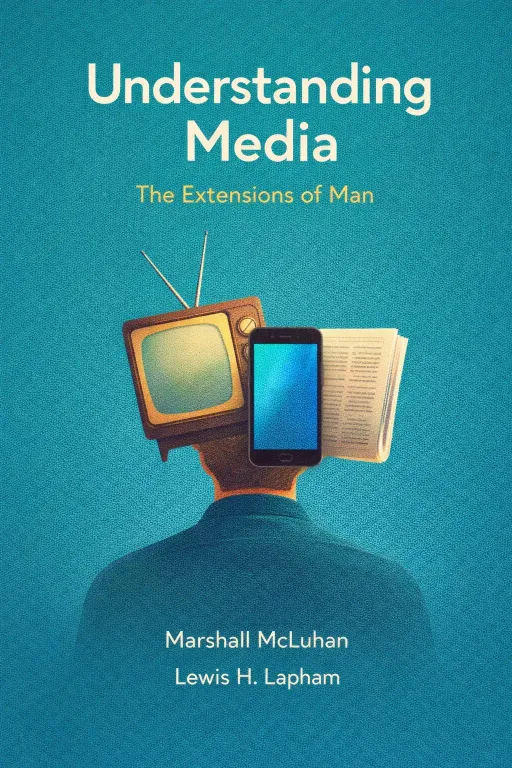
The Message is the Screen
Golden Hook & Introduction
SECTION
Olivia: Here’s a thought: everything you think you know about the news, about politics, about your own smartphone... is wrong. The problem isn't the content you're consuming. The problem is the screen you're holding. Jackson: Okay, hold on. That sounds like a pretty extreme claim. You’re telling me the cat videos I watch are less important than the phone itself? That feels like a stretch. Olivia: It does, but that's the radical idea at the heart of Marshall McLuhan's 1964 masterpiece, Understanding Media: The Extensions of Man. Jackson: McLuhan... I know the name. He's the guy who coined 'the global village,' right? But I've also heard his writing is notoriously difficult, almost like riddles. It’s one of those books that’s highly rated but people warn you about. Olivia: Exactly! And that was part of his genius. He was controversial because he didn't write in straight lines. His contemporaries, who were used to linear analysis, were often baffled. But he wasn't trying to give simple answers; he was training our perception. He came from a literary background, a Cambridge Ph.D., but he saw that the new electric world of TV and radio was completely rewiring us, and he was one of the first to try and map it. Jackson: Training our perception. I like that. So where do we even start with a book that big? Olivia: We start with his most famous, most mind-bending, and most misunderstood idea of all.
The Medium is the Message: Why the 'How' Matters More Than the 'What'
SECTION
Olivia: The idea is simply this: "The medium is the message." Jackson: Right. I’ve heard that phrase a million times, but I’ve never really understood it. It makes no sense on the surface. The message of a news report is the news, not the newspaper itself. The message of a phone call is what my friend is telling me, not the phone. Olivia: That's the conventional way of thinking, and it's what McLuhan says blinds us. Let me ask you a question he would ask: What is the "content" of an electric light bulb? Jackson: The content of a light bulb? I don't know... there isn't any. It doesn't say anything. It just... shines. Olivia: Precisely. It has no content. But what is its message? Its message is a world without night. Its message is brain surgery at 3 AM, night baseball, cities that never sleep. The light bulb, as a medium, completely restructured human society, our work, our sleep, our safety. It created a totally new environment. That environmental change is its true message, not some non-existent content. Jackson: Whoa. Okay. That’s a much bigger idea than I thought. So the technology itself, just by existing, changes everything. Olivia: Everything. Think about the railway. McLuhan would say the message of the railway wasn't the coal or the passengers it carried. Its message was the creation of giant new cities, new kinds of work, new forms of leisure, a new scale of human life. It didn't matter what was on the train; the train itself was reshaping the world. The medium, not the content, was the message. Jackson: That’s a great way to put it. So the message of the internet isn't the cat videos or the angry political posts... it's the fact that it connects everyone, everywhere, instantly. It’s the global village he talked about. It’s the death of distance. Olivia: You've got it. The content is just, as he put it, "the juicy piece of meat carried by the burglar to distract the watchdog of the mind." We get so focused on the content that we don't notice the medium is completely rebuilding the house around us. Jackson: That’s a fantastic analogy. But if the medium is the message, are all media the same? Does a book change us in the same way a TV does? Olivia: Not at all. And that's where his next brilliant idea comes in. He argued that every medium has a different 'temperature'.
Hot vs. Cool Media: The Temperature of Technology
SECTION
Jackson: A temperature? Like, some are warm and fuzzy and others are cold and distant? Olivia: Almost! He called them 'hot' and 'cool'. A 'hot' medium is one that's 'high-definition.' It's filled with data, it's intense, and it extends one single sense. Think of a high-resolution photograph, a printed book, or radio. They give you a lot of information, so you don't have to do much work. They require low participation. Jackson: Okay, so a movie in a theater would be hot. It’s a huge, sharp image, loud sound... it just washes over you. Olivia: Exactly. Now, a 'cool' medium is the opposite. It's 'low-definition.' It's fuzzy, sketchy, and provides very little data. Because of that, it demands high participation from the audience. You have to work to 'fill in the gaps.' Think of a cartoon, a telephone conversation, or... television. Jackson: Wait, television is cool? A TV screen seems pretty high-definition to me. Olivia: Not to McLuhan. He argued the TV image is actually a mosaic of millions of dots of light, and our brain only picks up a few dozen at a time. We are constantly, unconsciously, filling in the image. It's why we feel so involved with TV. It's a 'do-it-yourself' experience. A comic book is cool for the same reason—it's just a few lines, and our brain does all the work to create the world. Jackson: Huh. I never thought of it that way. But why does this 'temperature' actually matter in the real world? Olivia: It matters immensely. It can literally shape history. The most famous example is the 1960 presidential debate between John F. Kennedy and Richard Nixon. Jackson: Oh, I know this story. Nixon looked terrible on TV. Olivia: He did, but McLuhan explained why. Radio is a 'hot' medium. It focuses on the single sense of hearing, and it's high-definition in its own way—you hear every nuance of the argument. On the radio, Nixon, with his sharp, logical, detailed points, sounded like the clear winner. He was a 'hot' candidate. Jackson: Right, he was presenting a lot of data. Olivia: Exactly. But then came television. TV is a 'cool' medium. It's low-definition and demands viewer involvement. Nixon's intense, sweaty, five-o'clock-shadow appearance was too 'hot' for the cool medium. It was too much data, too defined. The audience had nothing to 'fill in,' so they just felt uncomfortable. He came across as a 'phony.' Jackson: And Kennedy? Olivia: Kennedy was the perfect 'cool' candidate. He was relaxed, his image was a bit blurry, a bit shaggy. He didn't present a sharp, finished product. He presented an image that the audience had to participate in to complete. They could project their own hopes onto him. On TV, he was trustworthy and likable. On radio, he sounded inexperienced. The medium's temperature completely changed the perception of the candidates. Jackson: Wow. So the same people, saying the same things, were perceived as complete opposites depending on whether the audience was listening or watching. The medium really was the message. Olivia: It was everything. And this power of media to completely reshape our world and our perceptions is so immense, which leads to the next big question. Jackson: Which is? This is all fascinating, but if media are this powerful, this all-encompassing... why don't we notice it more? Why aren't we all talking about this all the time? Olivia: That's the million-dollar question, and McLuhan had a chilling answer for it, which he wrapped up in an ancient Greek myth.
Narcissus as Narcosis: Are We Numbed by Our Own Inventions?
SECTION
Jackson: An ancient myth? How does that connect to television and politics? Olivia: Because McLuhan believed the myth of Narcissus isn't a story about vanity. It's a story about technology. The key is in the name. 'Narcissus' comes from the same Greek root as 'narcosis,' which means numbness. Jackson: Numbness? I thought Narcissus fell in love with himself. Olivia: That's the common interpretation. But McLuhan's reading is more profound. Narcissus stares into the water and sees a reflection. He becomes so mesmerized by this image that he's completely paralyzed. He can't eat, he can't drink, he can't respond to the nymph Echo who loves him. The crucial part is that he doesn't know it's his own reflection. He's been numbed by this beautiful extension of himself. Jackson: Okay, I see where you're going with this. The reflection is the technology. Olivia: Precisely. Every technology is an extension of ourselves. The wheel is an extension of the foot. The book is an extension of the eye. The telephone is an extension of the voice. And just like Narcissus, we become so fascinated by our own extended powers that we become numb to what they're actually doing to us. We fall into a 'Narcissus trance.' Jackson: That is... a deeply unsettling idea. Can you give me an example? Olivia: Think of the invention of the clock. It's an extension of our internal sense of time. But by externalizing it and chopping it into uniform seconds and minutes, it created a new environment of mechanical, abstract time. It led us to eat not when we're hungry, but when it's 'time to eat.' It created the assembly line. It fragmented our world. But we're so used to it, so numb to it, that we just think of it as 'time.' We don't see the cage it built around us. McLuhan calls this process 'auto-amputation.' Jackson: Auto-amputation? Like we're cutting off parts of ourselves? Olivia: In a way, yes. He argues that when our central nervous system is over-stimulated or stressed, it protects itself by numbing or 'amputating' the offending faculty and extending it into the world as a technology. The stress of carrying heavy loads leads to the 'amputation' of the foot into the wheel. The stress of social complexity leads to the 'amputation' of memory into writing. We create these tools to solve a problem, but then we become servomechanisms to the tools, numb to their deeper effects. Jackson: Oh man. That's our relationship with our phones. It's a perfect modern Narcissus myth. We stare into this perfect, curated reflection of ourselves—our social media profiles, our perfectly organized apps, our endless stream of information—and we're totally numb to how it's rewiring our brains, destroying our attention spans, and changing our social interactions. We're in a trance. Olivia: We are. We're staring at our own reflection in the digital water, and we don't even recognize it as an extension of ourselves anymore. We just think it's 'connecting with friends.' We're numb to the narcosis. Jackson: That's a powerful and frankly terrifying thought. It reframes the whole debate. It's not about whether technology is 'good' or 'bad.' It's about whether we're awake or asleep. Olivia: Exactly. And for McLuhan, the whole point of his work, the reason he wrote in these strange, provocative 'probes,' was to try and wake us up.
Synthesis & Takeaways
SECTION
Olivia: So when you put it all together, you have these three layers of understanding. First, the technology itself—the medium—is the real message because it creates a new environment. Second, each medium has a 'temperature,' hot or cool, that dictates how we participate with it. And third, we're usually in a state of 'narcosis,' a deep numbness, that prevents us from seeing any of this clearly. Jackson: It's not about being anti-technology, then. It's about waking up from that numbness. McLuhan wasn't a pessimist; he was trying to give us the tools for awareness. I remember reading a quote of his where he said something like, "There is absolutely no inevitability as long as there is a willingness to contemplate what is happening." Olivia: That's the perfect summary. His goal was to train our perception. He believed that if we could understand the 'grammar' of our media, we could anticipate and control the changes they bring. Once you start seeing the world this way, you can't unsee it. You start asking, 'What is the real message of TikTok? What is the temperature of a podcast? What part of me am I numbing with this new app?' Jackson: It's about regaining agency. It’s about not being a sleepwalker in a world we built ourselves. And it all starts with just asking the right questions. Olivia: Exactly. It's about understanding the extensions of man. Jackson: So, for everyone listening, here's a challenge. Think about the one technology you use most. Your phone, your car, maybe even your coffee maker. What is its real message? What new environment, what new scale or pace, is it creating for you? Olivia: This is Aibrary, signing off.