

The Polymath's Path: Mastering Diverse Domains
Golden Hook & Introduction
SECTION
Nova: Alright, Atlas, quick game. I'll throw out a field, you tell me the most unexpected, brilliant thing you could connect it to. Ready?
Atlas: Oh, I like that! My brain is already buzzing. Hit me.
Nova: Coffee sensory science.
Atlas: Oh, I love that. Coffee sensory science... connected to... advanced audio production. Thinking about the nuances of flavor profiles, the 'notes' in a coffee, like the timbre and harmonics in a soundscape. It’s all about discerning subtle patterns in complex data.
Nova: Whoa, that's incredibly precise. Okay, my turn: web development ethics.
Atlas: Right, like, the moral frameworks and user privacy? That's directly connected to the development of ethical AI in SmartHome technology. It's about building trust, anticipating unintended consequences, and designing systems that truly serve, not just collect.
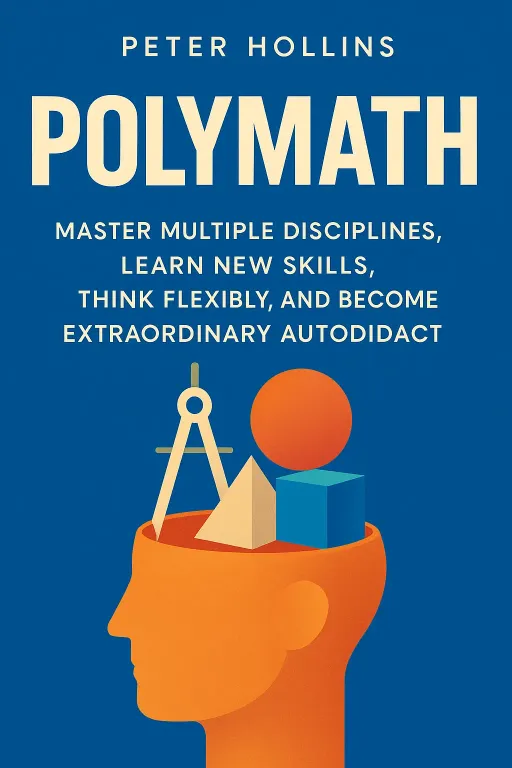
Nova: Absolutely! That's exactly the kind of intellectual acrobatics we're diving into today. Because what you just demonstrated, that's the heart of what Peter Hollins explores in his book,. He argues that true polymathy isn't about dabbling; it's about making those deep, insightful connections across seemingly disparate fields. And then, for the of doing that deeply and efficiently, we turn to Scott Young's, a rigorous framework that helps you master complex skills in compressed timeframes.
Atlas: That makes me wonder, Nova, we hear "polymath" and we often think of historical figures like Da Vinci, right? But is there a risk that in our modern, hyper-specialized world, this concept of deep diving into fields just leads to being a "jack of all trades, master of none"?
The Polymathic Advantage: Deep Dives and Cross-Pollination
SECTION
Nova: That’s a common misconception, Atlas, and it’s precisely what Hollins addresses. He flips that old adage on its head. He says the "master of none" part only applies if you're superficial. True polymathy, as he defines it, is about. It's about immersing yourself in a field, understanding its fundamental principles, its nuances, its craft, and then, crucially, finding the between that deep knowledge and another completely different domain. It's not about knowing a little about everything; it's about knowing a lot about several things and seeing the invisible threads that weave them together.
Atlas: Okay, but how does someone really that? I'm imagining someone like our listener, Brian, who has this incredibly rich background in coffee, music, and tech. He's got precision and deep understanding in each. How does he go from having three distinct areas of expertise to creating something truly novel by connecting them?
Nova: Let's take a hypothetical. Imagine someone, let's call her Dr. Anya Sharma. She starts her career as a neuroscientist, deeply understanding brainwaves, cognitive processing, and how external stimuli affect perception. She spends years in labs, dissecting complex systems, achieving a profound capacity for detail. Then, driven by a passion for human connection and healing, she decides to pursue a second deep dive into traditional textile weaving, learning ancient patterns and the tactile experience of creation.
Atlas: Fascinating. Those seem worlds apart. Where's the connection?
Nova: Exactly! For years, they separate passions. But then, she starts noticing patterns. The rhythmic, repetitive motions of weaving, the way certain colors and textures evoke specific emotional responses, the almost meditative state it induces. She begins to see parallels with brainwave patterns she studied, with concepts of neural plasticity. She realizes that the tactile and visual engagement of weaving could be a profound tool for cognitive rehabilitation, perhaps for patients recovering from stroke or PTSD, by stimulating specific neural pathways.
Atlas: Wow, that's truly novel. So, she's not just a neuroscientist a weaver; she's a neuroscientist-weaver who’s invented a new therapeutic approach. That's a powerful example of what Hollins means by "cross-disciplinary insights to foster innovation." It's about that intentional connection.
Nova: Precisely. The innovation doesn't come from merely possessing two skills, but from the. Hollins emphasizes that this is where true competitive advantage lies in today's world. When you can draw from a well of deep, diverse knowledge, you're not just solving problems within one box; you're seeing problems and solutions that others, stuck in their single domain, can't even perceive. It allows you to build an intellectual ecosystem where ideas cross-pollinate and grow exponentially.
Atlas: That’s a great way to put it. It feels like it requires a certain mindset shift too, right? To actively look for those connections, rather than just compartmentalizing your interests. It's about embracing the weave, as it were, and trusting that your diverse experience is a strength.
Ultralearning for Accelerated Mastery: The 'How' of Deep Skill Acquisition
SECTION
Nova: Absolutely, it's a mindset shift, but it also requires a practical toolkit. Because if you're going to take multiple deep dives, you can't spend 10,000 hours on one. That’s where Scott Young’s becomes indispensable. It’s not about shortcuts, but about smartcuts – a rigorous, self-directed framework for mastering complex skills in compressed timeframes. Young, who famously completed MIT's four-year computer science curriculum in just twelve months through self-study, proves these methods work.
Atlas: Okay, so this is the "how-to" guide for becoming Dr. Sharma, the neuroscientist-weaver, without taking twenty years to get there. I'm curious, what does "ultralearning" actually entail? What are its core principles?
Nova: He outlines nine principles, but for our discussion, three are foundational: Metalearning is arguably the most crucial starting point.
Atlas: What does "Metalearning" actually mean? It sounds a bit abstract.
Nova: That’s a great question, and it's less esoteric than it sounds. Metalearning is simply. Before you dive into a new skill or field, you spend a short, focused time mapping out the skill itself. What are its core concepts? What are the common pitfalls? What resources are truly effective? It’s like a reconnaissance mission. Imagine you want to master advanced audio production. Metalearning would involve talking to experts, looking at syllabi from top audio engineering schools, researching the most common mistakes beginners make, and identifying the key software and hardware. You’re building a map you start the journey, understanding the landscape of the skill.
Atlas: So you're not just blindly jumping in, you're strategically planning your learning path. That sounds incredibly efficient, especially for someone who wants to go deep and really understand something at a fundamental level. And what about "Directness"? Isn't all learning "direct" in some way?
Nova: Not necessarily. Think about learning a language. A traditional approach might be to spend years studying grammar rules and vocabulary lists. That's learning. Young's principle of means learning by the thing you want to get good at. If you want to speak Spanish, you speak Spanish from day one, even if it's broken. If you want to be a software developer, you start coding and building projects, not just reading theory. For advanced audio production, it means getting into your home studio, experimenting with microphones, mixing tracks, even if they sound terrible at first. You learn by encountering the real challenges, not just theoretical ones.
Atlas: Ah, I see. So for Brian, who has a "hands-on & deep dive" learning style, this is perfectly aligned. It’s about getting your hands dirty immediately and learning through feedback from actual application. So for his goal of elevating his home studio recordings, it’s less about watching endless tutorials and more about... recording something, anything, and then dissecting what worked and what didn't?
Nova: Exactly. It's about active engagement and immediate feedback loops. And that leads us to the third principle,. It’s not enough to learn something quickly; you need to remember it. Young emphasizes spaced repetition, active recall, and making connections to existing knowledge. If you're ultralearning multiple domains, you need robust systems to keep that knowledge accessible and integrated, rather than letting it fade away. It's about building a robust mental library that you can constantly access and cross-reference. You’re curating your understanding at a fundamental level, ensuring that your quest for mastery actually sticks.
Atlas: That makes perfect sense. Because what’s the point of taking a deep dive if the knowledge just evaporates? It's about cultivating that intellectual ecosystem you mentioned earlier, and ensuring the knowledge is truly within it, ready to be woven with other insights.
Synthesis & Takeaways
SECTION
Nova: So, when you combine Hollins's vision of polymathy – the deep dives and intentional cross-pollination – with Young's ultralearning framework for rapid, effective skill acquisition, you have a powerful recipe. It's about strategically building diverse expertise and then actively looking for the unexpected intersections. It's about seeing your varied passions not as distractions, but as components of a unique, powerful advantage. It gives you the tools to dissect complex systems in multiple fields, find joy in precision across them, and ultimately, achieve mastery.
Atlas: That’s actually really inspiring. Because for our listeners who are navigating their own unique blend of passions – maybe they're like Brian, connecting web development ethics with AI in SmartHome tech, or coffee sensory science with sound design principles in their home studio – it's about asking that deep question: how can you connect these to create truly novel solutions or artistic expressions?
Nova: It starts with trusting your diverse experience. It is your unique strength. See the connections. Embrace the weave. And to make it actionable, dedicate specific time each week. Explore one new connection between your varied passions. Don't wait for inspiration; schedule the exploration. Just as you connected coffee to audio, or web ethics to AI, think about how your specific crafts intersect.
Atlas: That's a brilliant, concrete step. It's about cultivating your intellectual ecosystem, one intentional connection at a time. The real magic happens at the crossroads of your deep dives, leading to integrated portfolio designs, advanced audio production, and ethical AI applications.
Nova: Indeed. Your unique blend of interests isn't a scattered mess; it's a fertile ground for innovation. It's your path to mastery, not just in one domain, but across a rich tapestry of knowledge.
Atlas: Thank you, Nova. This has been a truly insightful journey into mastering diverse domains.
Nova: My pleasure, Atlas. And thank you all for joining us on this exploration of how to cultivate your own intellectual ecosystem.
Atlas: This is Aibrary. Congratulations on your growth!









