The Learning Machine: How to Master Complex Skills Effectively
Golden Hook & Introduction
SECTION
Nova: What if everything you thought about learning new, complex skills was fundamentally wrong? What if the slow, steady path, the one we've all been told is the 'right' way, was actually the scenic route to mediocrity?
Atlas: Oh, I like that. That’s a bold claim, Nova. I imagine a lot of our listeners, especially those grappling with the ever-evolving landscape of web architecture or the complex strategies of independent business, feel stuck on that 'scenic route.' How does one even begin to challenge that conventional wisdom?
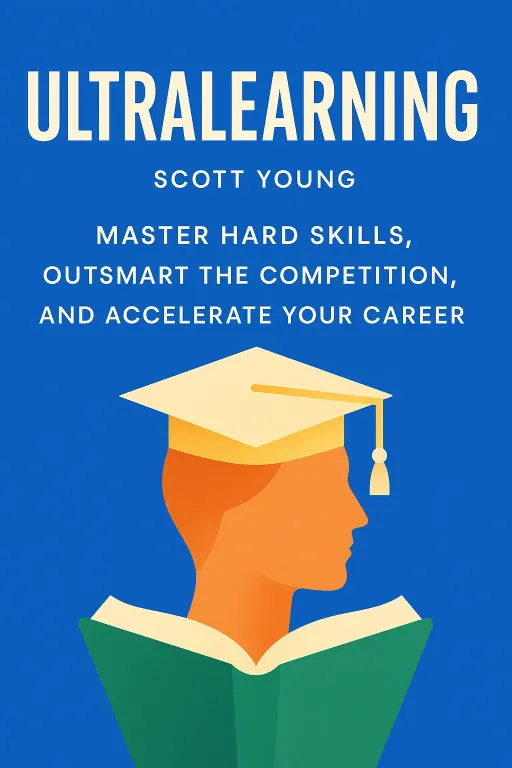
Nova: Well, today, we're tearing down those assumptions with Scott H. Young's groundbreaking work, "Ultralearning: Master Hard Skills, Outsmart the Competition, and Accelerate Your Career." Young himself is a fascinating case study; he famously tackled MIT's 4-year computer science curriculum in just 12 months, purely through self-study, and documented the entire process. He wasn't some child prodigy; he just had a systematic approach.
Atlas: Wow, MIT in a year? That's not just learning; that's an operational overhaul. For someone who thinks deeply and is driven to build impactful solutions, that kind of efficiency is absolutely gold. So, what's the core insight here? What's the secret sauce behind ultralearning?
Deep Dive into Ultralearning and 'Directness'
SECTION
Nova: The cold fact, as Young points out, is that our traditional approach to learning is often deeply inefficient. It's slow, it lacks deep understanding, and it leads to a lot of wasted effort. Ultralearning is his aggressive, systematic solution to that problem. It's about designing your learning process to be intensely effective.
Atlas: Aggressive? That sounds… intense. I’m thinking about someone trying to master, say, a brand-new programming language or a complex client acquisition strategy for their independent business. Is this just for academic challenges, or can a professional pushing for lasting contributions actually apply this without completely burning out?
Nova: It's absolutely applicable, and it's less about brute force and more about strategic design. One of Young's core principles, and arguably the most potent, is 'Directness.' It's deceptively simple: learn by the thing you want to get good at, in a real, applied context, as much as possible.
Atlas: So, if I'm trying to understand, let's say, a cutting-edge web framework or a new component of cloud architecture, the 'Directness' principle would mean… not meticulously reading all the documentation and theoretical whitepapers first, but immediately trying to build a small app or a prototype with it? That feels counter-intuitive to how I’d usually approach a complex system, where I’d want to map out the entire architecture and understand all the foundational concepts before I even write a line of code.
Nova: Exactly! That's the paradigm shift. Traditional learning often creates artificial environments. Think about learning a language: we spend years on grammar drills and vocabulary lists, but then we freeze when a native speaker asks for directions. Directness says, "If you want to speak the language, speak it. If you want to code, code." You're closing the gap between learning and application. It’s like learning to swim by reading a book versus jumping in the pool. The pool gives you immediate, relevant feedback.
Atlas: I get it, it's like 'learn by doing,' but supercharged. But for someone who's a strategist, who likes to break down problems into their constituent parts before building a solution, the idea of "just jumping in" can feel like inviting chaos. What about the inevitable mistakes? The frustration of not knowing what you're doing?
Nova: That's where the complementary principles come in. Young isn't advocating for reckless abandon. Directness your weaknesses quickly. You jump in, you try to build that web app, and you immediately hit a wall because you don't understand how authentication works. the point. That frustration isn't a sign to quit; it's a signal. Then, you can apply another ultralearning principle, 'Drill,' which means isolating and practicing those specific weaknesses. So you jump in, find your exact friction points, and then strategically drill those specific areas until they're no longer weak spots.
Atlas: Oh, that’s smart. So it’s not just reckless abandon; it’s a highly intelligent, iterative feedback loop. You get direct exposure, identify the bottlenecks in your understanding or skill, and then strategically drill those weaknesses. That makes so much sense for an architect who wants to optimize a system – you find the friction points and solve them directly. It’s almost like agile development for your brain, constantly refining based on real-world testing.
Nova: It truly is. Young himself, in his MIT challenge, didn't perfectly understand every mathematical proof before moving on. He'd tackle problems, identify areas where his understanding was shaky, and then go back and 'drill' those specific concepts. This led to a much deeper, functional understanding than simply passively reading textbooks cover-to-cover would have. It transforms learning from consumption into active creation and problem-solving.
Atlas: This is potent for someone driven by impact. It's about getting to the 'building solutions' phase faster, not just accumulating knowledge for knowledge's sake. It’s about actively shaping the outcome rather than passively absorbing input. It aligns perfectly with the mindset of trusting your vision and building, not just theorizing.
Synthesis & Takeaways
SECTION
Nova: Absolutely. Ultralearning isn't just about speed; it's about achieving a deep, functional understanding by constantly engaging with the skill in its purest, most challenging form. It's about designing your learning environment to be as close to the real challenge as possible, turning frustration into a compass for mastery.
Atlas: So, the 'tiny step' for our listeners this week, especially those looking to amplify their unique voice through personal branding, or perhaps mentor others in their field, would be to pick one small skill – maybe even just a micro-skill within a larger domain – and immediately apply Young's 'Directness' principle. Don't read another article about it; just try to it. Trust your vision, as our growth recommendations suggest, and build that solution directly.
Nova: Exactly. It’s about leveraging your deep thinking not just to understand, but to and. It’s about transforming that frustration with slow learning into aggressive, impactful progress. It's a mindset shift that empowers you to truly build the future, whether it's groundbreaking web architecture or a thriving independent business.
Atlas: We'd love to hear what small skill you're applying Directness to this week. Share your insights, your challenges, and your breakthroughs with us online. What's that one thing you're going to stop just reading about and start?
Nova: Because true mastery isn't found in the margins of a textbook, but in the crucible of real-world application.
Nova: This is Aibrary.
Atlas: Congratulations on your growth!