

The Learning Loop: Stop Forgetting, Start Mastering
Golden Hook & Introduction
SECTION
Nova: Alright, Atlas, here's a radical thought: What if everything you've been told about how to 'study' or 'learn' is fundamentally wrong? That the harder you try to cram, the less you actually retain?
Atlas: Whoa, Nova, that's a bold claim! I mean, it like I'm learning when I'm re-reading my notes for the tenth time. Are you telling me I've been doing it wrong all along?
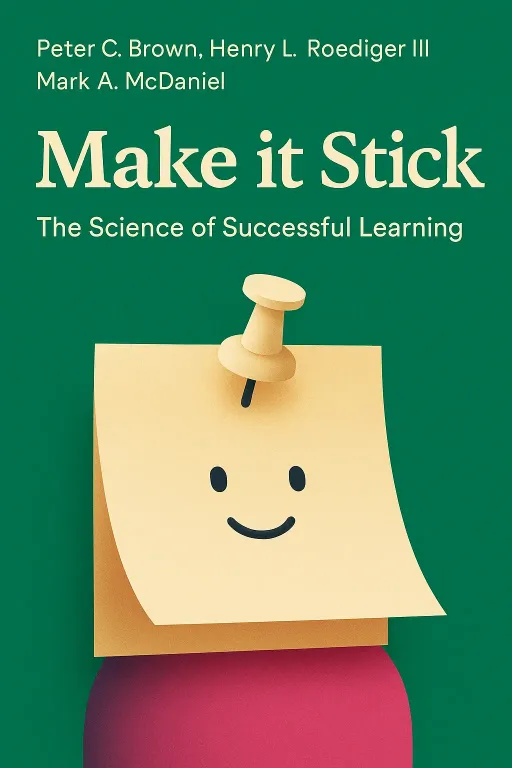
Nova: That's exactly what we're diving into today, drawing insights from two phenomenal books. First up, 'Make It Stick' by Peter C. Brown, Henry L. Roediger III, and Mark A. McDaniel. This isn't just theory; these are cognitive scientists who spent decades proving the counter-intuitive ways our brains actually learn. They really turned the academic world on its head with their research.
Atlas: So it's not just a self-help guru's opinion, it's backed by hard science. I like that. What's the core misconception they tackle first for someone like me, who's always trying to understand complex systems?
Nova: They tackle what they call the 'illusion of knowing.' We think we know something because it feels familiar. That re-reading you mentioned? It makes the material familiar, like you've got it, but it doesn't build strong, retrievable memories. It's a trick our brains play on us.
Atlas: That sounds like a common trap for anyone trying to master complex fields, like someone learning architecture or tackling global challenges. You consume so much information, but then it's gone when you actually need to apply it.
The Myth of Passive Learning: Embracing Active Recall and Spaced Repetition
SECTION
Nova: Precisely. The book argues that true learning happens when you actively information. Think of it like this: every time you retrieve a memory, you're not just accessing it, you're strengthening the pathway to it, making it easier to find next time. It's like exercising a muscle, the more you flex it, the stronger it gets.
Atlas: So, instead of just looking at the answer, I should try to remember it first, even if it's hard? That feels slower, almost inefficient, especially when I have so much to learn.
Nova: It slower, but it's far more effective. They call this 'desirable difficulty.' A classic example shared in the book is a study where students were either given extra study time or tested immediately after learning. The tested group performed significantly better in the long run, even though they felt less confident initially. The struggle itself cemented the knowledge.
Atlas: That's incredibly counterintuitive! So, the struggle actually builds the knowledge. How does 'spaced repetition' fit into this, because I've heard that term before?
Nova: Spaced repetition is the strategic timing of that recall. Instead of cramming, where you try to shove everything in at once, you review material at increasing intervals. Imagine learning a new design principle. You review it today, then in three days, then a week, then a month. Each retrieval strengthens the memory, and the increasing intervals force your brain to work harder to retrieve, making the memory far more durable and accessible long-term.
Atlas: Right, because if you just keep it in your short-term memory, it fades. But if you have to really dig for it, that act of digging solidifies it. For our listeners who are trying to grasp new frameworks for problem-solving, this could be huge. It means you don't just read about a framework; you actively try to apply it, then revisit it later when it's just starting to get fuzzy.
Nova: Exactly. It's about active engagement, not just passive exposure. They also talk about 'interleaving,' which means mixing up different subjects or types of problems during practice. This helps you distinguish between concepts and apply the right solution in varied contexts.
Atlas: That completely contradicts how most people study, right? We tend to focus on one thing until we 'master' it, then move to the next. But that just creates an illusion of mastery within a single, isolated context.
Nova: Precisely. It's like a basketball player only practicing free throws. They might get incredibly good at free throws, but they won't be a great player until they practice shooting from different spots on the court, under pressure, and with defenders in their face. That's interleaving in action.
Atlas: So, the core takeaway here is: don't just consume, actively retrieve. And don't cram, space it out. That's a fundamental shift in how we approach learning that feels incredibly empowering.
Accelerating Mastery: The Power of Ultralearning's Intense Focus and Direct Practice
SECTION
Nova: And this idea of active engagement naturally leads us to our second powerful insight, from Scott H. Young's 'Ultralearning.' If 'Make It Stick' gives us the fundamental mechanics of memory, 'Ultralearning' provides the strategic blueprint for mastering hard skills. Young himself is famous for learning college-level computer science in a year, or becoming fluent in four languages in a single year, all without attending traditional classes.
Atlas: Wow, four languages in a year? That sounds almost impossible. What's his secret sauce? Is it just raw talent, or some kind of genetic lottery?
Nova: He strongly argues it's not talent; it's a deliberate, systematic approach. The core principles are intense focus, direct practice, and constant feedback. He emphasizes 'metalearning' – which is essentially learning to learn a specific skill, mapping out all the resources and strategies needed for that particular domain. Then, he dives in with intense, undistracted focus.
Atlas: Intense focus is something we all struggle with in our hyper-connected, distracted world. How does he even achieve that, especially for complex subjects that demand so much mental energy?
Nova: He creates an environment conducive to deep work, minimizing distractions – essentially building a 'focus bubble' around himself. But crucially, it's not just about spending hours; it's about the of those hours. And he pairs that with 'directness' – learning by doing the thing itself. If you want to learn to code, you code. If you want to learn a language, you speak it from day one.
Atlas: So, less theoretical study and more immediate application. That really resonates with the idea of wanting a meaningful impact. You don't just read about global challenges; you engage with the data or the people directly. But what about mistakes? Doesn't direct practice mean you'll make a lot of them, and that can be discouraging?
Nova: Absolutely! And that's where 'feedback' comes in as a critical component. Ultralearners actively seek out feedback, dissect their mistakes, and use them as fuel for improvement. It's a rapid iteration cycle. They don't shy away from looking foolish; they embrace it as an essential part of the learning process rather than a sign of failure.
Atlas: That's a huge mindset shift. Many of us avoid feedback because it feels like criticism or judgment. But he frames it as essential data for growth. So, combine the active recall from 'Make It Stick' with Young's intense, direct, feedback-driven practice, and you've got a learning superpower in the making.
Nova: Exactly. He also talks about 'retention' and 'intuition.' Once you've learned something intensely and directly, maintaining that knowledge and skill requires active recall – just like 'Make It Stick' preaches. And true intuition, that ability to just 'know' the right answer or solution, develops not from passive exposure, but from countless iterations of direct practice and immediate feedback.
Atlas: I can see how this would accelerate mastery for an aspiring architect, for instance. Instead of just studying building codes, you're designing, getting feedback on your designs, iterating rapidly. Or for someone trying to understand complex global systems, you're not just reading reports, you're engaging with data, modeling scenarios, and constantly getting feedback on your assumptions. It makes learning feel like a mission.
Synthesis & Takeaways
SECTION
Nova: So, when we combine these two powerhouses, 'Make It Stick' and 'Ultralearning,' we get a truly formidable, purpose-driven approach to knowledge acquisition and skill mastery. It's a call to move beyond the comfortable illusion of learning and embrace the 'desirable difficulty' that actually builds lasting understanding and rapid competence.
Atlas: It's a complete paradigm shift, really. From passive consumption to active engagement, from rote memorization to purposeful practice. It's about designing your learning environment for maximum impact, not just maximum effort or superficial retention.
Nova: And the beauty is, the tiny step for our listeners is so accessible. Tomorrow, before you look at your notes from a recent meeting or a book you just read, just try to recall the key ideas. Five minutes. That simple act of retrieval is the first step into this powerful learning loop.
Atlas: Five minutes of active recall. That's a tiny step with potentially massive ripple effects. It's about trusting your inner wisdom, as our growth recommendations suggest, and taking that small action. Because true understanding, the kind that leads to meaningful impact and allows you to contribute consciously, doesn't come from how much you passively consume, but how effectively you engage and connect with the material.
Nova: It's about building those stronger mental connections, not just collecting information. The world needs deep thinkers and conscious contributors, and mastering how you learn is perhaps the most fundamental skill for making a profound difference.
Atlas: Absolutely. So, challenge your assumptions about learning. Embrace the struggle. And start making your knowledge stick.
Nova: This is Aibrary. Congratulations on your growth!









