

The Learning Ladder: How to Master Anything Without Burning Out
Golden Hook & Introduction
SECTION
Nova: Atlas, I need to ask you something. Be honest: when you're trying to learn something new, what's your go-to method? Do you highlight? Re-read? Maybe make some meticulous notes?
Atlas: Oh, Nova, you know me. I'm a connoisseur of the perfectly highlighted textbook. My notes are legendary, colour-coded, cross-referenced... I practically re-write chapters. Why? Is my system flawed? Don't tell me all those hours were for nothing!
Nova: Well, my friend, what if I told you that those very methods, the ones we've been taught since grade school, are often the least effective ways to actually anything? They’re the learning equivalent of trying to get fit by watching someone else run a marathon.
Atlas: Oh, I know that feeling. That’s actually really inspiring! So, you’re saying my meticulous notes are essentially mental dust collectors? My brain isn't actually absorbing it like I think it is?
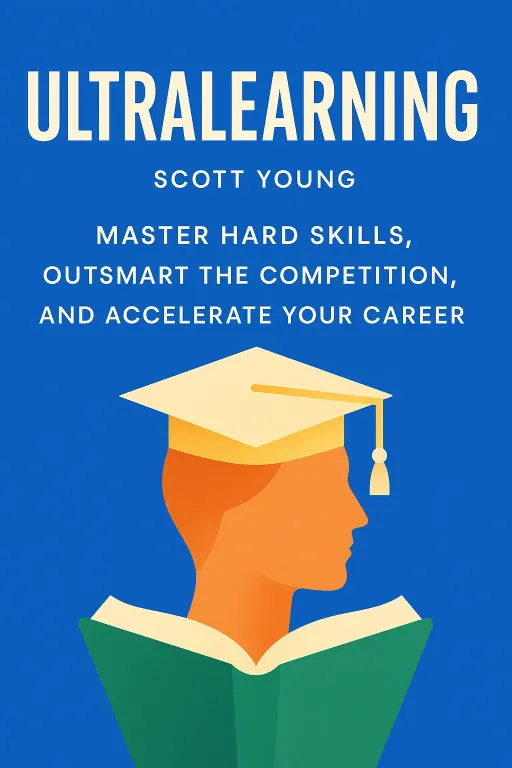
Nova: Precisely. And that's exactly why we're diving into the brilliant insights from books like "Ultralearning" by Scott Young and "Make It Stick" by Peter C. Brown, Henry L. Roediger III, and Mark L. McDaniel today. Scott Young, for instance, famously taught himself MIT's entire 4-year computer science curriculum in 12 months, without ever enrolling. He didn’t do it by highlighting.
Atlas: Wow. That’s actually really inspiring. I mean, my brain is already buzzing just thinking about what that implies for anyone trying to deeply understand complex systems or craft meaningful experiences. So, if highlighting isn’t the answer, what’s the cold, hard truth about why our usual learning methods fall short?
The Ineffectiveness of Passive Learning & The Power of Active Recall
SECTION
Nova: The core issue is that our standard approaches—reading, highlighting, re-reading—are largely passive. They create an illusion of fluency. You feel like you know the material because it looks familiar on the page, but that familiarity is a trick of the mind. It doesn't mean you can actually that information when you need it.
Atlas: So basically you’re saying, I can read a blueprint a hundred times, but it doesn't mean I can build the house. I can study human psychology for weeks, but it doesn't mean I can actually apply it to a team dynamic. That’s going to resonate with anyone who struggles with feeling like they’re putting in the effort but not seeing the results.
Nova: Exactly! It’s like trying to learn to swim by watching Olympic divers on YouTube. You might feel like you understand the strokes, but try jumping in the pool, and suddenly it’s a very different story. The authors of "Make It Stick" call this the "illusion of knowing."
Atlas: That makes me wonder, for our listeners who are managing high-pressure teams or architecting new systems, how does this passive learning lead to burnout? Because it feels like the more I re-read, the more exhausted I get, and the less actually sticks.
Nova: It’s incredibly draining because you’re expending effort without engaging the deeper neural pathways. The brain isn't being challenged to anything with the information. The real antidote, the scientific breakthrough, is what's called "active recall."
Atlas: Active recall? That sounds a bit out there. What exactly do you mean by that?
Nova: Instead of passively re-reading, you actively try to retrieve the information from your memory. Close the book, put away the notes, and ask yourself questions. Summarize what you just read in your own words. Try to explain it to an imaginary friend.
Atlas: So it's like building a muscle for your brain? You're forcing it to work, rather than just letting it sit there?
Nova: Precisely! Think of it like this: there was a student, let's call her Sarah, who was struggling with her history exams. She'd spend hours highlighting, re-reading, convinced she was studying hard. But come exam day, her mind would go blank. Then, she shifted her strategy. After every chapter, instead of re-reading, she'd close the book and try to write down everything she could remember, without looking. If she got stuck, only then would she peek.
Atlas: And what happened?
Nova: Her grades soared. Not because she studied more, but because she studied. The act of that information, even if it was difficult, strengthened the memory pathways. It made the knowledge more accessible and durable. It's about engaging your brain more deeply.
Atlas: That’s a great way to put it. For those of us who want sustainable impact and to avoid burnout, how does this prevent the exhaustion from feeling like you're constantly fighting for information?
Nova: It's actually less draining in the long run because you're making your learning more efficient. You're not just spinning your wheels. You're building robust, accessible knowledge. It makes the learning stick the first time, reducing the need for endless, frustrating repetition. It's about working with your brain, not against it.
Strategic Learning for Durable Mastery: Interleaving, Elaboration, and Real-World Application
SECTION
Nova: Active recall is the foundation, but to truly anything, especially for complex fields like psychology or architecture, we need to build on that. The next layers are techniques like interleaving and elaboration.
Atlas: Okay, so, what's interleaving? My instinct as an architect, when I'm designing a new user experience, is to focus on one specific aspect until it's perfect. How does jumping between topics improve understanding for complex projects?
Nova: It sounds counterintuitive, right? Interleaving means mixing different types of problems or topics within a single study session, rather than blocking them. So, instead of practicing all your algebra problems, then all your geometry, you'd mix them up. Or, in an architectural context, maybe you'd work on structural elements, then user flow, then material selection, all within the same block of time.
Atlas: That’s a bit like a musician practicing different scales, then a chord progression, then a piece, all in one session, rather than just one scale for an hour.
Nova: Exactly! That’s a perfect example. What happens is your brain has to constantly differentiate between problem types, which forces it to understand the rather than just memorizing a specific solution for a specific problem. It builds discernment and adaptability. For someone crafting experiences, this is invaluable because real-world problems never come neatly packaged.
Atlas: I can see how that would be important for building resilient systems, not just rote memorization. It sounds like it fosters a more flexible mindset. What about elaboration? How does that fit into this picture of durable mastery?
Nova: Elaboration is about connecting new ideas to what you already know, expanding on them, and finding analogies. When you learn something new, ask yourself: How does this relate to X? What's an example of this in my own life? Can I explain this in simpler terms?
Atlas: So it's not just about knowing the facts, it's about building a rich mental model, like mapping out a user journey and understanding all the interconnected touchpoints?
Nova: Precisely. A study might show a child learning about different types of animals. Instead of just memorizing "mammals eat plants or meat," they'd be asked, "How is a bat like a bird, but also like a mouse?" or "Imagine a squirrel trying to fly – why wouldn't that work?" Those kinds of questions force elaboration. And here's where the "tiny step" from our book content comes in: tomorrow, when you learn something new, try to explain it to someone else without looking at your notes.
Atlas: Oh, I love that. That’s a concrete step I can take, and it directly uses elaboration and active recall. How does this tie into preventing burnout and ensuring sustainable growth for a team or even for an individual leader trying to master mindful leadership?
Nova: When you elaborate, you're not just storing isolated facts; you're building a deeply interconnected web of knowledge. This means you understand the material on multiple levels, making it far more robust and less likely to fade. You're reducing the cognitive load of constant re-learning. For a leader, fostering this kind of deep, interconnected understanding within a team creates a more resilient, adaptable, and innovative group, reducing the stress of constantly having to re-explain or re-teach. It's about building a learning culture that sustains itself.
Synthesis & Takeaways
SECTION
Nova: So, what we're really talking about today is a complete paradigm shift in how we approach learning. It's not about passive absorption, but active, strategic engagement. It's about smart strategies, not just brute force.
Atlas: Right, like, the cold hard truth is our old ways are often broken, but the good news is there's a ladder to mastery that doesn't just demand more hours, but more thoughtful, engaged effort. It's about building a resilient mind and creating sustainable knowledge.
Nova: Absolutely. To truly master anything without burning out, it's about learning, not harder. Engage your brain deeply through active recall, mix things up with interleaving, and connect new ideas to everything you already know through elaboration.
Atlas: And the tiny step? Tomorrow, when you learn something new, try to explain it to someone else without looking at your notes. That simple act is your first step onto that learning ladder, building those connections that really stick.
Nova: It's about making your learning journey not just effective, but incredibly rewarding and sustainable.
Atlas: That’s such a hopeful way to look at it. It's about crafting a better way to learn, which for anyone trying to craft a better future, is invaluable.
Nova: This is Aibrary. Congratulations on your growth!









