

The 'Cognitive Overload' Trap: Why You Need Focused Learning.
Golden Hook & Introduction
SECTION
Nova: What if I told you that in today's world, the more you try to learn, the less you actually retain? That your relentless pursuit of knowledge might be actively making you in the long run?
Atlas: Wait, actively dumber? That feels personally attacked, Nova, but also… incredibly relatable. What exactly is going on here?
Nova: Well, it's the 'cognitive overload' trap, Atlas. In fields like Deep Learning or Computer Vision, the sheer volume of new information, frameworks, and research papers can feel like trying to drink from a firehose. And without a deliberate strategy, you risk burnout, hindering your actual growth and mastery.
Atlas: Oh man, I know that feeling. You spend hours reading, watching tutorials, and at the end of the day, it feels like you've absorbed nothing concrete.
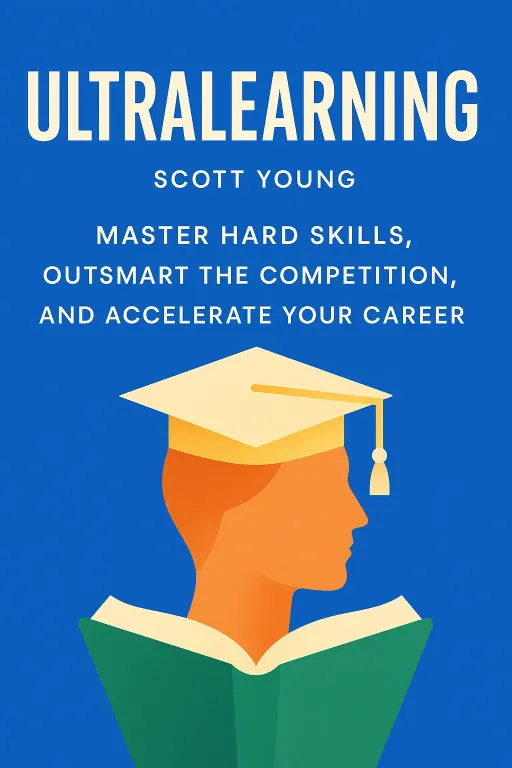
Nova: Exactly! And today, we're dissecting this paradox through the lenses of two incredible books: Scott H. Young's and Josh Waitzkin's. These aren't just books; they're manifestos for a new era of brain-optimized learning, fundamentally shifting how we approach skill acquisition in a world drowning in data.
Atlas: Okay, 'brain-optimized learning' sounds like exactly what our 'Deep Diver' and 'Growth Architect' listeners need. But how do these books actually tackle this cognitive overload? Where do we even begin to untangle that firehose?
The Cognitive Overload Trap and Ultralearning's Directness
SECTION
Nova: We begin by understanding that the traditional model of passive learning – just consuming information – is often the culprit. It creates this illusion of progress, but it rarely leads to true mastery. Scott H. Young, in, makes a powerful case for what he calls 'directness.'
Atlas: Directness? In learning? So you’re saying it's not about consuming information, it's about consuming? Or perhaps not consuming at all, but doing?
Nova: Precisely. Young argues for intense, self-directed learning to acquire tough skills quickly. And the core of that is directness in application. Instead of reading a skill, you the skill. It's about immersing yourself, getting your hands dirty, and iterative experimentation.
Atlas: Can you give an example? Like how would this play out for, say, a Computer Vision engineer trying to learn a brand-new framework? Because I imagine a lot of our listeners are facing that exact challenge right now.
Nova: Absolutely. Imagine our CV engineer. The old way: they’d spend weeks reading all the documentation, watching every YouTube tutorial the framework, trying to understand every nuance before they even write a line of code. They're trying to build a perfect mental model first.
Atlas: Sounds logical, right? Understand before you act.
Nova: It logical, but it's often a trap. The way, applying directness, is completely different. Our engineer would immediately try to build a small, functional component with that new framework. Maybe just loading an image and applying a basic filter. It will be messy. It will break. They'll have to look up simple things constantly.
Atlas: That sounds rough, but… also like how I often learn best, honestly. Just dive in and flail.
Nova: Exactly! The of the old way's failure is that passive consumption creates a gap between knowledge and application. The of directness is immediate hands-on work, even with mistakes. You're forcing your brain to engage with the actual problem, not a theoretical abstraction. The is significantly faster skill acquisition, a much deeper and more intuitive understanding, and paradoxically, less long-term frustration because you're building real competence. You're learning what you need to know, not what someone you need to know.
Atlas: That’s a great way to put it. So, if I want to master a new deep learning architecture, I shouldn't just read papers for weeks, but actually try to implement a small part of it right away, even if I don’t fully grasp the math yet?
Nova: That's the spirit of it. You're forcing the knowledge to become active right away. Young emphasizes immersion – surrounding yourself with the subject, and iterative experimentation – which means trying, failing, analyzing, and trying again. It’s about pushing past that comfort zone into active application.
Atlas: That sounds great in theory, but for someone in a high-stakes tech environment, 'messy' learning might feel risky. Isn't there a fear of not doing it 'right' or wasting valuable time? I imagine a lot of our listeners feel pressure to deliver polished results, not experiment.
Nova: That's a very valid concern. But consider the hidden time cost of the "perfect preparation" approach. How many hours are spent passively consuming information that you then forget because you never applied it? The "messy" experimentation of ultralearning is actually highly efficient. It's not about being reckless; it's about being strategic with your mistakes, using them as immediate feedback loops. It's the difference between reading a textbook on swimming and actually getting in the pool. You'll splash, you'll swallow water, but you'll learn to swim much faster.
Mastering Fundamentals: The 'Art of Learning' in a Complex World
SECTION
Nova: While Young pushes us to dive in, Josh Waitzkin, a chess prodigy and martial arts champion, in, shows us to dive in, and more importantly, to focus that intense energy. He highlights the importance of 'making the small bigger' – a deep focus on fundamentals.
Atlas: Okay, so Young says 'do it,' and Waitzkin says 'do the of it really, really well.' That’s an interesting complement. What does 'making the small bigger' actually mean in a practical sense?
Nova: Waitzkin's insight comes from his journey to mastery in both chess and martial arts. He didn't just memorize openings in chess; he spent countless hours mastering subtle pawn structures and specific endgames. In martial arts, he would perfect a single punch or block until it was effortless, versatile, and could be applied in a myriad of situations. The of many people's stagnation is the illusion that complexity requires only complex solutions.
Atlas: Right, like if my deep learning model isn't performing, I should immediately try a new, more complex architecture instead of re-evaluating my data preprocessing or my loss function.
Nova: Precisely. Waitzkin's is about isolating a fundamental, deconstructing it, practicing it to absolute mastery, and then integrating it seamlessly. This isn't about rote repetition; it’s about understanding the and the at the deepest level. The is profound understanding, incredible adaptability, and the ability to innovate, not just replicate. For optimizing CV algorithms, this means understanding the core principles of neural networks, how gradient descent actually works, or the nuances of different loss functions, rather than just treating off-the-shelf libraries as black boxes.
Atlas: That's a great analogy. I imagine a lot of our listeners, especially those optimizing CV algorithms, might be tempted to jump straight to the latest, flashiest model or the most cutting-edge paper. How does 'making the small bigger' apply there, when the pressure is to always be on the bleeding edge?
Nova: It applies directly. The bleeding edge is built on fundamentals. If you don't deeply understand the core principles of, say, backpropagation or convolution operations, you're just tweaking parameters blindly. Waitzkin would argue that true innovation comes from understanding those foundational elements so thoroughly that you can then see new ways to combine or apply them. It's about building an unshakeable base. It allows you to troubleshoot, to invent, to adapt when the next "flashy" model inevitably comes along.
Atlas: That's actually really inspiring. It feels like it gives permission to slow down on the basics, which can feel counter-intuitive when the tech world moves so fast. It's like building a skyscraper – you can't just keep adding floors without a rock-solid foundation. But what's the synthesis here? How do these two approaches – 's directness and 's focus on fundamentals – work together to solve the cognitive overload problem?
Synthesis & Takeaways
SECTION
Nova: They're two sides of the same coin, Atlas. gives us the – to stop procrastinating with passive consumption and actually the thing we want to learn. then gives us the. It's not just about direct effort; it's about direct effort.
Atlas: So, the message is: don't just passively consume, but actively build, and while you're building, intentionally seek out and master the tiny, foundational pieces until they become second nature. That sounds like a powerful recipe for true mastery, not just surface-level understanding, and a real antidote to that feeling of overwhelm.
Nova: Exactly. It's how you shift learning from passive consumption to active, high-leverage skill acquisition, directly impacting your engineering prowess and preventing that insidious burnout. It's about making every learning minute count, building competence and confidence one focused step at a time.
Atlas: That’s a fantastic, actionable challenge. It's about trusting your inherent capability and celebrating those small wins, which I know our 'Resilient Explorer' listeners will appreciate. It really does make you rethink how you approach every new concept.
Nova: So, for our 'Deep Diver' listeners out there, here's your 'Tiny Step' for this week: Choose one core Computer Vision concept you want to master. Just one. And for 30 minutes, apply a 'directness' learning strategy from. Don't just read about it; try to implement a tiny piece of it, directly. See what happens.
Atlas: And let us know how it goes! That's the kind of intentional action that truly drives growth, and frankly, makes learning exciting again.
Nova: This is Aibrary. Congratulations on your growth!









