Stop Rote Learning, Start Deep Understanding: The Guide to Lasting Knowledge.
Golden Hook & Introduction
SECTION
Nova: Atlas, give me a five-word review of how most people typically try to learn new things – be brutal.
Atlas: Re-read. Forget. Frustrate. Repeat. Ugh.
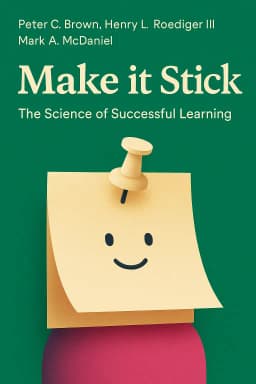
Nova: Exactly! And that 'ugh' is precisely what we're tackling today. That feeling of hitting your head against a wall, thinking you're being productive, but the knowledge just… evaporates. We're diving into some truly groundbreaking work that fundamentally shifts our understanding of learning. We'll be pulling insights from two phenomenal books: 'Make It Stick' by the cognitive scientists Peter C. Brown, Henry L. Roediger III, and Mark A. McDaniel, and then layering in the real-world application from Scott H. Young's 'Ultralearning.'
Atlas: Oh, I like that. So it's like the scientific blueprint meets the extreme adventurer who built a skyscraper with it?
Nova: That’s a perfect analogy! What’s so compelling is that 'Make It Stick' distills decades of rigorous research into how our brains actually learn, and 'Ultralearning' showcases how a self-taught polymath applied these exact principles to master skills like programming, languages, and even an entire university curriculum in months, not years. It's about going from theory to radical practice.
Atlas: Wow. So it’s not just academic, it’s intensely practical for anyone who wants to learn anything.
Nova: Absolutely. The core of our podcast today is really an exploration of how we can move beyond superficial learning to cultivate deep, lasting knowledge that truly sticks. Today we'll dive deep into this from two perspectives. First, we'll explore why our traditional learning methods often fail us, then we'll discuss the counterintuitive strategies that actually build stronger, more durable memories.
The Illusion of Familiarity vs. Deep Understanding
SECTION
Nova: So, let's start with a common scenario. You're studying, maybe for an exam, or trying to grasp a new concept for work. You read a chapter, then you go back and re-read it, maybe highlight some key passages. It feels good, right? You recognize the words, the concepts seem familiar. You think, "Yep, I got this."
Atlas: Oh, I've been there. Honestly, that sounds like my Monday mornings. I highlight, I underline, I might even make little notes in the margin. It feels like I'm making progress, like I'm absorbing it.
Nova: And that, Atlas, is the illusion. It's what 'Make It Stick' calls the "fluency illusion." The mere act of re-reading or highlighting creates a sense of familiarity. Your brain sees the information again and says, "Hey, I've seen this before!" But familiarity is not the same as understanding, and it's certainly not the same as being able to retrieve that information when you actually need it.
Atlas: Wait, so you're telling me all those hours I spent highlighting textbooks and re-reading notes... that felt so productive... was actually a waste? My brain was lying to me?
Nova: Precisely! It's our brain's sneaky way of making us feel good without doing the heavy lifting. The book describes experiments where students who simply re-read material like they knew it better, they were more confident, but they performed significantly worse on tests than those who used more challenging methods.
Atlas: That’s incredible. But why does it so good? It’s like comfort food for the brain, right? Why do we gravitate towards it if it's so ineffective?
Nova: It’s because it's easy. It's low-effort. And our brains, like all good energy-conserving machines, love efficiency. When you re-read, the material looks familiar. That familiarity like understanding. But it's just recognition. It's like seeing a friend's face in a crowd versus being able to recall their entire life story, their phone number, and their favorite coffee order. One is passive recognition, the other is active retrieval and deep understanding.
Atlas: I can definitely relate. I’ve often found myself nodding along while reading something complex, thinking I get it, only to draw a blank when someone asks me to explain it in my own words. It’s a bit humbling, to be honest.
Nova: It is, but it's also a crucial insight. The problem isn't our intelligence; it's our strategy. We’re often using strategies that create a fragile grasp of new ideas, causing real progress to feel incredibly slow. We mistake the ease of processing for the depth of learning. The more fluent something feels to us in the moment of study, the less likely we are to truly remember it long-term.
Atlas: So the comfortable path is actually the less effective path. That's a counterintuitive thought right there. It completely upends how I've approached learning for years. It's almost like our brains are designed to trick us into thinking we've learned something when we haven't.
Effortful Learning: The Counterintuitive Path to Mastery
SECTION
Nova: That’s a great way to put it, Atlas. Our brains aren't trying to trick us, but they are incredibly efficient, and they will take the path of least resistance unless we deliberately challenge them. So, if passive consumption is the problem, what's the solution? It’s about making learning in the short term, for massive gains in the long term. This is where 'Make It Stick' introduces concepts like retrieval practice and spaced repetition, and where 'Ultralearning' offers a masterclass in their application.
Atlas: Harder? That sounds a bit out there, especially for someone who feels like they're already working hard to learn. What does 'harder' even mean in this context?
Nova: It means active engagement, Atlas. It means forcing your brain to something with the information, not just passively absorb it. Think about the "Testing Effect" – another core principle from 'Make It Stick.' In experiments, students who were frequently tested on material, even if they struggled and failed some of the questions, retained that information far better than those who only re-studied. The act of to retrieve information, even when it's difficult, strengthens the memory trace.
Atlas: So the struggle, the effort of trying to pull the information out of your brain, even if you don't quite get it right... that's the workout?
Nova: Exactly! It's your brain building those neural pathways. It's like lifting weights – the muscle soreness means growth. The struggle the learning. Scott Young, the ultralearner, embodies this. When he was tackling a new programming language, he didn't just read the manual. He immediately tried to something with it, forcing himself to recall syntax, debug errors, and actively problem-solve. He didn't wait until he felt "ready." He jumped in, struggled, and learned exponentially faster because of that struggle.
Atlas: Okay, so how do we actually this? What does 'effortful learning' look like in my daily life? I'm not a cognitive scientist, and I'm certainly not an ultralearner trying to learn Mandarin in three months.
Nova: That's the beauty of it – it's surprisingly simple and accessible. The Tiny Step we often recommend, for instance: after reading a chapter, close the book and write down everything you remember for five minutes. That's retrieval practice. You're forcing your brain to recall, to reconstruct the information. It’s far more effective than re-reading. Or, explain what you just learned to someone else, or even to an imaginary person. If you can explain it clearly, you truly understand it.
Atlas: Right, like forcing your brain to the information, not just recognize it. But isn't that... frustrating sometimes? When you can't remember something you just read?
Nova: Absolutely! And that frustration is actually a good sign. It means you're at the edge of your knowledge, and that's where the most powerful learning happens. Embrace that momentary discomfort. It's the signal that your brain is creating stronger, more durable connections.
Atlas: That makes sense. So, the discomfort is part of the process. And then there's spaced repetition... is that just reviewing flashcards every now and then?
Nova: It’s smarter than that. It's reviewing at intervals. If you learn something today, review it tomorrow, then in three days, then a week, then a month. Each time you successfully retrieve it, the memory gets stronger, and your brain signals that it can wait longer before the next review. It's about optimizing the forgetting curve, ensuring that just as you’re about to forget, you bring it back to mind, reinforcing it. Think of it like a memory workout schedule, tailored to your brain's needs. Scott Young used this extensively, meticulously scheduling his review sessions to maximize retention across vast amounts of information.
Atlas: That completely shifts the perspective. It’s not about how many times you see something, but how many times you it, and at the right moments. It's almost like you're training your brain to be a better retrieval artist.
Synthesis & Takeaways
SECTION
Nova: Precisely, Atlas. The profound insight from 'Make It Stick' and 'Ultralearning' is that we need to actively difficulty into our learning process. The familiar, easy path of passive review creates an illusion of knowing, leading to fragile, quickly forgotten knowledge. The harder, more effortful path of retrieval practice and spaced repetition – the act of struggling to recall and applying that knowledge – is what builds robust, lasting, and flexible understanding.
Atlas: That’s actually really inspiring. It means we have more control than we think. It’s not about being 'smart enough,' it’s about learning 'smart enough.' For anyone who's ever felt stuck in a learning rut, endlessly re-reading without progress, this is a game-changer. It’s about replacing that 'ugh' with a 'yes, I can do this.'
Nova: Absolutely. It’s a call to action for every curious learner, every deep thinker. So, for our Tiny Step, the one actionable thing you can do tomorrow: after reading a chapter, or listening to a new concept, close the book or turn off the podcast, and for five minutes, write down everything you remember. Don't look back until the five minutes are up.
Atlas: That sounds simple, but powerful. It forces you to engage, to actually the learning.
Nova: Exactly. It's a small act of effortful learning that will pay dividends in deep, lasting knowledge. It's how you stop rote learning and start deep understanding.
Nova: This is Aibrary. Congratulations on your growth!