Stop Rote Learning, Start Deep Understanding: The Guide to Lasting Knowledge.
Golden Hook & Introduction
SECTION
Nova: You’ve poured hours into studying, highlighting every paragraph, re-reading chapters until your eyes blurred. You felt productive, even brilliant, in the moment. Only to find, a week later, that the knowledge has vanished like a whisper in the wind. Sound familiar?
Atlas: Oh, Nova, that sounds less like a question and more like a personal attack on my entire academic history! I’ve been there, staring blankly at a page, convinced I knew it, then utterly failing to recall a single detail. It’s infuriating. What's going on? Is my brain just… broken?
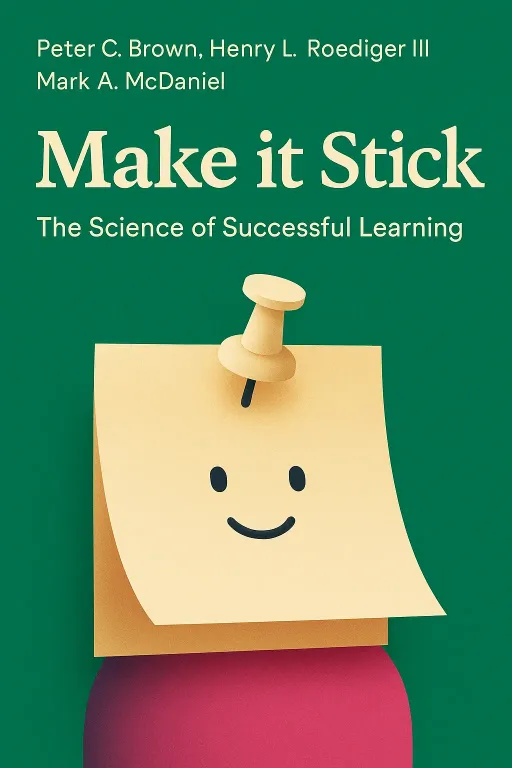
Nova: Absolutely not broken, Atlas! Your brain is just operating on a set of assumptions that, frankly, science has proven wrong. Today, we're diving into some groundbreaking insights, particularly from the cognitive scientists Peter C. Brown, Henry L. Roediger III, and Mark A. McDaniel, authors of the seminal book,. They, along with ultralearning expert Scott H. Young, essentially flip our traditional understanding of learning on its head.
Atlas: ? That’s a bold title if what you’re saying is true – that most of us are doing it all wrong. What makes their perspective so different, and why haven't we heard this before?
Nova: Well, it’s not that it hasn’t been said, but rather that old habits die hard, and the illusion of knowing is incredibly powerful. Their work, particularly in, challenges the very foundation of how we've been taught to learn. They're not just offering tips; they're revealing a fundamental mismatch between our intuitive study methods and how our brains actually build lasting knowledge. And that, Atlas, leads us directly to our first big dive.
The Illusion of Fluency: Why Rote Learning Fails Us
SECTION
Nova: Think about it: when you re-read a textbook chapter, the material feels familiar, right? Your brain recognizes the words, the concepts. That feeling of recognition? It’s profoundly misleading. It’s what cognitive scientists call the "illusion of fluency."
Atlas: Oh, I know that feeling! It’s like I’m nodding along, thinking, "Yep, got it, makes perfect sense." Then the book closes, and suddenly, my mind is a complete blank. What exactly is the brain doing there? Why does it trick us like that?
Nova: It's a subtle but critical distinction. Our brains are incredibly efficient pattern-matchers. When you re-read, your brain says, "Hey, I've seen this before!" and registers that familiarity as understanding. But it’s not understanding; it’s merely recognition. True understanding and retention come from, from actively retrieving that information from memory, not just passively re-exposing yourself to it.
Atlas: That makes sense, but it also feels a bit cruel! So, for someone who loves diving deep into complex topics, constantly seeking new knowledge, this is a massive trap. You think you're absorbing intricate details, but it's just washing over you, leaving no real imprint. Can you give me an example of how this plays out in real life?
Nova: Absolutely. Imagine a classic experiment: two groups of students are given material to learn. Group A is told to re-read the text multiple times, highlighting key passages. Group B is told to read it once, then immediately try to recall everything they can, maybe even writing it down, without looking at their notes.
Atlas: My money’s on Group A. They put in more time, more effort, more exposure.
Nova: That’s what most students would predict, and crucially, what most students in the moment. Group A, the re-readers, consistently report feeling more confident about their understanding. They feel incredibly fluent with the material. But when tested a week later, Group B, the students who practiced active recall, consistently perform better, often significantly so. Their initial effort felt harder, less fluent, but it built stronger, more durable memories. The cause was passive repetition, the process was superficial engagement, and the outcome was poor retention despite high perceived effort and confidence.
Atlas: Wow. That’s actually kind of heartbreaking for anyone who's ever burned the midnight oil with a highlighter in hand. It’s not just inefficient; it’s actively misleading. So, how do we break free from this cycle of well-intentioned but ultimately futile study habits?
Unlocking Lasting Knowledge: The Power of Active Engagement
SECTION
Nova: Well, this is where the good news comes in! The same cognitive science that reveals our learning flaws also gives us the blueprint for true mastery. This is where insights from, and also Scott H. Young’s, become incredibly powerful. Young, who is himself a master of intense, self-directed learning, really exemplifies how these principles can accelerate skill acquisition.
Atlas: Ultralearning? That sounds intense. Is this just for prodigies, or can a regular curious learner, someone like me who just wants to genuinely understand new fields, actually apply this? It sounds a bit intimidating.
Nova: Not intimidating at all, Atlas, quite the opposite! It's about working smarter, not necessarily harder in the traditional sense. The core idea is active engagement. Let's break down a few key strategies:
Nova: First, and perhaps most powerful, is. This is simply the act of self-testing—forcing your brain to recall information without any notes or prompts. Instead of re-reading that textbook, close the book and try to explain the main concepts out loud, or write down everything you remember.
Atlas: So, it's like trying to remember the plot of a movie you saw last year without looking it up? That's definitely harder than just re-watching it.
Nova: Exactly! That struggle, that effort to retrieve, is precisely what strengthens the neural pathways and makes the memory more robust. It's like exercising a muscle. Then there's. Instead of cramming, you review material at increasing intervals. A little bit today, a little more tomorrow, a bit next week. This leverages the "spacing effect," where memories are consolidated more effectively over time.
Atlas: I guess that makes sense. It's like watering a plant just enough, not drowning it. You give it time to absorb and grow.
Nova: Precisely. And finally,. This means mixing different types of problems or topics in a single study session, rather than focusing on one topic until mastery. If you're learning coding, don't do 20 problems of just 'loops,' then 20 of 'variables.' Mix them up.
Atlas: Wait, so it's not about how time I spend, but I spend it? And it sounds like these methods are actually in the moment, less comfortable than just passively reviewing. That's counterintuitive.
Nova: It absolutely is, initially. The short-term performance might even feel a bit slower, a bit more challenging. But the long-term gains are immense. Think of it this way: someone trying to master a new language. If they just passively listen to conversations, they'll recognize words, but they won't it. If they actively try to construct sentences, even if they make mistakes, they're engaging in retrieval practice, direct practice, and getting feedback. That's how Scott Young was able to learn new languages in months. The initial struggle is the learning itself. It’s what builds genuine understanding and transferability, not just memorization.
Synthesis & Takeaways
SECTION
Nova: So, what we're really talking about here is a fundamental shift from viewing learning as passive intake to active engagement. It's about understanding that your brain isn't a bucket to be filled, but a complex network to be strengthened and rewired. True mastery comes from understanding how your brain actually works, not just memorizing facts.
Atlas: That’s actually really inspiring. It's not just about learning facts; it's about fundamentally changing our relationship with knowledge. It’s empowering for anyone who’s ever felt frustrated by their learning process. This approach gives them the tools to genuinely and new information, no matter how complex.
Nova: Absolutely. And the best part is, you can start small. That "tiny step" we talked about? Tomorrow, when you're reviewing something new, try to recall the main points you look at your notes. Just that simple act of retrieval practice, even for a minute or two, will strengthen those memory circuits and prove to you the power of active learning.
Atlas: I love that. It makes the grand idea of "ultralearning" feel accessible, something we can all integrate into our daily quest for knowledge. It’s truly about building a mind that can genuinely grasp and grow.
Nova: This is Aibrary. Congratulations on your growth!