

Beyond Rote Learning: Cultivating Deep Understanding for Lasting Impact
Golden Hook & Introduction
SECTION
Nova: What if everything you thought you knew about learning, about how to truly understand something, was fundamentally wrong? We're not talking about just getting bad grades, but about building knowledge so fragile it crumbles the moment you need it most.
Atlas: Oh, I love that as an opener, Nova! Because honestly, that resonates so deeply with that frustrating feeling of studying for hours, feeling totally prepared, and then… blank. Like, the knowledge just evaporates under pressure.
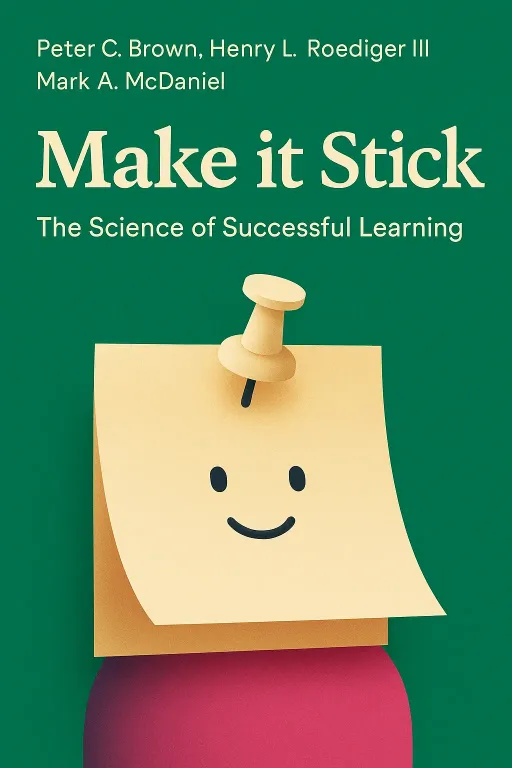
Nova: Exactly! And that "cold fact" is where we kick off our dive into cultivating deep understanding for lasting impact. Today, we're really unpacking the profound insights from “Beyond Rote Learning,” heavily drawing on the seminal work,, by Peter C. Brown, Henry L. Roediger III, and Mark A. McDaniel.
Atlas: Ah,. A true game-changer.
Nova: Absolutely. What’s fascinating is that this book emerged from a truly interdisciplinary collaboration—a cognitive scientist, an experimental psychologist, and a science writer. They blended rigorous academic research with accessible storytelling to fundamentally shift how we perceive and approach learning. Their work really forms the bedrock of understanding why our traditional study habits often fail us.
Atlas: That’s a great way to put it, Nova. Because for anyone out there who identifies as an Ideologue, an Analyst, or a Seeker—someone driven by truth, building frameworks, trying to connect those threads of understanding—this idea of fragile knowledge must hit hard. What exactly do you mean by confusing familiarity with true understanding?
The Illusion of Familiarity vs. True Understanding
SECTION
Nova: It's a classic trap, Atlas. We all fall for it. Imagine you're reading a textbook or your notes. You highlight, you re-read, and as you go over the material, it starts to feel… familiar. You recognize the words, the concepts, and your brain says, "Yep, got it!" But that feeling of familiarity is deceptive. It's like having a friend you see often but never really talk to deeply. They look good on the surface, but they’re not there for you when you actually need support.
Atlas: That makes perfect sense. I can see how that would be a huge problem for someone who's trying to build robust mental models or analyze complex systems. If your foundational knowledge is just a superficial recognition, your entire framework could be built on quicksand. Can you give us a concrete example of how this plays out, maybe in a common academic scenario or even just everyday learning?
Nova: Of course. Think about the classic student scenario: cramming. Most students will sit down before an exam and re-read their notes, perhaps for hours straight. They feel a surge of confidence because the material is right there, fresh in their short-term memory. They might even ace a practice quiz immediately after.
Atlas: Oh, I’ve been there! That feeling of "I've got this!"
Nova: Exactly! But then, a few days later, or worse, a few weeks later when they need to build on that knowledge, it's gone. The confidence was an illusion. The book highlights how this 'massed practice'—cramming—leads to knowledge that decays incredibly rapidly. It’s a very fragile kind of knowing.
Atlas: But wait, why does that feel so productive at the time? I mean, it like you’re learning, like you’re doing the work. Isn't there something to be said for the sheer volume of exposure? It sounds a bit out there to say that feeling easy actually makes it less effective.
Effortful Retrieval & Spaced Repetition: The Science of 'Making It Stick'
SECTION
Nova: That feeling of ease, Atlas, is precisely the problem. The authors of explain that true learning, the kind that creates durable and adaptable knowledge, requires. It's about effortful retrieval practice. Instead of passively re-reading, you actively try to recall information from memory. This struggle, this mental exertion, is what strengthens the neural pathways and makes the memory more robust.
Atlas: So you’re saying the harder it feels, the more effective it actually is? That’s kind of counter-intuitive, especially for people who might be used to seeking efficiency in their learning. For our listeners who are constantly connecting information and trying to build frameworks, how does this 'effortful retrieval' translate into practical strategies beyond just flashcards?
Nova: That’s a great question, Atlas. Beyond simple recall, it involves strategies like spaced repetition—distributing your learning over time rather than cramming—and interleaving, which means mixing up different subjects or types of problems. These techniques force your brain to work harder to retrieve information, making the learning stick. It's not just about recalling facts; it's about retrieving the and too. This is crucial for the "Analyst" who needs to see the bigger picture.
Atlas: I can see how that would build stronger frameworks. If every piece of information is actively retrieved and re-contextualized, then your understanding becomes far more interconnected and resilient. But what about accelerating skill acquisition? For someone who wants to take that deep understanding and rapidly apply it to master new skills, where do these principles lead us?
Nova: That’s where we can look to Scott H. Young’s work in. He takes these principles of effortful learning and applies them to intense, self-directed projects. Young demonstrates that you can dramatically accelerate skill acquisition by immersing yourself deeply, often through direct application and immediate feedback.
Atlas: So, it’s not just about learning something, but about it, intensely? Like, if I want to learn to code, I shouldn't just read books, I should immediately start building an app, even if it's terrible at first?
Nova: Precisely. Young's ultralearning principles emphasize directness—learning by doing the thing itself—and also things like immersion and experimentation. It’s about creating a feedback loop where you’re constantly testing your understanding in a real-world context, getting immediate feedback on what works and what doesn't. Think of someone learning a new language by speaking it from day one, even if they make countless mistakes. That’s ultralearning in action.
Atlas: Wow, that’s actually really inspiring. Because for the Seeker, who is driven by a desire for truth and understanding, this provides a pathway to not just absorb knowledge, but to truly embody it and apply it to the forces that shape humanity. But how does someone, say, with a demanding job or limited time, actually begin to implement something that sounds so intense? What’s the tiny step for ultralearning?
Synthesis & Takeaways
SECTION
Nova: That’s the beauty of it, Atlas. The core message, drawing from both and, is that moving beyond passive consumption to active, effortful learning is the key to building robust and applicable knowledge. It's not necessarily about more hours, but about smarter, more engaged hours. It’s about making your learning active.
Atlas: That’s a great way to put it. It shifts the focus from simply "doing time" with the material to actually "engaging" with it in a way that forces your brain to work harder. And that’s going to resonate with anyone who struggles with feeling like their efforts aren’t leading to lasting understanding.
Nova: Exactly. So, for that tiny step you asked about, something anyone can do tomorrow to start applying these powerful insights, it's incredibly simple but profoundly effective.
Atlas: I’m ready. What is it?
Nova: Tomorrow, instead of re-reading notes or articles, try to recall the main points from memory first. Just close the book, put away the notes, and see what you can remember.
Atlas: Oh, I love that. It immediately forces that effortful retrieval you talked about, right at the start. It's such a simple shift, but it fundamentally changes your relationship with the information you're trying to learn. It's about building knowledge that truly serves you, that's there when you need it most.
Nova: Absolutely. It’s a small step towards a much deeper, more impactful understanding.
Atlas: Incredible insights today, Nova.
Nova: This is Aibrary. Congratulations on your growth!









