

Beyond Memorization: The Art of Deep Learning for Lasting Knowledge
Golden Hook & Introduction
SECTION
Nova: Atlas, if you had to review 'school' in five words, what would they be? Just off the cuff.
Atlas: Oh, I love this game! Let's see... "Sit, listen, forget, cram, repeat." Yeah, that about sums it up for me.
Nova: Ouch! That's a brutally honest five words. And honestly, Atlas, that describes exactly what we're dissecting today. We're talking about how to move beyond that cycle, how to truly make knowledge stick, not just for the next test, but for life.
Atlas: I'm intrigued. Because for a long time, I thought I was a pretty good learner, but then you try to recall something a month later and it's just... gone. Like a phantom limb of knowledge.
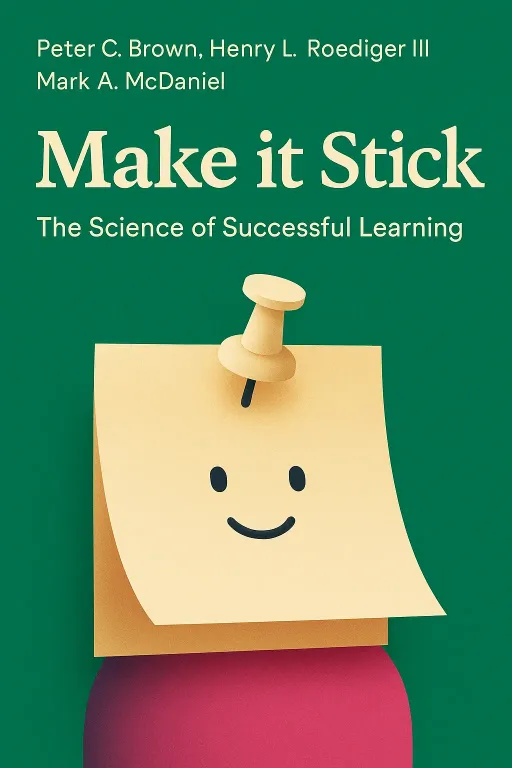
Nova: Exactly that. And much of that illusion of mastery comes from habits we think are productive. Today, we're diving into the brilliant insights from two landmark books: "Make It Stick: The Science of Successful Learning" by Peter C. Brown, Henry L. Roediger III, and Mark A. McDaniel, and "Ultralearning: Master Hard Skills, Outsmart the Competition, and Accelerate Your Career" by Scott H. Young.
Atlas: Those titles alone sound like they're going to challenge everything I thought I knew about learning.
Nova: They absolutely will. What's fascinating about "Make It Stick" is how it brings together a journalist, Peter Brown, with two eminent cognitive scientists, Roediger and McDaniel. This blend allows them to present rigorous, peer-reviewed research in a way that's incredibly engaging and accessible, making it a highly acclaimed and influential book across not just academic circles, but for anyone who wants to learn better. It’s a testament to how powerful science can be when it’s told as a compelling story.
Atlas: That’s a great combination. So, let's start with the big reveal. What's the biggest lie our brains tell us about learning?
The Illusion of Mastery: Why Common Study Habits Fail Us
SECTION
Nova: The biggest lie, Atlas, is that familiar equals learned. We fall into the trap of 're-reading,' 'highlighting,' or simply 'passively reviewing' material. It feels good. It feels productive. We recognize the words, we nod along, we think, "Aha! I know this!"
Atlas: Oh, I know that feeling. I'd read a chapter, then read it again, maybe highlight some key sentences. I'd feel this warm glow of understanding.
Nova: Exactly! That warm glow is the illusion. It’s like recognizing a path you’ve walked before. You see the landmarks, you know you’ve been there. But if I asked you to draw a detailed map of that path from memory, including every turn and elevation change, you’d likely struggle.
Atlas: Hold on. Are you saying my entire study strategy from college was basically a lie? All those hours spent re-reading textbooks?
Nova: Well, it wasn't a lie in the sense that you were intentionally deceiving yourself. It's more like a cognitive quirk. When you re-read, the material is right there. Your brain doesn't have to work hard to retrieve it. It just recognizes it. That recognition creates a feeling of fluency, a sense of familiarity, which we mistakenly interpret as deep understanding and retention. We confuse the ease of processing with actual learning.
Atlas: That sounds rough. So, it's like I can recognize the words on a page, but I can't actually anything with them when the book is closed. The knowledge isn't truly integrated.
Nova: Precisely. It’s like being able to identify a specific type of tree, but not being able to explain its root system, its life cycle, or its ecological role. You have surface-level recognition, but not the deep, connected understanding that allows you to apply or transfer that knowledge. The 'aha!' moment you get from re-reading quickly fades because it never forced your brain to build robust retrieval pathways. You're just taking the same well-worn path without forging new ones.
Atlas: That happened to me once. I was so sure I understood a complex coding concept after watching a tutorial a few times. Then, when I had to write the code myself from scratch, I froze. It was like the information just evaporated. I could recognize the solution if I saw it, but I couldn't it.
Nova: That’s a perfect example. The difference between recognition and recall is immense. Passive review is recognition. True learning, durable learning, is about recall. It's about strengthening the mental muscles required to pull that information out when you need it, not just when it’s presented to you. It's about building knowledge that's ready to be used, not just admired.
Atlas: So this illusion of mastery is almost insidious because it makes us feel good about doing something that's actually ineffective. It's a self-soothing lie.
Active Engagement: The Science-Backed Path to Durable Knowledge
SECTION
Nova: It absolutely is. And if passive review is a mirage, then active engagement is a wellspring. This is where "Make It Stick" really shines, championing methods like 'retrieval practice' and 'interleaving.' And Scott Young's 'Ultralearning' builds on this with concepts like 'directness' and 'drill.'
Atlas: Okay, so if re-reading is out, what's in? What does 'retrieval practice' actually mean for someone trying to learn something new?
Nova: Retrieval practice is essentially self-testing. It’s forcing yourself to recall information without looking at the source material. Instead of re-reading a chapter, you close the book and try to summarize everything you just read on a blank piece of paper. Or you use flashcards, but crucially, you don't just flip through them; you try to the answer before looking.
Atlas: So, for someone trying to learn a new language, what would retrieval practice actually look like, beyond just flashcards?
Nova: Great question. Beyond flashcards, it could be trying to explain a new grammar rule to an imaginary friend, or writing a short paragraph using only the new vocabulary you just learned, without checking your notes. Or even translating a simple sentence from your native language into the new one, purely from memory. The key is the of retrieval. Each time you successfully pull information from your memory, you're strengthening the neural pathways that lead to that information, making it easier to access next time. It’s like a muscle: passive review is looking at a dumbbell; retrieval practice is actually lifting it. The struggle is what builds the strength.
Atlas: That makes sense. The act of struggling to remember is actually the learning itself. What about 'interleaving'? That sounds a bit more abstract.
Nova: Interleaving is about mixing up different types of problems or subjects during your study session, rather than blocking out one topic entirely before moving to the next. For example, if you're learning different types of math problems – say, geometry, algebra, and calculus – instead of doing all your geometry problems, then all your algebra, then all your calculus, you mix them up. You might do a geometry problem, then an algebra, then a calculus, then back to geometry.
Atlas: How does interleaving just feel like chaotic multi-tasking? My brain usually prefers to focus on one thing at a time.
Nova: That's a common misconception and why it feels counterintuitive! It feels harder at first because your brain has to constantly switch gears, identify the type of problem, and then retrieve the correct strategy. But that very difficulty is what makes it effective. It helps you discriminate between different concepts and understand to apply which knowledge. Think of a chef learning to cook. If they only practiced chopping onions for a month, then only dicing carrots for a month, they’d be good at those individual tasks. But a chef who practices making diverse dishes, mixing different ingredients and techniques, learns how to and skills in context. Interleaving builds that adaptive flexibility.
Atlas: That’s a great analogy! So it’s not just about knowing the ingredients, but knowing how to combine them for a specific dish. And what about Scott Young's 'directness' and 'drill' from Ultralearning? How do they fit in?
Nova: Scott Young takes it even further. 'Directness' means learning by doing the thing itself, as much as possible. If you want to be a better public speaker, you don't just read books about public speaking; you get up and speak, even if it's just to a mirror or a small group. You embrace the context of the skill. And 'drill' is about intensely focusing on your weakest points, isolating specific components of a skill and practicing them relentlessly. It’s the deliberate practice that targets your bottlenecks.
Atlas: So, if I'm learning to code, 'directness' would be building actual projects, and 'drill' would be spending an hour just mastering a particularly tricky algorithm I keep messing up?
Nova: Exactly. It's about active, targeted engagement that forces your brain to grapple with the material in a meaningful way. These methods fundamentally restructure how information is stored and accessed in your brain, building stronger, more interconnected neural networks. This isn't just about studying smarter; it's about fundamentally changing your relationship with knowledge, turning temporary information into lasting, transferable wisdom.
Synthesis & Takeaways
SECTION
Atlas: This is actually really inspiring. It means that the discomfort we feel when learning something new, that struggle to recall or apply something, isn't a sign of failure. It's actually the learning happening.
Nova: Absolutely! The discomfort is the signal of true growth. Learning isn't about passive consumption; it's about active creation and productive struggle. The goal isn't just to accumulate facts, but to build a flexible mental model that allows for transfer and innovation. It’s about building knowledge that you can use to solve new problems, not just regurgitate old answers.
Atlas: So, for our curious listeners who are passionate about exploring new knowledge areas and enjoy deep thinking, what's a tiny step they can take after this episode to put these ideas into practice?
Nova: Here’s a simple one: after your next learning session, instead of immediately re-reading your notes or the chapter, grab a blank piece of paper. Set a timer for five minutes and try to recall everything you learned. Don't look at your notes. What did you remember? What did you miss? That act of trying to retrieve will tell you more about what you actually know than any amount of passive review ever could.
Atlas: That's a perfect example. It's simple, actionable, and it forces that active retrieval. It’s a bit scary to face the blank page, but I can see why it's so powerful.
Nova: It truly is. The blank page doesn't lie. It shows you where the real learning needs to happen. And that, my friends, is the art of deep learning for lasting knowledge.
Atlas: I'm ready to embrace the struggle.
Nova: This is Aibrary. Congratulations on your growth!









