

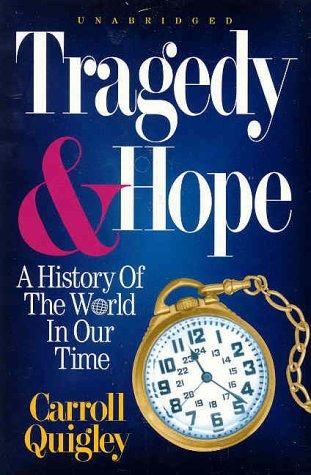
Tragedy and hope
Introduction
Nova: Imagine a book so revealing about the hidden machinery of global power that its own publisher allegedly destroyed the printing plates after the first edition. A book written not by a fringe theorist, but by a respected professor at Georgetown University who had been given two years of access to the secret records of the Council on Foreign Relations. That book exists. It's called Tragedy and Hope: A History of the World in Our Time, and its author, Carroll Quigley, spent 1,348 pages laying out what he discovered.
Nova: It's one of the enduring mysteries surrounding this book. Macmillan published it in 1966, but after the first edition, they refused to print a second edition despite strong demand. The plates were reportedly destroyed. Whether this was routine business or something more consequential depends on who you ask. But it's part of why first editions of Tragedy and Hope now sell for hundreds of dollars.
Nova: That's the fascinating part. Carroll Quigley held a PhD from Harvard. He taught at Princeton, then Harvard, and spent 35 years at Georgetown's School of Foreign Service. He consulted for the U. S. Department of Defense, the Navy, the Smithsonian, and even the congressional committee that helped create NASA. He won Georgetown's Faculty Award four years in a row. When he died in 1977, former students including a young Bill Clinton eulogized him as their most influential professor.
Nova: At its heart, Tragedy and Hope argues that a transnational network of Anglo-American elites — rooted in finance, media, academia, and government — has quietly shaped world events since the late 19th century. Not through overt conspiracy, but through coordinated influence. Quigley called it the "international Anglophile network," and he traced it back to a secret society founded by Cecil Rhodes and Alfred Milner in 1891. Today we're going to unpack this extraordinary book, separate fact from myth, and ask: what does Tragedy and Hope tell us about the world we live in now?
Who Was Carroll Quigley?
The Historian and His Magnum Opus
Nova: Carroll Quigley was born in Boston in 1910 and educated at Harvard, where he earned his BA, MA, and PhD in history. But what made him unusual was his methodological approach. He had early training in physics, and he brought that scientific mindset to historical analysis. He believed you could study civilizations the way a biologist studies organisms — identifying patterns, cycles, and structural dynamics.
Nova: Exactly. His earlier book, The Evolution of Civilizations, laid out that framework. Tragedy and Hope applied it to the period from roughly 1880 to 1963. The book is enormous — 1,348 pages covering military history, political developments, economic transformations, social movements, religious shifts, and intellectual trends. Quigley organized it around what he called the three major areas of any society: patterns of power, rewards, and outlooks.
Nova: Mixed, honestly. Kirkus Reviews called it "a staggering project" but complained about "appalling oversimplifications" in Quigley's extensive use of précis. The American Historical Review gave it a brief, polite notice. Historian Robert Rotberg later noted that the book "lacks the usual scholarly apparatus" and "cites nothing." Yet other scholars, like L. S. Stavrianos, took it seriously. The book sold $12.50 in 1966 — about $120 in today's money — and it found a dedicated audience that kept it alive long after mainstream academia moved on.
Nova: Absolutely. At Georgetown, Quigley taught a two-semester course on the development of civilizations from 1941 to 1972. According to his obituary in The Washington Star, many alumni said it was the most influential course of their undergraduate careers. Bill Clinton took it in 1965. When Clinton launched his presidential campaign in 1991, he stood at Georgetown and credited Quigley with teaching him that "the future can be better than the past, and that each of us has a personal, moral responsibility to make it so." Nancy Pelosi met her husband in Quigley's African history class.
The Secret Society at History's Center
The Round Table and the Rhodes Network
Nova: This is where things get genuinely remarkable. Quigley argued that in 1891, Cecil Rhodes — the British imperialist, diamond magnate, and namesake of the Rhodes Scholarship — created a secret society modeled on the Jesuit order. Rhodes believed passionately in Anglo-Saxon supremacy and wanted to bring the entire world under British rule. After his death in 1902, Alfred Milner, a high-ranking British administrator, expanded and formalized the organization.
Nova: Quigley described two concentric circles. There was an inner circle called "The Society of the Elect," and an outer circle called "The Association of Helpers" — also known as Milner's Kindergarten and the Round Table groups. The outer circle was semi-secret, meaning influential people knew about it but the general public did not. Quigley identified the group under various names it had used over the decades: the Rhodes crowd, the Times crowd, the All Souls group, and the Cliveden set.
Nova: Quigley assigned them primary credit for an extraordinary list of historical events: the Jameson Raid, the Second Boer War, the founding of the Union of South Africa, the transformation of the British Empire into the Commonwealth of Nations, and numerous British foreign policy decisions in the 20th century. He traced the leadership lineage: Rhodes and Milner from 1891 to 1902, Milner alone until his death in 1925, Lionel Curtis from 1925 to 1955, Robert Brand from 1955 to 1963, and Adam Marris from 1963 onward.
Nova: Here's the crucial passage from page 950 of Tragedy and Hope. Quigley wrote: "I know of the operations of this network because I have studied it for twenty years and was permitted for two years, in the early 1960s, to examine its papers and secret records. I have no aversion to it or to most of its aims and have, for much of my life, been close to it and to many of its instruments."
Nova: That's the paradox at the heart of this book. Quigley wasn't a whistleblower in the conventional sense. He admired much of what the network tried to accomplish. His objection wasn't to its goals but to its secrecy. He wrote: "My chief difference of opinion is that it wishes to remain unknown, and I believe its role in history is significant enough to be known." He believed the Anglo-American elite network had noble intentions — spreading liberal values, maintaining global stability — but he thought operating in secret was both wrong and ultimately counterproductive.
Nova: Quigley identified several: the Royal Institute of International Affairs in London, the Council on Foreign Relations in New York, and the Institute of Pacific Relations. He saw these as the outer layer through which the inner group exerted influence on policy, media, and education. He also described a consortium of central bank leaders who formed the Bank for International Settlements as part of this broader system of financial coordination.
Money as the Lever of Power
Financial Capitalism and the World System
Nova: If the Round Table network provided the coordinating intelligence, Quigley argued that financial capitalism provided the muscle. This is where Tragedy and Hope delivers its most quoted and most incendiary passage.
Nova: Exactly. Quigley wrote: "The powers of financial capitalism had another far-reaching aim, nothing less than to create a world system of financial control in private hands able to dominate the political system of each country and the economy of the world as a whole." He then explained that this system was to be "controlled in a feudalist fashion by the central banks of the world acting in concert, by secret agreements arrived at in frequent private meetings and conferences."
Nova: Quigley traced the story back to the late 19th century, when international banking families — the Morgans, the Rothschilds, and others — consolidated their influence over central banks and government finance. His argument was that they promoted two key ideological axioms: first, that money must be based on gold to preserve its value, and second, that control of the money system should be in the hands of bankers rather than politicians, because politicians were too subject to popular pressures.
Nova: That was Quigley's argument. He saw the gold standard as a mechanism that insulated monetary policy from democratic accountability. When a country was on the gold standard, its government couldn't print money to fund social programs or respond to economic crises without facing capital flight. The bankers held the ultimate veto. Quigley devoted extensive attention to this in a section of the book he titled "Financial Capitalism," which he described as of "overwhelming significance" with "ramifications and influences" that were "subterranean, and even occult."
Nova: Interestingly, no. Quigley argued that the power of international bankers declined sharply between 1931 and 1940, displaced by the rise of monopoly industrial capitalism and the growing strength of nation-states after the Great Depression and World War II. This is a point that many of his later interpreters completely ignored. He explicitly stated that the bankers "were much divided, often fought among themselves, had great influence but not control of political life and were sharply reduced in power about 1931-1940."
Nova: Right. And that distinction gets lost in nearly every popular treatment of his work. Quigley was describing a historical phenomenon that had peaked and receded, not an eternal conspiracy.
How the Book Was Misread and Weaponized
The Conspiracy Controversy
Nova: Here's the irony of Tragedy and Hope: Quigley wrote it partly to debunk the conspiracy theories of the radical right, and it ended up becoming their favorite source.
Nova: Quigley opened his discussion of the Round Table network by explicitly contrasting it with what he called the "radical Right fairy tale" — a myth that recent American history was a well-organized plot by extreme left-wing elements. He said: "This myth, like all fables, does in fact have a modicum of truth. There does exist, and has existed for a generation, an international Anglophile network which operates, to some extent, in the way the Radical right believes the Communists act." He was trying to say: you're looking in the wrong direction. It's not a communist conspiracy; it's an Anglo-American establishment network.
Nova: Precisely. In 1970, W. Cleon Skousen published The Naked Capitalist, which excerpted large portions of Tragedy and Hope and interpreted them as proof of a single, unified conspiracy for world domination. Then in 1971, Gary Allen of the John Birch Society published None Dare Call It Conspiracy, which became a massive bestseller and cited Quigley extensively. Allen connected Quigley's network to the Bilderberg Group, the Trilateral Commission, and even Richard Nixon. Later, Pat Robertson's The New World Order and Jim Marrs's Rule by Secrecy both used Quigley as an authority.
Nova: He was withering. About Skousen, he said: "Skousen's book is full of misrepresentations and factual errors. He claims that I have written of a conspiracy of the super-rich who are pro-Communist and wish to take over the world and that I'm a member of this group. But I never called it a conspiracy and don't regard it as such." He noted that Skousen's program "has echoes of the original Nazi 25 point program." About Gary Allen, he said Allen and others "constantly misquote me" — for example, claiming that Milner helped finance the Bolsheviks, which Quigley said he had found no evidence for despite going through Milner's private papers.
Nova: That's the tragedy within Tragedy and Hope. Quigley believed in transparency, not in lurid conspiracy theories. He thought understanding how power actually works would help citizens make better democratic decisions. Instead, his book became ammunition for people who saw hidden hands everywhere. One reviewer at the journal Dialogue put it well: Quigley "unintentionally made" Americans realize "the utter contempt which the network leaders have" for ordinary people, but the radical right twisted that into a simplistic good-versus-evil narrative.
Nova: Absolutely. The fact that Macmillan allegedly destroyed the printing plates and wouldn't issue a second edition, despite demonstrated demand, became part of the lore. It seemed to confirm that powerful interests wanted to suppress the book. Whether that's what actually happened or whether it was an ordinary business decision remains disputed, but the optics were terrible.
Weapons, Civilizations, and Inclusive Diversity
The Big Ideas Beyond the Secrets
Nova: It would be a disservice to Tragedy and Hope to reduce it entirely to the secret society material. Quigley had a genuinely original mind, and the book contains some fascinating analytical frameworks that deserve attention on their own terms.
Nova: Take his weapons-democracy thesis. Quigley argued that the single most important predictor of whether a society will be democratic is the nature of its weapons. When the most effective weapons are cheap and easy for individuals to obtain and use — like rifles in the 19th century or the simple weapons of ancient Greek citizen-soldiers — democracy flourishes. When weapons become expensive and require specialist training — like tanks, bombers, and nuclear systems — power concentrates in the hands of the state and its military specialists.
Nova: It is, and it comes from Quigley's training in physics and his work as a consultant to the U. S. Navy and the Department of Defense. He argued that World War I was so catastrophically bloody precisely because of a mismatch: citizen-soldier armies armed with rifles had to charge defensive positions fortified with machine guns. The weapons had changed, but the political system — mass mobilization — hadn't adapted. That mismatch produced the slaughter.
Nova: Quigley's big idea was the distinction between "instruments" and "institutions." Societies create instruments — social arrangements designed to meet real human needs. Over time, those instruments become institutions — organizations that serve their own perpetuation rather than the needs they were created to address. The classic example is a bureaucracy that starts out efficient and helpful and gradually becomes rigid, self-serving, and obstructive. Quigley saw this as the universal mechanism of civilizational decline.
Nova: He called it "inclusive diversity." Quigley believed that the distinctive genius of Western civilization was its capacity for pluralism — different ideas, different ways of life, competing perspectives that could coexist and generate creative tension. He contrasted this with the dualism of Plato, which he saw as dividing the world into rigid categories of truth and falsehood, good and evil. He ended Tragedy and Hope with the hope that the West could "resume its development along its old patterns of Inclusive Diversity." He wrote that the West "believes in diversity rather than in uniformity, in pluralism rather than in monism or dualism, in inclusion rather than exclusion, in liberty rather than in authority, in truth rather than in power."
Nova: It's why reducing Quigley to the secret-society guy misses so much. He was a complex thinker who believed deeply in democratic values. His critique of elite secrecy was an expression of his democratic faith, not a rejection of it. He wanted the network's activities to be known so that citizens could evaluate them, debate them, and decide whether they served the public good.
Conclusion
Nova: So where does that leave us with Tragedy and Hope? It's a book that resists easy categorization. It's too scholarly to be dismissed as conspiracy literature, yet too provocative to be comfortably absorbed into mainstream historiography. It reveals genuine insider knowledge about elite networks, but it's been so heavily appropriated by conspiracy theorists that many serious readers won't touch it.
Nova: I'd say three things. First, Quigley was right that networks of powerful people do coordinate across institutions — across finance, media, government, and academia. That's not a conspiracy; it's how power works in complex societies. Understanding those networks is essential to understanding modern history. Second, Quigley's analytical frameworks — the role of weapons in shaping political systems, the instrument-to-institution decay pattern — remain genuinely useful tools for thinking about the world. Third, and perhaps most importantly, Quigley's example reminds us that transparency is a democratic value in itself. His core objection to the network was not its goals but its secrecy.
Nova: That's beautifully put. Quigley closed his massive work with the conviction that "war and depression are man-made, and needless." He believed we could do better if we understood the forces shaping our world. In an era of renewed anxiety about hidden influence, algorithmic manipulation, and concentrated wealth, Tragedy and Hope feels more relevant than ever. The book is out of print from its original publisher, but it's widely available in used copies and digital formats. If you're willing to tackle 1,348 pages of dense, opinionated, sometimes maddening history, you might find it changes how you see the world.
Nova: This is Aibrary. Congratulations on your growth!