

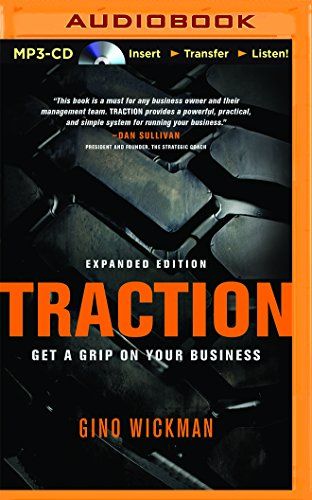
Traction
Introduction
Nova: Have you ever felt like you are working eighty hours a week, running as fast as you can, but your business is basically standing still? It is like being on a treadmill that someone else is controlling, and they keep bumping up the speed while you are just trying to keep your balance.
Nova: Exactly. Gino Wickman calls that the entrepreneurial whirlwind. And he wrote a book called Traction to provide the antidote. It is built around something called the Entrepreneurial Operating System, or EOS. It is not just a bunch of management theories; it is a literal manual for how to run a company without losing your mind.
Nova: It is much more than a to-do list. It is a holistic system. Wickman actually developed it after taking over his family's struggling business when he was only twenty-five. He turned it around, sold it, and then spent years studying what makes small to mid-sized businesses actually scale. Today, over a hundred thousand companies use these tools.
Key Insight 1
The Vision and the People
Nova: The first step in the EOS model is Vision. But Wickman argues that most companies fail here because their vision is too vague. To solve this, he uses a tool called the V/TO, or Vision/Traction Organizer. It forces the leadership team to answer eight specific questions, like What are your core values? and What is your ten-year target?
Nova: It is a north star. If you don't know where you are going in ten years, you can't decide what to do in three years, which means you can't decide what to do this year. The V/TO simplifies everything down to two pages. No hundred-page business plans that nobody reads. It is about getting everyone on the same page, literally.
Nova: This is where it gets a bit uncomfortable for some. Wickman talks about the People Component. He says you need the right people in the right seats. To figure this out, he uses the People Analyzer. It rates employees based on your core values to see if they fit the culture, and then it uses a framework called GWC.
Nova: Get it, Want it, and have the Capacity to do it. Do they truly understand the role? Do they wake up wanting to do it? And do they have the mental, physical, and emotional capacity to actually excel at it? If the answer to any of those is no, you have a person in the wrong seat.
Nova: Wickman is very clear on this: the brilliant jerk will eventually destroy your culture. They are a person in the wrong seat. In the EOS world, you have to be willing to make those tough calls to protect the health of the entire organization. You cannot have traction if the wheels are all pointing in different directions.
Nova: Precisely. It turns the organization from a group of individuals into a focused machine.
Key Insight 2
The Dynamic Duo: Visionary and Integrator
Nova: One of the most famous concepts from the book is the distinction between two specific roles in the leadership team: the Visionary and the Integrator. Wickman even wrote a follow-up book called Rocket Fuel just about this dynamic.
Nova: Exactly. The Visionary usually has ten new ideas a week. They are great at big-picture thinking, culture, and high-level relationships. But the problem is that nine of those ten ideas are usually distractions. They are like a kite flying high in the air.
Nova: Spot on. The Integrator is the person who lives in the day-to-day. They are the glue. They take those big ideas, filter out the distractions, and turn the remaining ones into an actual plan. They manage the internal operations, the people, and the processes.
Nova: There is definitely a natural friction there, but Wickman argues that this friction is actually productive. Without an Integrator, the Visionary just creates chaos. Without a Visionary, the Integrator just manages a stagnant business. You need both to create what he calls organizational traction.
Nova: That is the biggest bottleneck in most small businesses. The founder tries to be the Visionary and the Integrator. They have the ideas, but they also try to manage the payroll and the project timelines. Eventually, they hit a ceiling. Traction is about recognizing that you probably lean toward one side and you need to find your counterpart to break through that ceiling.
Key Insight 3
Data, Issues, and the Scorecard
Nova: This brings us to the Data Component. Wickman is a huge believer that you cannot manage what you do not measure. He suggests every company should have a Scorecard. This is a weekly report with five to fifteen high-level metrics that tell you exactly how the business is performing.
Nova: Actually, those are lagging indicators. By the time you see the profit margin, the work is already done. Wickman wants leading indicators. Things like how many sales calls were made, how many support tickets are open, or how many units were shipped today. If those numbers are off, you can predict a problem before it shows up in your bank account.
Nova: That leads to the Issues Component. Most companies are terrible at solving problems. They talk around them for hours and never reach a conclusion. EOS uses a process called IDS. It stands for Identify, Discuss, and Solve.
Nova: The catch is that people usually spend all their time on the Discuss part. They sit in a meeting, complain about a problem, and then go back to their desks. In IDS, you spend the majority of the time on Identify. You keep asking why until you find the root cause. Often, the problem people are complaining about is just a symptom of a deeper issue.
Nova: Yes. Every issue must end with a specific action item. If there is no action item, the issue isn't solved; it is just postponed. This creates a culture of accountability where people can't just hide behind vague complaints.
Key Insight 4
The Level 10 Meeting and Rocks
Nova: Now we get to the actual execution, which Wickman calls the Traction Component. This is where the rubber meets the road. There are two main tools here: Rocks and the Level 10 Meeting.
Nova: It is. The idea is that if you fill a jar with sand first, you can't fit the big rocks in. But if you put the big rocks in first, you can pour the sand in around them. In EOS, Rocks are your ninety-day priorities. Every person in the leadership team should have three to seven Rocks every quarter.
Nova: Because humans tend to lose focus after ninety days. We get distracted by the whirlwind. By resetting every quarter, you ensure that the most important things are always front and center. If everything is a priority, nothing is a priority.
Nova: That is the Level 10 Meeting. It is a weekly ninety-minute meeting that happens at the same time, on the same day, with the same agenda every single week. It is called Level 10 because if you rate your meetings on a scale of one to ten, most people would give theirs a four. Wickman wants a ten.
Nova: It actually saves time. Because you have this high-pulse meeting, you eliminate the need for those dozens of little update emails and ad-hoc meetings throughout the week. The agenda is strict: a five-minute segue, a scorecard review, a rock review, people headlines, a to-do list, and then sixty minutes for IDS.
Nova: It is the most important part. You spend most of the meeting actually working on the business, not just reporting on it. And the meeting always ends on time. No exceptions. This creates a rhythm that the entire company can feel.
Key Insight 5
The 20/80 Process Rule
Nova: The final piece of the puzzle is the Process Component. This is often the part entrepreneurs hate the most: documentation. But Wickman has a very different approach. He calls it the 20/80 rule.
Nova: Exactly. He isn't asking you to write a five-hundred-page operations manual that will sit on a shelf and gather dust. He wants you to document the high-level steps for your core processes: how you sell, how you market, how you fulfill orders, and how you manage people.
Nova: Precisely. If a process is too complex, no one will follow it. If it is simple and documented, you can train anyone to do it. This is how you stop being a business that relies on heroes and start being a business that relies on a system. It makes the company scalable and, eventually, sellable.
Nova: Wickman argues that if you don't have the right people and the right vision first, documenting your processes is a waste of time. You will just be documenting a mess. You have to get the other components in place so the processes actually have a foundation to stand on.
Nova: That is a great way to put it. It is about creating a healthy, functional organism that can move forward without the founder having to push it every single inch of the way.
Conclusion
Nova: We have covered a lot today, from the V/TO and the People Analyzer to Scorecards and Level 10 Meetings. The core message of Traction is that you don't need more ideas; you need more discipline. Most businesses don't fail because of a bad product; they fail because of a lack of execution.
Nova: If you are listening and you feel like you are losing your grip on your business, start with the Scorecard. Find five numbers that really matter and start tracking them every week. That small step toward data-driven clarity can be the beginning of your traction.
Nova: Well said. Traction is about getting a grip and moving forward, one quarter at a time. If you implement even half of these tools, your business will look completely different in a year.
Nova: This is Aibrary. Congratulations on your growth!