

Stop Guessing, Start Building: The Guide to Predictable Growth.
Golden Hook & Introduction
SECTION
Nova: What if everything you thought about growing your business was actually holding you back? Not your effort, not your passion, but your fundamental approach. What if you're stuck in a cycle of guessing when you could be building?
Atlas: Oh man, that's going to resonate with anyone who’s ever felt like they’re just throwing spaghetti at the wall to see what sticks. The endless to-do lists, the new shiny tactics… and then the results just… aren't there. It’s exhausting.
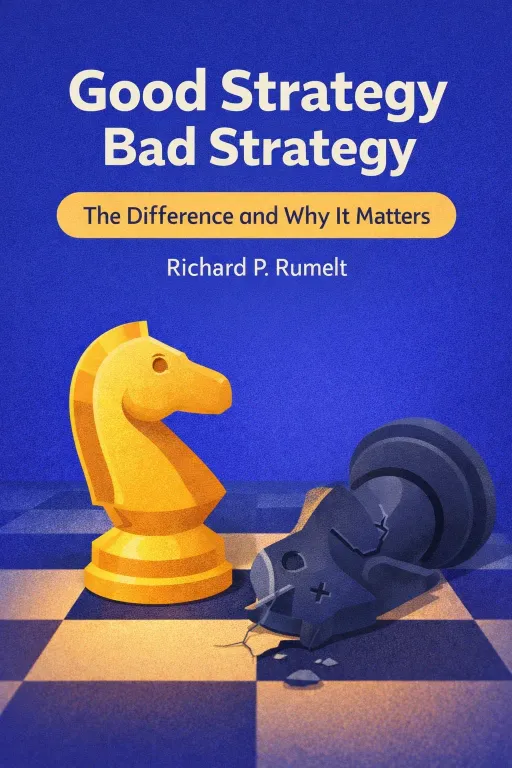
Nova: Exactly! And that feeling, that exhaustion, that unpredictability, it’s not a failure of or your team. It’s often a failure of. Today, we're diving into how to stop guessing and start building truly predictable growth, drawing powerful insights from two seminal works: Richard Rumelt's "Good Strategy/Bad Strategy" and Gabriel Weinberg and Justin Mares' "Traction."
Atlas: Nova, that's a powerful pairing. Rumelt, of course, is this academic heavyweight, renowned for cutting through business fluff, and Weinberg and Mares are the entrepreneurs who built a company and then wrote the playbook on how they actually. It’s a perfect blend of theory and street-level execution.
Nova: Absolutely. Rumelt, a professor at UCLA, has spent decades dissecting what makes strategies succeed or fail, often calling out the vague, aspirational 'strategies' that plague many organizations. And Weinberg, the founder of DuckDuckGo, along with Mares, brought that rigorous, data-driven mindset to the often-chaotic world of customer acquisition. They’re giving us the tools to turn guesswork into a science.
The Strategy Gap: Why Growth Feels Like Gambling
SECTION
Nova: So, let's start with the cold, hard fact: many marketing efforts like a gamble. You pour in resources, time, and talent, but the outcomes are often frustratingly unpredictable. The reason, as Rumelt brilliantly articulates, is often a fundamental misunderstanding of what strategy.
Atlas: Okay, but isn't being busy, trying new things, and chasing trends part of growth? I imagine a lot of our listeners are thinking, "I'm working hard, I'm trying!" What’s the difference between being busy and having a bad strategy?
Nova: That's the crux of it! Rumelt shows us that bad strategy isn't just strategy; it often masquerades as one. He identifies a few common culprits. The first is "fluff"—using high-sounding but meaningless words to mask an absence of thought. Think mission statements that could apply to any company, or marketing objectives like "maximize shareholder value" without a clear path. It sounds important, but it's empty.
Atlas: Oh, I know that feeling. Like when a marketing plan just says "leverage synergies for optimal brand visibility." It sounds impressive, but what do you with that? It’s completely unactionable.
Nova: Precisely. Another hallmark of bad strategy is the "failure to face the problem." Instead of confronting the actual obstacles or challenges, it often skirts around them, or worse, ignores them entirely. If your growth strategy doesn't clearly diagnose what's your growth, it's already doomed. And the third common failure? Simply listing goals as if they were a strategy. "We want 20% growth this quarter!" is a goal, not a strategy. A strategy explains you'll achieve that growth, by diagnosing the challenge and outlining a guiding policy.
Atlas: That makes me wonder, how does someone, say, running a small business or a marketing team, actually their problem effectively? Because it feels like everyone's just trying to grow, and the problem often feels like "we don't have enough customers."
Nova: That's where Rumelt's "good strategy" comes in. It has three core components: a clear of the challenge, a to address that diagnosis, and a set of that work together to implement the guiding policy. So, if your problem is "we don't have enough customers," a good diagnosis might be: "Our brand awareness is low in our target demographic because our content isn't reaching them effectively through their preferred channels."
Atlas: See, that's already so much more specific than just "get more customers." That gives you something to actually work with. It's like a doctor diagnosing an illness versus just saying "you're sick."
Nova: Exactly! And once you have that diagnosis, your guiding policy might be: "Focus all content creation and distribution efforts on platforms where our target demographic actively seeks information and entertainment, with a clear value proposition." Then, your coherent actions are the specific steps you take to enact that policy. This structured thinking moves you away from random acts of marketing into a focused, deliberate approach.
Blueprinting Predictable Growth: From Diagnosis to Traction
SECTION
Nova: Now, once you have that clear strategy, that guiding policy, the next logical question is: how do you actually those customers? How do you get that "traction"? That’s where Gabriel Weinberg and Justin Mares’ book, "Traction," becomes incredibly illuminating.
Atlas: I've heard about this book. It's famous for its "19 channels" approach, right? Like a menu of ways to get customers. But for someone pressed for time, how do you choose? It could feel like another list, like those bad strategies you were just describing.
Nova: That's a fair point, and it’s a common misconception. The book isn't just a list; it’s a methodology. Weinberg and Mares outline 19 distinct channels for customer acquisition, everything from viral marketing and SEO to public relations and community building. Their core insight is that most startups, or even established businesses, only focus on 1-2 channels, often the most obvious ones, and then wonder why they’re not growing. The key is to systematically test and measure these channels to find what works for product or service.
Atlas: So you're saying instead of blindly pouring money into, say, paid ads because everyone else is doing it, you should be exploring a wider range, but with a disciplined approach? Like a scientist running experiments?
Nova: Precisely! They advocate for what they call the "Bullseye Framework" – though they don't explicitly name it that way in the book, the concept is to brainstorm all 19 channels, then pick the top 3-5 most promising ones for your specific situation. Then, you run small, cheap tests on those channels simultaneously to see which ones show the most initial traction. Once you find a winner, you double down and optimize it.
Atlas: That sounds like a game-changer for anyone who feels like they’re just guessing. It moves you from "what should we try next?" to "what does the data tell us is working?" Can you give us an example of how a company might have found traction in an unexpected way?
Nova: Absolutely. Think about a company focused on a niche B2B software. They might initially think "LinkedIn ads and email marketing are all we need." But after systematically testing, they might discover that targeted offline events—like sponsoring small industry meetups or even direct sales via cold calling—yield far superior results, not just in terms of leads, but in lead. Or, conversely, a consumer app might realize that while paid social is expensive, a clever viral loop integrated into their product dramatically lowers acquisition costs. It's about letting the data guide you, not assumptions.
Atlas: That's actually really inspiring. Because it means the answer isn't always the most obvious or the most expensive channel. It’s about smart, systematic experimentation. So it’s Rumelt giving you the overarching strategic clarity, and Weinberg and Mares giving you the tactical framework to execute and find those specific growth levers.
Nova: Exactly. Nova's Take, if you will, is that these two works fundamentally solve the problem of unpredictable growth by shifting your focus from random acts of marketing to a disciplined, testable approach. It's about moving from hoping something works, to knowing something works, and being able to replicate and scale that success. It’s about building, not just guessing.
Synthesis & Takeaways
SECTION
Nova: So, to bring it all together, the path to predictable growth isn't about working harder; it's about thinking smarter. It's about having a clear, well-diagnosed strategy, and then systematically testing and optimizing your customer acquisition channels. It's the ultimate antidote to the "random acts of marketing" that drain resources and deliver frustration.
Atlas: That's such a hopeful way to look at it. It puts the power back in the hands of the builder, the strategist. It means you can actually engineer your growth, rather than just crossing your fingers. For our listeners who are driven by a desire for mastery and tangible results, this is gold.
Nova: It truly is. And the best part? You can start today. Your tiny step for this week is to pick just core marketing channel you're currently using. It could be your social media, your email newsletter, or even your sales calls.
Atlas: And then, apply the Rumelt framework to it, right? Diagnose it, create a guiding policy, and outline coherent actions?
Nova: Precisely. First, diagnose its current state: what's the real challenge with this channel? Not just "it's not working," but isn't it? Second, formulate a guiding policy: what's your specific, focused approach to overcome that challenge? And third, outline three coherent actions you'll take in the next week to implement that policy.
Atlas: That's so practical. It takes these big, powerful ideas and boils them down to an immediate, manageable action. It's about building momentum, one strategic step at a time. This is how you move from a strategic seeker to a strategic.
Nova: Absolutely. Stop guessing, start building. This is Aibrary. Congratulations on your growth!