

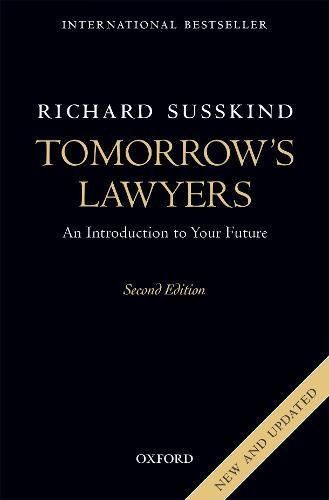
Tomorrow's Lawyers
An Introduction to Your Future
Introduction: The Lawyer's Existential Crisis
Introduction: The Lawyer's Existential Crisis
Nova: Welcome to Future Forward, the podcast where we dissect the ideas shaping tomorrow's world. Today, we are diving deep into a book that sent shockwaves through the staid halls of the legal profession: Richard Susskind's "Tomorrow's Lawyers."
Nova: It’s explosive because Susskind, a renowned legal futurist, doesn't just suggest minor tweaks. He argues that the traditional law firm model, built on the billable hour and bespoke, artisanal legal advice, is fundamentally unsustainable and heading toward obsolescence.
Nova: Not just software, Alex. It’s a perfect storm of economic pressure and technological capability. Susskind lays out a compelling case that the market will stop rewarding inefficiency. He famously uses the analogy: nobody actually wants a drill. They want the hole it makes. The lawyer has been selling the drill; the future sells the hole, delivered by technology.
Nova: Exactly. It’s a definitive guide for aspiring lawyers, but also a necessary wake-up call for established partners. We’re going to break down the three core drivers of this massive shift, explore the new roles that will replace the traditional associate, and look at Susskind's bold predictions for AI in the 2030s. Ready to look into the abyss of the future legal market, Alex?
Key Insight 1: The Unsustainable Model
The Economic Squeeze: More-for-Less and the Death of the Billable Hour
Nova: The first, and perhaps most potent, driver Susskind identifies is what he terms the 'More-for-Less' challenge. Clients, especially large corporate clients, are tired of paying exorbitant fees for work that they suspect could be done faster, cheaper, or even automated.
Nova: Precisely. The billable hour inherently rewards inefficiency. If you find a way to do a complex due diligence task in one day instead of five, you are financially penalized under the old model. Susskind argues that clients are now demanding transparency and predictability in pricing, which leads directly to fixed fees, subscription models, or outcome-based billing.
Nova: And that's where the second driver comes in: Liberalization. For centuries, the legal profession has been heavily protected, restricting who can provide legal services. Liberalization—the opening up of the market—means non-lawyers, tech companies, and alternative legal service providers, or ALSPs, can now compete directly.
Nova: Absolutely. Susskind notes that the market is segmenting. There will always be a need for highly bespoke, complex, 'bet-the-company' litigation that requires the traditional lawyer's judgment. But the vast majority of routine, high-volume legal work—the bread and butter of many junior lawyers—is ripe for commoditization.
Nova: That’s a perfect parallel. And the third driver, the technological one, is what enables this entire transformation. It’s the foundation upon which the 'More-for-Less' demand can actually be met. Without IT, the pressure would just lead to burnout, not innovation. With IT, it leads to reinvention.
Key Insight 2: Mapping the Future
The Three Horizons of Legal Transformation
Nova: Susskind maps this evolution across three distinct horizons, which is a fantastic framework for understanding where we are and where we're going. Horizon One was the era of basic IT—word processing, email, document management systems. That’s largely done; it made lawyers slightly more efficient.
Nova: Exactly. Horizon Two is where we are now, or perhaps just entering the deep end of it. This is driven by the Internet, cloud computing, and early forms of automation. Think online dispute resolution, self-service legal platforms, and the rise of those ALSPs we mentioned. This horizon is about legal services.
Nova: Precisely. And the real game-changer, the one that makes Horizon Two so disruptive, is the concept of online courts. Susskind predicts that routine litigation will move almost entirely online. Imagine small claims, uncontested divorces, or even some commercial disputes being resolved by AI-assisted judges or automated decision-making systems.
Nova: It does. But the most profound shift is Horizon Three, which is driven by Artificial Intelligence and advanced systems. This is where the nature of legal itself changes. Susskind suggests that by the 2030s, AI won't just be a tool; it will be a collaborator, or even a replacement, for many cognitive tasks currently performed by lawyers.
Nova: He stands by it, but with nuance. He’s not saying lawyers disappear entirely. He’s saying the lawyers currently do will be automated. He predicts that by 2040, perhaps 90% of the work currently done by junior lawyers will be automated. The remaining 10%—the truly novel, high-stakes, ambiguous problems—will require human judgment, but that human judgment will be vastly augmented by AI.
Key Insight 3: New Roles for a New Era
The Rise of the Legal Technologist and Engineer
Nova: This is arguably the most exciting part of the book. If lawyers aren't spending their time reviewing documents or drafting standard agreements, who is doing that work, and what are the lawyers doing instead? Susskind envisions a legal ecosystem populated by roles that barely exist today. We’re talking about Legal Process Engineers, Legal Project Managers, Legal Technologists, and Legal Product Developers.
Nova: Exactly. They map out the process, identify where technology can take over, and then build or procure the necessary tools. They are the architects of efficiency. The traditional lawyer, the one who only knows the law, becomes the of the engineer, asking them to build a better way to handle, say, intellectual property filings.
Nova: It is. And Susskind is clear: the lawyers who resist this change—the ones who insist on billing by the hour for tasks that can be automated—will find themselves marginalized. He suggests that the market will show no loyalty to the traditional way of working. The new successful firms will look more like technology consultancies than traditional partnerships.
Nova: That’s one of Susskind’s core motivations. He believes that by commoditizing routine work, we can drastically lower the cost barrier. If a standard will or a simple tenancy agreement can be generated for a fraction of the current cost through a sophisticated online service, millions more people gain access to basic legal certainty. The technology doesn't just serve corporate clients; it serves the underserved public.
Nova: It’s a bifurcation. High-end bespoke work remains expensive but highly augmented. Low-end routine work becomes cheap and widely available. The middle ground—the moderately complex, repetitive work—is where the traditional lawyer gets squeezed out entirely. It’s a hollowing out of the middle tier of legal practice, which is where many associates spend their formative years learning the ropes.
Case Study: The Reality Check
Addressing the Skeptics: AI, Online Courts, and the Human Element
Nova: That is absolutely the takeaway for the next generation. But let's address the pushback. When Susskind makes these predictions, especially the timeline for AI disruption—sometimes pegged around 2030 to 2035 for major transformation—there is significant skepticism from the established bar.
Nova: Susskind acknowledges this, but he frames it as a matter of versus. He points out that many jurisdictions are already experimenting with online courts for civil matters. The pandemic accelerated this trend dramatically. If an online system can process evidence, apply precedent, and render a judgment faster and with fewer errors than a human judge bogged down by administrative tasks, the pressure to adopt it becomes immense, regardless of tradition.
Nova: Exactly. And regarding judgment, Susskind argues that for the vast majority of legal issues, the law largely codified. Precedent is designed to create consistency. AI excels at pattern recognition and applying codified rules consistently. The truly novel legal questions—the ones that create new law—will remain human territory for longer, but those are statistically rare compared to the daily grind of legal practice.
Nova: That’s the perfect distinction. He’s not predicting the death of law; he’s predicting the death of the way of practicing law. He often cites his own work with his son, Daniel, in "The Future of the Professions," where they discuss how technology will transform professions, not just law. Lawyers are not unique in facing this challenge; accountants, radiologists, and architects are all on the same trajectory.
Nova: That’s the ultimate test. Susskind believes that the firms that fail to make this transition—the ones that remain stubbornly attached to the old partnership model and the billable hour—will simply be replaced by agile, tech-first competitors, whether they are new startups or existing ALSPs that evolve into full-service providers. The market will reward those who can deliver legal outcomes reliably and cheaply, regardless of who or what delivers it.
Conclusion: Embracing the Inevitable Transformation
Conclusion: Embracing the Inevitable Transformation
Nova: We’ve covered a lot of ground today, Alex. From the economic squeeze of 'More-for-Less' to the three horizons of technological adoption, Richard Susskind’s "Tomorrow's Lawyers" paints a picture that is both daunting and exhilarating for the legal world.
Nova: The key takeaway for anyone listening, whether you’re a seasoned partner or just starting out, is adaptation. If your value proposition relies solely on the time you spend, you are vulnerable. If your value proposition relies on designing efficient, technology-enabled solutions to legal problems—the 'hole'—then you are future-proofed.
Nova: Indeed. The future lawyer needs to be comfortable with ambiguity, skilled in process design, and fluent in the language of technology. It’s a call to action to stop being passive consumers of technology and start being active architects of the legal future.
Nova: My pleasure, Alex. The legal landscape is shifting beneath our feet, and understanding these forces is the first step toward mastering them. This is Aibrary. Congratulations on your growth!