The Universal Power of Persuasion
Golden Hook & Introduction
SECTION
Nova: Alright, Atlas, quick question for you: what's the first word that comes to mind when I say "salesperson"?
Atlas: Oh man, "pushy." Definitely pushy. And probably wearing a slightly-too-shiny suit, if we're being honest.
Nova: Exactly! That's the stereotype, isn't it? The aggressive, fast-talking individual focused solely on closing the deal. Now, what if I told you that you, me, and literally everyone listening right now, are all in sales, every single day, whether we realize it or not?
Atlas: Whoa. Hold on. Are you saying my morning routine of convincing myself to get out of bed is "sales"? Because if so, I'm a terrible salesperson.
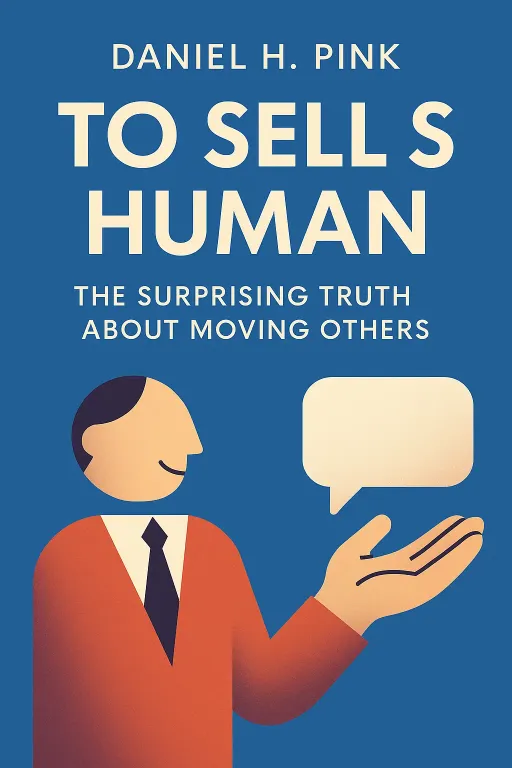
Nova: Well, it might be! That's the radical reframe Daniel H. Pink brings to the table in his bestselling book, "To Sell Is Human." Pink, known for his incisive takes on the modern workforce, argued that the very nature of work has changed. He wrote this book based on the insight that in our increasingly service-oriented economy, everyone is engaged in what he calls "non-sales selling." It's a widely acclaimed book that really shifted how we think about influence.
Atlas: Okay, so it’s not about selling widgets, but about moving people? I can definitely see that. As someone who's always trying to get buy-in on new ideas or lead a team effectively, the idea of "moving people" is central. But it still feels a bit abstract.
Nova: That's the beauty of it. Pink's core argument is that modern work requires us to constantly influence, persuade, and convince others. Think about it: a doctor persuading a patient to follow a treatment plan, a manager motivating a team, a teacher engaging students, a parent negotiating bedtime. None of these are traditional sales roles, yet they all rely on the ability to move others.
Atlas: That makes sense. I can definitely relate to the need for persuasive communication, especially when trying to introduce innovative solutions or get a project off the ground. My team might be brilliant, but getting everyone aligned on a new strategic direction often feels like a full-contact sport.
Redefining "Sales": Everyone's a Mover
SECTION
Nova: It absolutely can. Pink breaks down this "non-sales selling" into three essential qualities, his new ABCs of moving others: Attunement, Buoyancy, and Clarity. Forget the old "Always Be Closing"; he says it's "Attunement, Buoyancy, Clarity."
Atlas: Attunement, Buoyancy, Clarity. Okay, so what does Attunement mean in this context? Because I'm picturing a guitar tuner.
Nova: That’s a great analogy, actually! Attunement means the ability to take another person's perspective, to understand their thoughts, feelings, and interests. It's about truly listening and adapting your approach to match their wavelength. It’s a deep form of empathy, crucial for leaders and innovators.
Atlas: I see. So, for a pragmatic innovator like me, trying to get a new initiative approved, Attunement would be understanding the CEO's priorities, the finance department's concerns, or my team's bandwidth limitations, rather than just pushing my agenda. It's about stepping into their shoes.
Nova: Exactly. It's about asking, "What are needs? What are pain points?" And then framing your message in a way that resonates with. Pink emphasizes that those in power actually need to be attuned to others, not less, because they often have less incentive to listen.
Atlas: That’s a really insightful point. It’s easy to assume that if you're the one with the vision, everyone should just get on board. But if you don't attune, you're just talking to yourself. What about Buoyancy? Does that mean being a good swimmer in the ocean of rejection?
Nova: You're close! Buoyancy is about staying afloat in that ocean. It's the ability to persevere in the face of rejection, to maintain a positive outlook, and to bounce back from setbacks. In any role that involves moving others, you're going to encounter resistance. Buoyancy is your mental and emotional resilience.
Atlas: That sounds rough, but also incredibly necessary. As someone who's constantly strategizing and trying to implement change, I know that not every idea lands perfectly. It can be disheartening when a well-thought-out plan gets shot down. So, Buoyancy is about not letting that rejection sink you.
Nova: Precisely. Pink suggests three components to Buoyancy: interrogative self-talk, a positive explanatory style, and understanding that rejection is rarely personal. It’s often about timing, resources, or the other person's own fears.
Atlas: Interesting. So, if I'm trying to improve sales performance, and a pitch doesn't go well, instead of thinking "I failed," I should ask, "What could I have done differently? What did I learn?" That shifts the perspective from personal failure to a learning opportunity.
Nova: Absolutely. And that leads us to Clarity. This isn't just about making things simple, but about helping others see situations in a new light, to identify problems they didn't know they had, or to discover solutions they didn't anticipate. It's about being an expert problem-finder, not just a problem-solver.
Atlas: So, it's not just clear communication, it's clear. It's about providing a fresh perspective that helps people understand their own needs better. For leaders, that’s huge. It’s about not just presenting data, but framing it in a way that reveals a clear path forward, even if it's unconventional.
Nova: Exactly. Pink illustrates this with "sense-making." In a world flooded with information, the ability to curate, simplify, and clarify is incredibly valuable. It’s about asking "What's the problem here?" and then guiding them to the answer. Together, Attunement, Buoyancy, and Clarity form a powerful toolkit for anyone looking to master influence, regardless of their job title.
Atlas: Wow, that’s a complete shift from the old "always be closing." It transforms "sales" from a dirty word into a fundamental human skill for collaboration and impact. I love that. But wait, if Pink talks about conscious influence, what about the kind of influence we don't even see coming?
The Silent Influence: Brain Science in Action
SECTION
Nova: That’s a brilliant segue, Atlas, because that naturally leads us to the hidden levers of persuasion, the silent architects of our decisions. If Pink shows us how we consciously move others, Roger Dooley, in his book "Brainfluence," reveals the subtle, scientific secrets of neuromarketing that influence us without us even realizing it. Dooley is a leading expert in neuromarketing, and his book is widely acclaimed for its practical, science-backed advice, offering over a hundred actionable insights derived from brain science and behavioral research.
Atlas: Wait, are you saying people can be influenced without even knowing it? That sounds a bit... well, manipulative, if I'm honest.
Nova: It's a valid concern, and ethics are paramount here. But Dooley’s work isn't about coercion; it's about understanding the innate biases and triggers hardwired into our brains. It’s about leveraging insights from neuroscience to make communication more effective and experiences more intuitive, often for the benefit of the consumer. Think about it: if you understand how the brain works, you can design products, services, and messages that naturally resonate.
Atlas: So, give me an example. How does this "brainfluence" work in the real world, in a way that isn't just about tricking people?
Nova: Okay, let's take a classic. The principle of "social proof." We are inherently social creatures, and we look to others for cues on how to behave. Dooley would point to how hotels often place signs in bathrooms saying, "75% of our guests reuse their towels to help the environment."
Atlas: Oh, I've seen those! I always thought it was just a gentle nudge.
Nova: It is, but it's a very subtle, powerful one. The hotel isn't explicitly you to reuse your towel. It's simply stating a social norm. Your brain, seeing that "75% of others" are doing it, unconsciously nudges you towards that behavior. It taps into our desire to conform and be part of the group.
Atlas: That’s fascinating. So, for someone wanting to understand their audience deeply, like our listeners, this isn't about hard selling. It's about creating an environment or a message that naturally aligns with how the brain processes information and makes decisions. How else does this show up?
Nova: Another powerful one is the "anchoring effect." Our brains tend to rely heavily on the first piece of information offered when making decisions. Dooley provides examples of how this is used in pricing. A high initial price for a product, even if you don't buy it, can make a subsequent, lower price seem much more reasonable.
Atlas: Oh, I’ve definitely felt that. Like when you see a really expensive item, and then a slightly less expensive one, and suddenly the second one feels like a bargain, even if it's still quite pricey. It's like my brain recalibrates its expectation.
Nova: Exactly! It's not explicit persuasion in the Pink sense; no one is trying to convince you directly. It's a subtle architectural decision in how information is presented. Dooley gives countless examples like this, from the color of a "buy now" button influencing conversions, to the precise phrasing of a guarantee impacting perceived value. The entire field of user experience design is essentially applied neuromarketing.
Atlas: That's incredible. So, for those of us trying to boost efficiency and results, or trying to master influence, understanding these subtle triggers could be a game-changer. It’s about designing for the human brain, not just for logic. But how can someone, like a resilient strategist who might feel overwhelmed by choices, start applying these insights without getting lost in the weeds of brain science?
Nova: That's a great question, and it speaks to the actionable nature of Dooley's work. His book is full of "tiny steps." One immediate application is simply to observe. Pay attention to how companies try to influence your behavior without directly asking you to do something. Notice the layout of a grocery store, the language on a website, the subtle cues in an advertisement.
Atlas: So, it's about becoming a detective of influence. And then, once you start noticing these patterns, you can begin to think about how you might ethically apply them. For instance, using social proof by highlighting testimonials or showcasing how many people have already adopted a new internal tool.
Nova: Precisely. It’s about moving from being a passive recipient of brainfluence to an active, informed participant, and potentially a conscious, ethical architect of it. The key is understanding that influence isn't just about what you say, but also about you set the stage, you present choices, and you tap into those universal human tendencies.
Synthesis & Takeaways
SECTION
Nova: So, bringing Pink and Dooley together, we see that the universal power of persuasion operates on two crucial levels: the conscious and the subconscious. Pink empowers us with the tools for explicit influence—Attunement, Buoyancy, Clarity—skills we actively develop and deploy. Dooley reveals the hidden architecture of the brain, showing us how subtle cues and innate biases shape decisions without explicit effort.
Atlas: It’s a powerful combination. It tells me that mastering influence isn't just about having a great product or a compelling argument. It's about deeply understanding human behavior, both what people say they want and what unconsciously drives them. It's about being empathetic and strategic.
Nova: Exactly. True influence isn't about manipulation; it's about understanding human behavior to create value, foster connection, and move people towards mutually beneficial outcomes. It's about empathy and insight, whether you're explicitly persuading or subtly guiding. The profound insight here is that every interaction is an opportunity to move someone, and by understanding that happens, we become more effective, more ethical, and ultimately, more impactful.
Atlas: That's a powerful thought, especially for those of us driven by impact. It makes the idea of "sales" feel less like a dirty word and more like a fundamental aspect of human connection and leadership. So, what's a small, actionable step our listeners can take today to start applying these ideas?
Nova: My challenge for everyone listening, especially our pragmatic innovators, is to dedicate just five minutes today to observe. For one day, notice every instance where you attempt to move or influence someone, even subtly. Then, reflect on how Pink's ABCs—Attunement, Buoyancy, Clarity—could refine your approach in that moment. Or, from Dooley's perspective, identify one subtle environmental cue or piece of phrasing that influenced decision today.
Atlas: I love that. Start small, be consistent. That’s how real growth happens. It's about bringing conscious awareness to an unconscious process.
Nova: Absolutely. That consistent, small observation builds momentum and transforms how you interact with the world.
Atlas: What an insightful journey into the heart of persuasion. Thank you, Nova.
Nova: My pleasure, Atlas. It's always a privilege to explore these profound ideas with you.
Nova: This is Aibrary. Congratulations on your growth!