

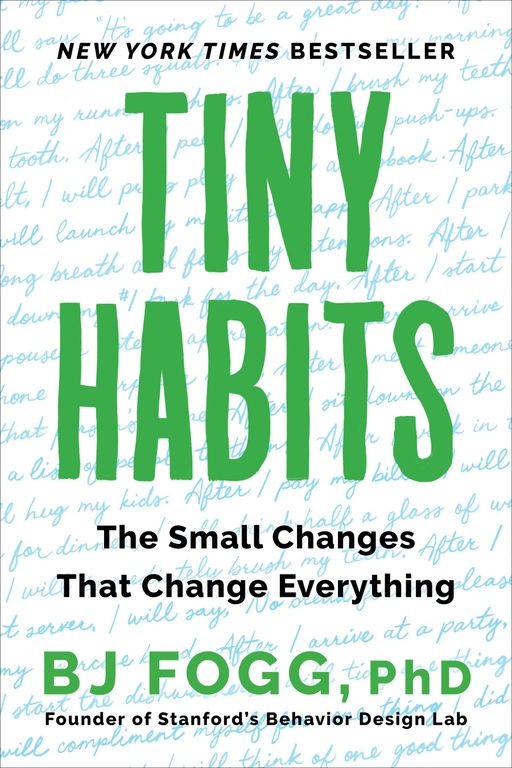
Tiny Habits
Introduction
Nova: Have you ever noticed how we always try to change our lives with these massive, sweeping gestures? We wait for January first, we buy the expensive gym membership, we announce to the world that we are finally becoming a runner, and then, by February, the shoes are gathering dust in the closet.
Nova: And that is exactly where we are going to start today. Welcome to the show. Today we are diving into Tiny Habits by BJ Fogg, a PhD researcher from Stanford who has spent twenty years studying human behavior. His big revelation? It is not a willpower problem. It is a design problem.
Nova: Exactly. Fogg argues that if you are struggling to change, you should stop blaming yourself. Instead, blame the system you are using. He has developed a method that is so small it is almost impossible to fail. We are talking about flossing one tooth or doing two push-ups. It sounds ridiculous, but there is a profound science behind why starting small is the only way to actually grow big.
Key Insight 1
The Fogg Behavior Model
Nova: To understand why we do anything at all, we have to look at the Fogg Behavior Model. It is a simple formula: B equals M A P. Behavior equals Motivation, Ability, and a Prompt.
Nova: Exactly. If one is missing, the behavior does not happen. Think of it like a recipe. You need the motivation to want to do it, the ability to actually do it, and a prompt that tells you to do it right now.
Nova: Right. But here is the kicker: Motivation and Ability have a specific relationship. Fogg calls it the Action Line. When your motivation is sky-high, you can do really hard things. Think about someone lifting a car off a trapped child. That is extreme motivation allowing for extreme ability.
Nova: And that is the problem! Most people rely on what Fogg calls the Motivation Wave. It comes and goes. It is unreliable. If you design a habit that requires high motivation, you will only do it when you are feeling inspired. As soon as that wave crashes, the habit dies.
Nova: You focus on Ability. Specifically, you make the behavior so easy that you can do it even when your motivation is at zero. If the task is tiny, you do not need the Motivation Wave. You stay above that Action Line because the ability required is so low.
Nova: Precisely. If putting on your shoes is the habit, you can do that even if you are exhausted and had a terrible day. You have the ability, and you probably have just enough motivation for that tiny step.
Nova: That is the most underrated part. No behavior happens without a prompt. You can have all the motivation and ability in the world, but if nothing triggers the action, it stays in your head. Fogg argues that we should stop using our phones for every reminder and start using our existing lives.
Key Insight 2
The Power of Tiny
Nova: It is his most famous example! And you are right, flossing one tooth will not save you from a cavity tomorrow. But that is not the point. The goal of a Tiny Habit is not the physical result on day one; it is the act of becoming the person who flosses.
Nova: Exactly. Fogg calls it Planting a Seed. If you plant a giant oak tree, it is probably going to die because you do not know how to care for it yet. But if you plant a tiny seed and nurture it, it grows naturally. By flossing one tooth, you are establishing the routine. Once the routine is there, it is very easy to scale up to two teeth, then five, then the whole mouth. But the entry point must be tiny.
Nova: That is the Perfectionism Trap. Fogg wants us to embrace being lazy in the beginning. He says that if you make it tiny, you bypass the brain's natural resistance to change. Your brain hates big changes because they feel like threats or massive drains on energy. But a tiny change? Your brain barely notices it. It sneaks under the radar.
Nova: He does. It is called Behavior Design. You start with a big aspiration, like get in shape. Then you brainstorm what he calls Swarm of Behaviors. These are all the specific actions that could help you get in shape. Finally, you pick the ones that are high impact but also high in ability for you personally.
Nova: Correct! This is a huge point. Fogg says we should do what we already want to do. Help yourself do what you already want to do. If you love dancing, make your tiny habit one minute of dancing after you get home. Do not force yourself into a behavior that feels like a chore, because then you are relying on motivation again, and we know how that ends.
Nova: It is exactly that. It is the path of least resistance. He even says that if you are having a really hard day, it is okay to just do the tiny version and stop. You still get the win because you kept the habit alive. Consistency is more important than intensity when you are in the design phase.
Key Insight 3
Anchors and Prompts
Nova: Fogg has a brilliant solution called Anchor Moments. An Anchor is an existing routine in your life that you already do without thinking. Brushing your teeth, brewing coffee, hanging up your coat, sitting down at your desk.
Nova: Yes. He uses a specific formula: After I, I will. For example, After I pour my morning coffee, I will set my gym bag by the door. Or, After I sit down on the train, I will open my book and read one sentence.
Nova: That is a great analogy. The Anchor is the power source. You are just plugging your new habit into it. The key is to find an anchor that matches the frequency and the location of the new habit. You would not want to anchor a flossing habit to your morning coffee if you drink your coffee in the car.
Nova: Exactly. Location and sequence matter. And here is a pro-tip from the research: The best anchors are very specific moments. Not just during lunch, but after I take the last bite of my sandwich. The more specific the anchor, the clearer the prompt is to your brain.
Nova: It does, but Fogg approaches it differently. He calls it Untangling. You do not just stop a bad habit; you have to look at the B equals M A P model for that bad habit. Can you remove the prompt? Can you make the ability harder? If you check social media too much, delete the app so the ability becomes harder. If you eat cookies because they are on the counter, put them in a high cabinet so the prompt is hidden.
Key Insight 4
The Power of Shine
Nova: This is actually the most controversial part of Fogg's work for some people, but it is the most important. He says that emotion creates habits, not repetition. We have all heard that it takes twenty-one days or sixty-six days to form a habit, right?
Nova: Fogg says that is a myth. Repetition does not create habits. Positive emotion does. When you do something and you feel a burst of success, your brain releases dopamine, and that chemical reaction is what wires the habit into your brain.
Nova: Precisely. If you feel like a failure while you are doing it, your brain will actually learn to avoid it. To fix this, Fogg introduced a technique called Celebration. He calls the feeling of success Shine.
Nova: More like that feeling you get when you hit a bullseye or find a twenty-dollar bill in your pocket. To make a tiny habit stick, you have to celebrate immediately after doing it. You have to give yourself a shot of Shine.
Nova: It can be as simple as saying, I did a good job! or giving yourself a thumbs up in the mirror, or even just doing a little fist pump. It sounds cheesy, I know. It feels ridiculous to celebrate flossing one tooth.
Nova: I know, but the biology does not care if it is cheesy. Your brain just needs the reward signal. Fogg found that people who celebrate their tiny wins are significantly more likely to keep the habit than people who just grit their teeth. Celebration is the gasoline for the habit engine.
Nova: Exactly. You were punishing yourself into change, and the brain is very good at escaping punishment. If you want to change, you have to feel good. You have to be your own cheerleader, especially for the tiny things. This is where Tiny Habits differs from books like Atomic Habits. While James Clear focuses a lot on the system and identity, BJ Fogg is hyper-focused on the immediate neurological reward of celebration.
Conclusion
Nova: We have covered a lot today, from the B equals M A P model to the importance of anchors and the power of Shine. If there is one takeaway from BJ Fogg's work, it is this: Small is powerful because small is manageable. When you start tiny, you remove the fear of failure.
Nova: Oh, that is a great one! For those who do not know, the Maui Habit is: After I put my feet on the floor in the morning, I will say, It is going to be a great day. Even if you do not believe it yet, just saying it starts the day with a tiny win.
Nova: That is the spirit. Remember, you can apply this to anything. Want to write a book? Write one sentence after you open your laptop. Want to be more mindful? Take one deep breath after you put your phone on the charger. The world is built of these tiny moments, and by designing them, you design your life.
Nova: That is the goal. Thank you for joining us on this deep dive into Tiny Habits. Go out there, find your anchor, make it tiny, and don't forget to celebrate. This is Aibrary. Congratulations on your growth!