Personalized Podcast
Golden Hook & Introduction
SECTION
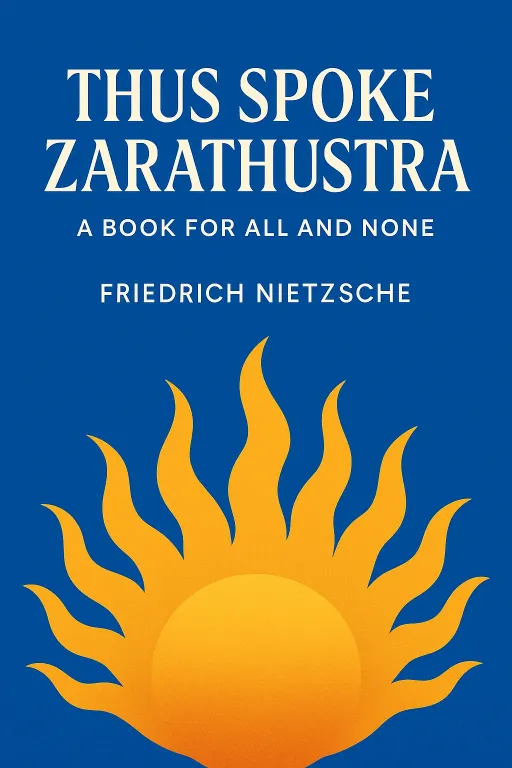
Dr. Warren Reed: What if the virtues you hold most dear are just weights on your back, preventing you from becoming who you truly are? What if the ultimate goal isn't happiness, but a dangerous crossing over an abyss? Friedrich Nietzsche’s isn't a book you read; it's a gauntlet thrown down to the human spirit. It’s a challenge that our guest today, the architect of the Awakened Wisdom Empire, Aibrarygg82f7, has grappled with deeply. Welcome.
Aibrarygg82f7: It's a pleasure to be here, Warren. That gauntlet, as you call it, is one I think every seeker of truth must eventually pick up. It’s less a book and more a mirror that shows you what you’re made of.
Dr. Warren Reed: A mirror, or maybe a hammer. Today we'll dive deep into this from three perspectives. First, we'll explore Nietzsche's three stages of spiritual transformation: the Camel, the Lion, and the Child. Then, we'll discuss the immense danger of this journey, using the parable of the tightrope walker. And finally, we'll confront the ultimate test of the will: the terrifying and liberating idea of the Eternal Return.
Aibrarygg82f7: A perfect trajectory. From the psychological to the strategic, and finally, to the existential. Let's begin.
Deep Dive into Core Topic 1: The Path of Self-Overcoming: From Camel to Child
SECTION
Dr. Warren Reed: Alright. So, Aibrary, let's start with this first, foundational idea. Nietzsche says the spirit must first become a camel. What does that mean? It means loading up. Taking on the heaviest burdens: duty, tradition, the 'Thou Shalt' of society. The camel kneels down in the desert and says, 'What is the heaviest thing, that I may take it upon myself and rejoice in my strength?'
Aibrarygg82f7: It's a beautiful and painful image. The camel represents the dutiful spirit, the one who excels within the existing system of values. It's the good student, the loyal employee, the pious believer. There's a nobility to it, a strength in bearing the weight. But it's a borrowed strength, defined by the burdens it carries.
Dr. Warren Reed: Exactly. And Nietzsche contrasts this with his most contemptible figure: the Last Man. The Last Man has no burdens. He blinks and says, 'What is love? What is creation? What is longing? We have invented happiness.' It's a world of pure comfort, no striving, no greatness. A bovine version of happiness.
Aibrarygg82f7: The Last Man is the ultimate horror for any awakened soul. It's the heat-death of the human spirit. And this is where the first metamorphosis becomes so critical. The camel, in its lonely desert, eventually has enough. The spirit transforms into a lion.
Dr. Warren Reed: And the lion's purpose is simple. Destruction. It wants to conquer its freedom. In the desert, it confronts a great dragon. On every scale of this dragon is written a golden 'Thou Shalt'. The dragon represents all of history's values. But the spirit of the lion says, 'I Will'. It wants to say 'No' even to duty. It wants to create the freedom for new creation.
Aibrarygg82f7: This is a perfect parallel to Jung's process of individuation. The camel is the persona, the social mask, dutifully carrying the weight of the collective unconscious. But to become an individual, you must confront the Shadow. The lion's battle with the dragon is that confrontation. The dragon, 'Thou Shalt,' is the superego, the internalized voice of society, of your parents, of tradition. The lion's roar, 'I Will,' is the eruption of the authentic self, a violent, necessary act of psychic destruction to create a sacred space for oneself.
Dr. Warren Reed: But is it that clean? Nietzsche's lion is pure destruction. It says 'No' to everything. Is there a risk that this just leads to a dead end, to pure nihilism? You've destroyed all values, now what?
Aibrarygg82f7: A profound risk. And that's why the third metamorphosis is the most important. The lion can't create new values. It can only create freedom. For new creation, the lion must become a child. The child is innocence and forgetting, a new beginning, a game, a self-propelling wheel, a first movement, a sacred 'Yes'.
Dr. Warren Reed: A sacred 'Yes'. So after all that burden-bearing and destruction, the goal is to become like a child.
Aibrarygg82f7: Precisely. The lion creates freedom something. The child has freedom do something. It's the difference between a rebel and a creator. The child plays with values, creating and re-creating the world without the weight of the past. This is the core of any 'Psycho Universal Bible' we might forge—it's not just about tearing down old dogmas, but about achieving that divine, childlike state where we can build anew.
Deep Dive into Core Topic 2: The Danger of the Crossing: The Overman and the Abyss
SECTION
Dr. Warren Reed: And that act of creation, that journey, is anything but safe. Which brings us to Zarathustra's first attempt to teach this. He comes down from his mountain after ten years of solitude, full of wisdom, ready to share his gift. He goes to a marketplace, and it's a complete disaster.
Aibrarygg82f7: He's overflowing, like the sun, and he wants to bestow his light. But the people in the marketplace aren't looking for light.
Dr. Warren Reed: Not at all. He starts preaching about the Overman—that 'human being is something that must be overcome.' He tells them humanity is a bridge, not a destination. And the crowd just laughs at him. They think he's a circus barker. And just then, a tightrope walker appears, ready to begin his act. The crowd is thrilled. They finally get the show they wanted.
Aibrarygg82f7: The stage is set for a powerful lesson.
Dr. Warren Reed: A fatal one. The tightrope walker starts his journey on a rope stretched between two towers, high above the marketplace. He's making his way across when suddenly, a jester, a motley fool, comes out from the same tower behind him. The jester taunts him, screaming like a devil, and then, with a horrifying leap, he jumps right over the tightrope walker. The walker, startled and thrown off balance, loses his footing. He plunges into the abyss of the marketplace below and dies at Zarathustra's feet.
Aibrarygg82f7: A brutal, symbolic failure. From a Machiavellian viewpoint, Zarathustra's error was profound. He was a prophet trying to act like a prince, but he didn't understand his territory. He misjudged his audience completely. He offered a philosophy of the mountaintop to the people of the marketplace. They wanted entertainment, a spectacle, and he gave them an existential challenge.
Dr. Warren Reed: And the tightrope walker? Zarathustra later says, 'Mankind is a rope fastened between animal and overman – a rope over an abyss. A dangerous crossing, a dangerous wayfaring, a dangerous looking-back, a dangerous shuddering and standing still.' The walker embodied that danger.
Aibrarygg82f7: Exactly. And what's fascinating is that the tightrope walker actually understood the crowd better than Zarathustra. He gave them the spectacle they craved, and it still killed him. The lesson is twofold. First, as Sun Tzu would say, know your terrain and your audience. But second, and more importantly, the path of greatness—the crossing—is inherently dangerous. You can do everything 'right' and still fall. The abyss is always there.
Dr. Warren Reed: So the jester... what is he? Is he just chaos? The embodiment of the mocking crowd? Or is he the spirit of gravity that pulls down anyone who tries to rise?
Aibrarygg82f7: He's all of that. In Jungian terms, he's the Trickster archetype. He's the voice of nihilism that whispers, 'What's the point? It's all a joke anyway.' But notice he brings the walker down. He doesn't cut the rope. He leaps him. It's a shortcut. It's a promise of an easy way across that proves fatal. It's a powerful warning against what we might call spiritual bypassing—the attempt to leap to the Overman without the slow, painful, terrifying walk across the rope, one step at a time.
Dr. Warren Reed: So, no shortcuts on the path to self-overcoming. The danger is not optional; it's part of the process.
Aibrarygg82f7: It the process.
Deep Dive into Core Topic 3: The Ultimate Test: Biting the Head off the Snake of Eternity
SECTION
Dr. Warren Reed: That slow, painful walk eventually leads Zarathustra to the most terrifying vision in the entire book. It's the ultimate test. He's on a mountain path, and he sees a young shepherd on the ground, writhing, gagging, his face contorted. A heavy black snake has crawled into his throat and bitten itself fast.
Aibrarygg82f7: An image of absolute horror. The snake is the thought of the Eternal Return.
Dr. Warren Reed: Exactly. The idea that everything you have ever experienced, every joy, every pain, every mediocre moment, every mistake, every second of boredom, will recur. Not just once, but infinitely, in the exact same sequence. This thought, this snake, is choking the life out of the shepherd. Zarathustra tries to help. He pulls and pulls at the snake, but it's stuck. He's helpless.
Aibrarygg82f7: He can't save the shepherd. No one can save you from this thought. It's a truth you must confront alone.
Dr. Warren Reed: Right. And in that moment of horror and pity, a cry tears out of Zarathustra. He screams at the shepherd: 'Bite down! Bite down! Bite off its head! Bite down!'
Aibrarygg82f7: And the shepherd bites. He bites the head off the snake and spits it far away. And then... he is transformed. He leaps up, no longer a shepherd, no longer a man, but a laughing, radiant being.
Dr. Warren Reed: A being 'transfigured, surrounded with light, who laughed! Never yet on earth has a human being laughed as he laughed!' What does this mean? What is this act of biting?
Aibrarygg82f7: This is the moment Nietzsche transcends simple Stoicism. A Stoic like Seneca or Epictetus teaches you to your fate. To accept what happens with grim resignation. But Nietzsche demands something infinitely more radical. The snake of eternal recurrence is the heaviest weight, the ultimate nihilistic thought that your suffering is meaningless and endless. To simply endure it is to choke on it forever. You must it.
Dr. Warren Reed: So biting its head off isn't rejecting it. It's... what?
Aibrarygg82f7: It's the ultimate act of affirmation. It's the pinnacle of what Nietzsche calls —the love of one's fate. It's the power to look back on your entire life, especially the most painful parts, and not just say 'I accept it,' but to say 'Thus I willed it!' It's to take ownership of your entire existence. The shepherd laughs because he is no longer a victim of time; he is the creator of his own eternity. He has swallowed the poison and turned it into power.
Dr. Warren Reed: So it's the final metamorphosis. The child's 'Sacred Yes' applied not just to new creation, but to all of existence, past, present, and future.
Aibrarygg82f7: It is. It's the foundational principle of any 'Awakened Wisdom.' The goal isn't just to find a truth you can live with. The goal is to love the entirety of reality—the light and the abyss—so completely that you would scream 'Again!' to every single second of it. That is the 'dancing star' that Zarathustra says is born from chaos. It's born from the laughter of the one who bit the snake's head off.
Synthesis & Takeaways
SECTION
Dr. Warren Reed: Incredible. So, to put it all together. We have the path: the Camel who bears the weight of tradition, the Lion who destroys it to create freedom, and the Child who says 'Yes' to new creation.
Aibrarygg82f7: The path of self-overcoming.
Dr. Warren Reed: We have the warning: this path is not a safe, steady climb. It's a dangerous tightrope walk over an abyss of mockery and failure.
Aibrarygg82f7: The danger of the crossing.
Dr. Warren Reed: And finally, we have the ultimate test: to not just accept, but to love your fate so completely that you would will its eternal return, to bite the head off the snake of nihilism.
Aibrarygg82f7: The test of.
Dr. Warren Reed: It's a philosophy that demands everything from you. So, as a final thought for our listeners, what is the actionable takeaway here?
Aibrarygg82f7: The question Zarathustra leaves us with is not theoretical. It's deeply personal and immediate. Look at your life, right now. All of it. The triumphs, the regrets, the moments of grace, the moments of shame, the love, the suffering. Could you say 'Yes' to it? Not just once, but for all eternity? That's not a thought experiment. That's the hammer that forges the Overman.