

Beyond the Charts: How Historical Cycles Shape Today's Market Trends
Golden Hook & Introduction
SECTION
Nova: Atlas, five words to describe today's topic: "Beyond the Charts: How Historical Cycles Shape Today's Market Trends."
Atlas: Oh, that's easy: "Déjà vu, but with money."
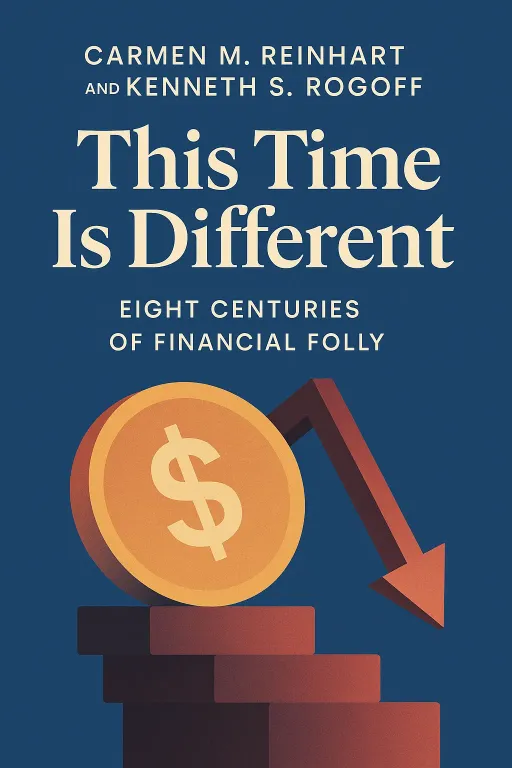
Nova: Ha! Perfect. Because today, we are diving deep into that very sentiment, exploring why understanding the past isn't just for history buffs, but essential for anyone navigating the wild currents of today's financial markets. We're drawing powerful insights from two monumental works: "This Time Is Different" by Carmen M. Reinhart and Kenneth S. Rogoff, which meticulously dissects eight centuries of financial crises, revealing uncanny, recurring patterns.
Atlas: Eight centuries! That's a serious deep dive. And I imagine they find that, spoiler alert, it's rarely "different."
Nova: Precisely. And we'll also touch on Niall Ferguson’s "The Ascent of Money," which charts the entire evolution of global finance, showing how our financial systems, from ancient Mesopotamia to modern times, are built on foundational elements that keep echoing through the ages. These books together really highlight how a broader historical lens provides truly invaluable context, helping us avoid what some call the "blind spot" of recency bias.
The Blind Spot of Recency Bias
SECTION
Atlas: The "blind spot." I like that. I imagine a lot of our listeners, especially those in high-stakes, fast-moving industries, are constantly bombarded with the latest data, the newest tech, the "next big thing." It's hard not to focus on what's happening right.
Nova: It absolutely is. And that's exactly the trap. Our brains are wired for novelty. We see new technologies, new markets, new global players, and it's incredibly tempting to believe that the old rules, the old patterns, simply don't apply anymore. This is the seductive whisper of "this time is different."
Atlas: But isn't some innovation truly new? How do you distinguish between genuine progress and just another echo? Because if everything is just a repeat, then what's the point of innovation?
Nova: That's a brilliant question, and it's key to understanding this. It's not about ignoring innovation. It's about recognizing that while the of a crisis or a boom might be novel – say, the dot-com bubble with its internet companies, or the Dutch Tulip Mania with its flower bulbs centuries ago – the underlying are often strikingly similar.
Atlas: Like, the human psychology remains consistent, even if the object of obsession changes?
Nova: Exactly! Take the Dutch Tulip Mania in the 17th century. People genuinely believed that tulips, a new and exotic import, would continue to increase in value indefinitely. Fortunes were made and lost overnight. Fast forward to the late 1990s, the dot-com bubble. Companies with no profits, often no clear business model, were valued in the billions based purely on speculative future growth.
Atlas: Ah, so the "new economy" narrative, then. We heard that a lot.
Nova: We did. And it created this intense psychological pressure. Everyone was getting rich, and the fear of missing out, or FOMO, was enormous. People rationalized that this new internet paradigm had fundamentally altered economic laws. It felt different. It looked different. But the underlying dynamics of excessive speculation, easy credit, and a collective belief in an ever-upward trajectory were eerily familiar to previous bubbles.
Atlas: So you're saying the "blind spot" isn't just about missing historical data, but about a psychological vulnerability where we convince ourselves that the current moment is exempt from past realities? That's a powerful thought, especially for anyone who prides themselves on deep analysis. It suggests even the sharpest minds can be swayed.
Nova: Indeed. Reinhart and Rogoff show us that this isn't just a quaint historical anecdote; it's a recurring, dangerous pattern. They document how claims of "new eras" or "new economies" frequently precede financial crises. It's almost a warning sign in itself. The moment a widespread consensus emerges that "this time is different," that's often when you should start looking for the rhymes.
The Enduring Power of Historical Cycles
SECTION
Atlas: So if we're so easily fooled by the "this time is different" narrative, how do we actually these patterns? What's the antidote to that blind spot you mentioned?
Nova: That's where works like "This Time Is Different" and "The Ascent of Money" become so invaluable. They provide the historical lens. Reinhart and Rogoff meticulously lay out eight centuries of financial crises – sovereign defaults, banking crises, currency crashes – across dozens of countries. And what they find is astonishing consistency in the underlying factors.
Atlas: So are we just doomed to repeat the past? What's the of knowing this if the cycles just keep grinding on? For a strategic analyst, understanding is one thing, but if it doesn't lead to better outcomes, it can feel a bit fatalistic.
Nova: That's a critical distinction. It's not about being doomed to repeat, but about being. History doesn't repeat exactly, but it often rhymes. By understanding the common threads, we can better identify when those rhymes are starting to play out in our current environment. The point isn't to predict the exact date of the next crash, but to understand the that lead to instability.
Atlas: Can you give an example of one of these "rhymes" that feels particularly relevant today?
Nova: Absolutely. One of the most persistent patterns they identify is the cycle of debt accumulation, followed by financial crises. Time and again, countries and institutions accumulate excessive debt – whether it's government debt, corporate debt, or household debt – often fueled by periods of easy money and exuberant optimism. This leads to speculative bubbles, and eventually, the debt becomes unsustainable, leading to defaults, banking crises, or currency devaluations.
Atlas: And this happens across different eras, different political systems, different technologies?
Nova: Precisely. From medieval defaults to modern emerging market crises, the script has a remarkable similarity. Ferguson's "Ascent of Money" shows us how basic financial instruments like debt and credit have always been the engines of economic growth and innovation, but also the instruments of our downfall when misused. The specifics change – the instruments might be subprime mortgages one century, or sovereign bonds another – but the underlying dynamic of too much debt chasing too few productive assets remains constant.
Atlas: So, it's like learning the immutable laws of physics for finance. The laws don't change, even if the experiments look different.
Nova: That's a brilliant analogy, Atlas. And for a strategic analyst, understanding these "financial physics" is incredibly empowering. It means you're not just reacting to the latest headline or the most recent quarterly report. You're able to contextualize it within a much grander narrative, discerning patterns that others, blinded by recency, might completely miss. It's about seeing the deep currents, not just the surface waves. It allows you to anticipate potential vulnerabilities and position yourself more resiliently.
Synthesis & Takeaways
SECTION
Nova: So, what we've really uncovered today is that the complexity of today's markets isn't entirely new. It's often an echo of past complexities, just dressed in modern attire. The "blind spot" isn't a lack of information, but a lack of historical perspective, causing us to misinterpret signals that have been flashing for centuries.
Atlas: And what these books offer is a powerful antidote to that short-term thinking. It’s not about predicting the future with certainty, but about understanding the enduring forces that shape our economic destiny. It's about mastering complexity by recognizing those deep patterns.
Nova: Exactly. It's about equipping ourselves with a wisdom that transcends the daily news cycle, allowing us to make more informed, more resilient decisions.
Atlas: That gives me so much to reflect on. What historical market cycle or financial crisis resonates most with current global economic conditions for, and what specific lessons does it offer for your own strategic analysis?
Nova: This is Aibrary. Congratulations on your growth!