

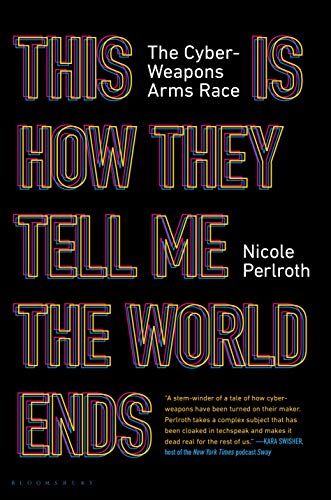
This Is How They Tell Me the World Ends
Introduction
Nova: Imagine you are sitting in your living room, and you have the most advanced security system in the world. Cameras, motion sensors, reinforced locks. You feel completely safe. But what you do not know is that the person who built your house left a tiny, secret door in the back of the pantry that only they know about. And they just sold the key to that door to a stranger for two million dollars.
Nova: Not at all. This is the reality of the world we live in today, and it is the central focus of Nicole Perlroth's book, This Is How They Tell Me the World Ends. Perlroth was a cybersecurity reporter for the New York Times for a decade, and she spent seven years investigating a market that most people do not even know exists. It is the global market for zero-day exploits.
Nova: A zero-day is essentially a software flaw that the developer of the software does not know about yet. It is called a zero-day because the developer has had zero days to fix it. If a hacker finds one, they have a secret skeleton key into your phone, your computer, or even a power plant's control system. And as Perlroth reveals, these keys are the most valuable weapons in the world right now.
Nova: Exactly. But in this case, the whimper is the sound of a silent line of code executing in the dark, shutting down a hospital's oxygen supply or turning off a city's power grid. Today, we are diving deep into the shadowy world of cyber warfare and the invisible arms race that is putting all of us at risk.
Key Insight 1
The Million Dollar Bug
Nova: To understand how we got here, we have to look at how the market for these bugs changed. In the early days of the internet, if a hacker found a flaw in Windows or Apple software, they would usually just tell the company. Maybe they would get a free t-shirt or a mention on a hall of fame page. It was about prestige and making the internet safer.
Nova: Definitely not. Perlroth tracks the shift to the early 2000s when the U. S. government and its allies realized that these flaws were not just nuisances; they were intelligence goldmines. If the NSA knows about a flaw in a router used by a foreign government, they can listen in on every conversation passing through it. So, they started buying these flaws quietly.
Nova: That is the ultimate catch-22 of the cyber age. It is called the Equities Process. The government has to decide: do we tell the company so they can patch it and protect our own citizens, or do we keep it secret so we can use it to spy on our enemies? For a long time, the scale tipped heavily toward keeping it secret.
Nova: Precisely. Perlroth introduces us to characters like the founders of VUPEN and Zerodium. These are companies that act as brokers. They buy zero-days from independent hackers and sell them to governments. And the prices are staggering. A zero-day that allows someone to remotely take over an iPhone without the user even clicking a link can go for two or three million dollars today.
Nova: It really is. And it is not just the U. S. buying. Perlroth describes how this market went global. Suddenly, countries like the UAE, Saudi Arabia, and Kazakhstan were showing up with suitcases of cash, looking for tools to track dissidents and journalists. The market became a Wild West with no regulation and no oversight.
Case Study
The Stuxnet Turning Point
Nova: If there is one moment where the world changed, it was the discovery of Stuxnet. This is a huge part of Perlroth's narrative. Stuxnet was a piece of malware discovered in 2010 that was designed to do something no virus had ever done before: cause physical destruction.
Nova: Yes. It was a joint operation between the U. S. and Israel. They managed to get this code into the Natanz uranium enrichment facility. The code was incredibly sophisticated. It waited until the centrifuges were spinning at a specific speed, and then it subtly altered their frequency to make them vibrate until they literally tore themselves apart. Meanwhile, it played back recorded data to the operators' screens so everything looked normal.
Nova: It was the first time a digital attack resulted in physical damage. But here is the problem: once you release a digital weapon into the wild, you cannot control where it goes. Stuxnet eventually leaked out of the Natanz facility and onto the open internet. Security researchers found it, dissected it, and realized what it was.
Nova: Exactly. Perlroth argues that by using Stuxnet, the U. S. gave every other nation a green light. We opened Pandora's box. Before Stuxnet, there was a sort of unspoken rule that you did not use cyberattacks to destroy physical infrastructure. After Stuxnet, that rule was gone. Russia, China, North Korea, and Iran all saw what was possible and started pouring billions into their own cyber programs.
Nova: And the irony is that the U. S. is the most vulnerable country in this race. We are the most digitized nation on earth. Our power grids, our water systems, our financial markets are all connected to the internet. We built a glass house and then started throwing stones at everyone else.
Deep Dive
The Shadow Brokers and the Great Leak
Nova: One of the most gripping chapters in the book covers the Shadow Brokers. In 2016, a mysterious group calling themselves the Shadow Brokers started leaking the NSA's own hacking tools online. These were the crown jewels of American cyber espionage.
Nova: We still do not know for sure, but the impact was devastating. One of the tools leaked was called EternalBlue. It exploited a flaw in Windows that allowed a hacker to spread through a network like wildfire. The NSA had known about this flaw for years and used it for spying, but they never told Microsoft.
Nova: Yes. And it did not take long for things to go south. In 2017, North Korea used EternalBlue to launch the WannaCry ransomware attack, which crippled the UK's National Health Service. Doctors could not access patient records, and surgeries had to be canceled. Then, a few months later, Russia used a modified version of the same tool to launch NotPetya.
Nova: According to Perlroth and many experts, yes. It was aimed at Ukraine, but it spread globally. It hit Maersk, the world's largest shipping company, and basically deleted their entire global network in minutes. They had ships stuck at sea and ports paralyzed. It hit Merck, the pharmaceutical giant, and stopped the production of life-saving vaccines. The total damage was estimated at over ten billion dollars.
Nova: It really highlights the danger of this arms race. When we build these weapons, we are creating vulnerabilities that can be turned back on us. Perlroth points out that the U. S. government's obsession with offensive capabilities has left our own defenses in shambles. We are so busy trying to hack everyone else that we have forgotten to lock our own front door.
Current State
The Mercenary Market
Nova: Beyond just nation-states, Perlroth explores the rise of private cyber-mercenaries. Companies like the NSO Group in Israel. They sell a product called Pegasus, which is essentially a zero-click surveillance tool for iPhones.
Nova: Correct. They can send a hidden message to your phone, and without you ever seeing it, they have access to your camera, your microphone, your encrypted messages, and your location. NSO Group claims they only sell to governments for the purpose of fighting terrorism and crime.
Nova: Not even close. Perlroth details how Pegasus has been used to track journalists, human rights activists, and even the family members of Jamal Khashoggi, the journalist who was murdered by Saudi agents. It has become a tool for authoritarian regimes to suppress dissent anywhere in the world.
Nova: That is the terrifying reality. And it is not just phones. Perlroth talks about the Internet of Things. Our smart fridges, our thermostats, our cars. Most of these devices have terrible security. They are built for convenience and low cost, not safety. Hackers can use these devices as entry points into our home networks or even use them to create massive botnets to take down websites.
Nova: And the people who are supposed to be protecting us are often the ones buying the matches. Perlroth's reporting shows that the market for zero-days has created a perverse incentive structure. If you are a brilliant coder, you can make a lot more money finding a bug and selling it to a broker than you can by working for a tech company to fix it. We are literally incentivizing the destruction of our own security.
Conclusion
Nova: As we wrap up our look at This Is How They Tell Me the World Ends, it is easy to feel a sense of doom. Perlroth does not sugarcoat the situation. We are in the middle of a global arms race with no rules, no treaties, and no clear end in sight.
Nova: There are solutions, but they require a massive shift in how we think about technology. Perlroth advocates for a Digital Geneva Convention. We need international agreements that prohibit attacks on hospitals, power grids, and election systems. We also need to change the incentives. Governments need to stop hoarding zero-days and start helping companies fix them.
Nova: Basic hygiene still matters. Use multi-factor authentication, keep your software updated, and be skeptical of everything. But more importantly, we need to demand better from our leaders and the companies that build our tech. We should not accept that our devices are inherently insecure.
Nova: Nicole Perlroth's book is a masterclass in investigative journalism and a vital warning for the 21st century. It reminds us that in the digital age, our greatest strength is also our greatest vulnerability.
Nova: Any time, Leo. This is Aibrary. Congratulations on your growth!