

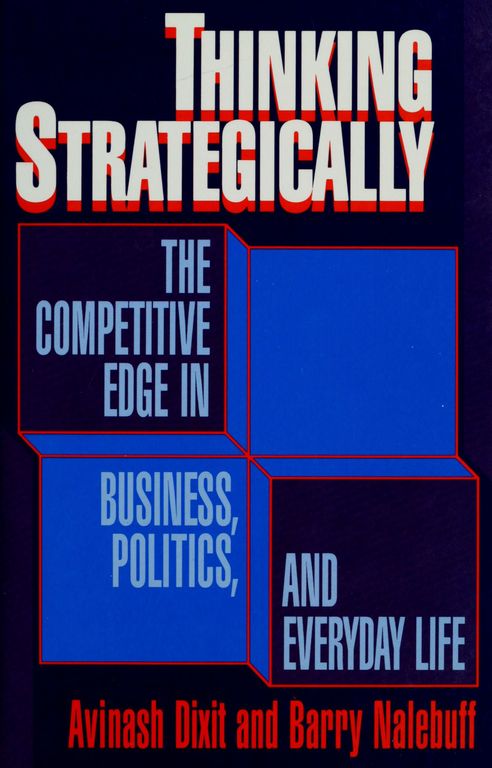
Thinking Strategically
The Competitive Edge in Business, Politics, and Everyday Life
Introduction
Nova: Imagine you are playing a game of tennis. You are at the net, and your opponent is about to hit a passing shot. Do you dive left or right? Now, zoom out. Imagine you are a CEO deciding whether to start a price war, or a politician deciding how to frame a new bill, or even just a parent trying to get a toddler to eat broccoli. What do all these situations have in common?
Atlas: They all feel like high-stakes gambles where the other person is actively trying to outsmart you. It is exhausting just thinking about it.
Nova: Exactly. And that is where game theory comes in. Today we are diving into a classic that changed how people think about these interactions: Thinking Strategically by Avinash Dixit and Barry Nalebuff. It is not just a book for economists; it is a field guide for anyone who has ever realized that their success depends on what someone else does.
Atlas: I have always heard of game theory as this dense, mathematical nightmare with lots of Greek letters. Is this book going to make my head spin, or is it actually something I can use when I am negotiating my next car lease?
Nova: That is the beauty of Dixit and Nalebuff. They stripped away the complex calculus and focused on the logic. They define strategic thinking as the art of outdoing an adversary, knowing that the adversary is trying to do the same to you. It is about interdependence. Your best choice depends on what they do, and their best choice depends on what you do.
Atlas: So it is like a hall of mirrors. I think that they think that I think... where does it end?
Nova: It ends with a set of very specific rules and frameworks. Over the next few minutes, we are going to break down those rules, from the famous Prisoners' Dilemma to the counterintuitive power of burning your own bridges. By the end, you might realize that being 'rational' is not always what you thought it was.
Key Insight 1
The First Rule of Strategy
Nova: Let us start with the foundation. Dixit and Nalebuff give us Rule Number One: Look forward and reason backward. In the world of game theory, we call this backward induction.
Atlas: Look forward and reason backward? That sounds like a riddle. If I am looking forward, how am I also going backward?
Nova: Think of it like a game of chess or a maze. Most people look at the first move and wonder, what should I do now? But a strategic thinker looks at the end of the game. They imagine all the possible final outcomes and then work their way back to the present to see which path actually leads to the win.
Atlas: Okay, give me a real-world example. I am not a Grandmaster.
Nova: The book uses a famous sports example: the 1984 Orange Bowl. Nebraska was playing Miami for the national championship. Nebraska was down by one point in the final seconds. They scored a touchdown. Now, they had a choice. They could take the easy one-point conversion for a tie, which would have guaranteed them the national championship because of their season record. Or, they could go for a two-point conversion to win the game outright.
Atlas: A tie gets them the trophy? That seems like a no-brainer. Why risk it?
Nova: Coach Tom Osborne went for the win. They missed the two-point conversion and lost the game and the championship. People called him a hero for his sportsmanship, but Dixit and Nalebuff look at it through the lens of backward induction. If you look forward, you see that a tie is a 'safe' win. But if you reason backward from the perspective of the fans and the legacy, a tie feels like a hollow victory. Osborne chose the path that led to a definitive outcome, even if it was a loss.
Atlas: So he was playing a different game than just the scoreboard. He was playing the game of 'Legacy.'
Nova: Precisely. To use this rule, you have to map out a 'game tree.' It is a visual map of every decision point. You start at the leaves of the tree—the final results—and you prune away the branches that lead to outcomes you do not want. What is left is your strategy.
Atlas: But that assumes the other person is also reasoning perfectly. What if I am playing against someone who is just making random moves or acting on pure emotion?
Nova: That is a common trap. Strategic thinking assumes your opponent is just as smart and self-interested as you are. If you assume they are 'dumb,' you leave yourself vulnerable to being surprised when they actually act in their own best interest. You have to put yourself in their shoes and ask: If I were them, looking at this same tree, what would I do to win?
Key Insight 2
The Prisoners' Dilemma
Nova: Now we have to talk about the most famous concept in the book: The Prisoners' Dilemma. This is the ultimate example of how individual logic can lead to collective disaster.
Atlas: I have heard of this. Two criminals in separate rooms, right? If they both stay quiet, they get a light sentence. If one rats the other out, the snitch goes free and the other gets ten years. But if they both rat each other out, they both get five years.
Nova: Exactly. Now, think about the logic from one prisoner's perspective. If my partner stays quiet, I should rat him out to go free. If my partner rats me out, I should definitely rat him out to avoid the maximum ten-year sentence. So, no matter what my partner does, my 'best' move is to rat him out.
Atlas: But if they both do that, they both get five years! If they had just trusted each other and stayed quiet, they would have only gotten one year. That is the 'dilemma.' Doing what is best for you individually makes everyone worse off.
Nova: It is everywhere, Atlas. Think about a price war between two gas stations on the same corner. If they both keep prices high, they both make a good profit. But if one cuts prices, they steal all the customers. So they both cut prices until neither is making any money. They are stuck in a Prisoners' Dilemma.
Atlas: It feels like a race to the bottom. Is there any way out? Or are we just doomed to screw each other over forever?
Nova: Dixit and Nalebuff argue that the way out is 'the shadow of the future.' If you only play the game once, you are probably going to defect. But if you know you have to play with this person again tomorrow, and the day after, you start to care about your reputation. You realize that if you rat them out today, they will rat you out tomorrow.
Atlas: So, cooperation is just a long-term calculation of self-interest?
Nova: In game theory terms, yes. They talk about 'Tit-for-Tat.' You start by cooperating, and then you just do whatever the other person did in the last round. If they were nice, you are nice. If they cheated, you punish them. It is simple, it is transparent, and it is incredibly effective at maintaining cooperation over time.
Atlas: It is like the Golden Rule, but with a bit of a sting if someone tries to take advantage of you.
Nova: Exactly. It is 'provocable' cooperation. You are nice, but you are not a doormat. The book emphasizes that for this to work, the game has to be indefinite. If you know exactly when the relationship ends—say, the last day of a contract—the incentive to cheat in that final round is huge. And if you are going to cheat in the last round, your opponent will cheat in the second-to-last round, and the whole thing collapses backward.
Key Insight 3
Strategic Moves and Credibility
Nova: This brings us to one of the most fascinating parts of the book: Strategic Moves. This is where you actively change the game to your advantage by limiting your own options.
Atlas: Wait, why would I want to limit my own options? Is not having more choices always better?
Nova: Not in strategy. Sometimes, having fewer choices makes your threats or promises more credible. Think about the story of Hernán Cortés when he landed in Mexico. He wanted to conquer the Aztec Empire with a tiny force. His men were terrified and wanted to sail back to Cuba. So, what did Cortés do?
Atlas: He burned the ships.
Nova: He burned the ships. By destroying his own means of retreat, he sent a powerful signal to both his men and the enemy. To his men, the message was: 'Win or die. There is no going back.' To the Aztecs, the message was: 'These guys are never leaving. We cannot wait them out.'
Atlas: So by removing the option to retreat, he made his commitment to stay and fight absolutely credible. That is terrifyingly brilliant.
Nova: It is a classic 'strategic move.' Dixit and Nalebuff break these down into three categories: commitments, threats, and promises. But the key to all of them is credibility. A threat is useless if the other person knows it would hurt you more than them to carry it out.
Atlas: Like a parent saying, 'If you don't stop crying, I'm canceling Christmas.' The kid knows you aren't going to cancel Christmas. You already bought the presents!
Nova: Exactly! That is an incredible threat. To make it credible, you have to take the control out of your own hands. You have to create a 'commitment device.' In business, this might be a 'most-favored-customer' clause. A company promises that if they ever lower their price for a future customer, they will retroactively give that same discount to you.
Atlas: That sounds like a nice deal for the customer.
Nova: It is, but it is also a strategic move against competitors. Because now, if that company wants to cut prices to steal a competitor's client, it becomes incredibly expensive for them because they have to give a refund to everyone else. It is a way of saying, 'My hands are tied. I cannot start a price war even if I wanted to.'
Atlas: So you are using your own 'weakness' or lack of choice as a shield. It is like that movie trope where the guy throws the steering wheel out the window during a game of chicken.
Nova: That is the ultimate example of brinkmanship! If you are heading toward a collision and you throw the steering wheel away, the other driver has to swerve. You have successfully shifted the entire burden of avoiding disaster onto them. But, as the authors warn, if both people throw their steering wheels out... well, you have a problem.
Key Insight 4
Information and Signaling
Nova: Let us talk about the 'Information Game.' In many strategic situations, one person knows something the other does not. This is called asymmetric information.
Atlas: Like a used car salesman knowing the engine is held together by duct tape while I am just looking at the shiny paint?
Nova: Precisely. In that scenario, how do you, the buyer, know if the seller is telling the truth? Dixit and Nalebuff talk about 'signaling' and 'screening.' A signal is an action that is so costly that it would only make sense for someone who is telling the truth to take it.
Atlas: Give me an example that is not a used car lot.
Nova: Education. Why do people spend four years and a hundred thousand dollars on a degree that might not even teach them the specific skills they need for their job? From a game theory perspective, the degree is a signal. It says, 'I am smart and disciplined enough to finish this difficult task.' If you were not smart or disciplined, the 'cost' of getting that degree—the effort and time—would be too high for you to fake it.
Atlas: So the degree is not just about the knowledge; it is a filter. It is a way of proving you are a 'high-quality' candidate because a 'low-quality' candidate could not afford to get the signal.
Nova: Exactly. And then there is 'screening.' That is when the person without the information sets up a test. Think of an insurance company. They cannot know if you are a risky driver or a safe one just by looking at you. So they offer two plans: one with a high premium but a low deductible, and one with a low premium but a huge deductible.
Atlas: Ah, I see. The risky drivers will gravitate toward the low deductible because they expect to crash. The safe drivers will take the low premium because they do not think they will ever need to pay the deductible.
Nova: You just screened them! By offering choices, you forced them to reveal their private information through their actions. The book is full of these 'information games.' It teaches you that talk is cheap. If someone wants you to believe them, look for the 'sunk cost' or the 'hostage' they have put up to prove they are serious.
Atlas: It makes me realize how much of our social interaction is just us trying to signal our value or screen other people's intentions. It is a bit cynical, but also very practical.
Nova: It can feel cynical, but Dixit and Nalebuff argue it is actually the path to more stable relationships. When you understand the incentives, you stop taking things personally. You realize that people are not necessarily 'bad'; they are just responding to the rules of the game they are in. If you want better behavior, you have to change the rules.
Conclusion
Nova: We have covered a lot of ground today. From the 'look forward, reason backward' rule to the strategic power of burning your ships and the complex dance of the Prisoners' Dilemma.
Atlas: It is a lot to take in. I think the biggest takeaway for me is that strategy is not about being 'mean' or 'aggressive.' It is about being aware. It is about realizing that you are not playing in a vacuum. Every move you make ripples out and changes the choices available to everyone else.
Nova: That is the heart of Thinking Strategically. Avinash Dixit and Barry Nalebuff show us that whether we are in a boardroom or a living room, we are all players in a series of interconnected games. The goal is not just to win, but to understand the logic of the game well enough to reach the best possible outcome for everyone involved—or at least to make sure you are not the one left with the ten-year sentence.
Atlas: I am definitely going to be looking for 'game trees' in my next meeting. And maybe I will be a bit more careful about making threats I am not willing to back up.
Nova: That is a great start. Remember, the world is a hall of mirrors, but with the right framework, you can find your way through. If you want to dive deeper, I highly recommend picking up the book. It is packed with even more examples from history, politics, and even classic movies.
Atlas: Thanks for the guide, Nova. I feel like I just leveled up.
Nova: This is Aibrary. Congratulations on your growth!