Stop Reacting, Start Anticipating: The Guide to Strategic Foresight.
Golden Hook & Introduction
SECTION
Nova: Here's a thought that might shake up your morning: A truly decision doesn't always lead to a outcome. In fact, sometimes the best possible decision can still end in disaster.
Atlas: Whoa, hold on. That sounds… counter-intuitive, to say the least. Isn't the whole point of making a good decision to ensure a good outcome? You're telling me I can plan perfectly, execute flawlessly, and still fail? That's a bit unsettling for anyone who values security and careful planning.
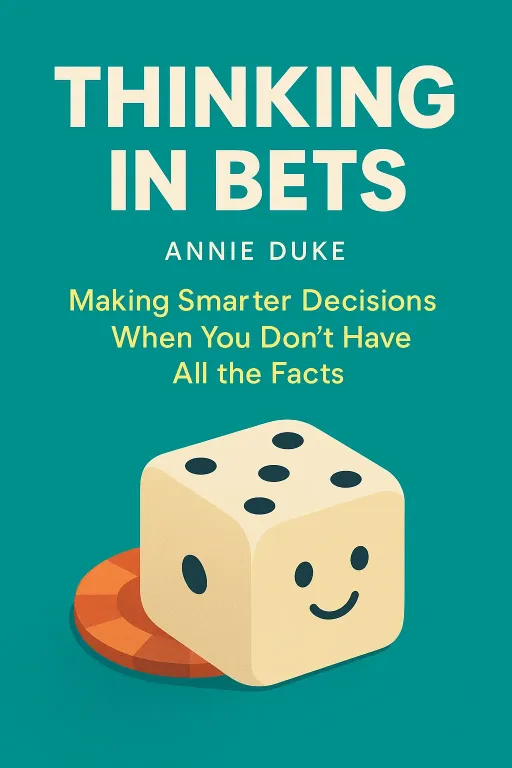
Nova: Absolutely, Atlas! And that unsettling truth is precisely what we're dissecting today, as we dive into the profound world of strategic foresight. We're pulling insights from a powerful guide called "Stop Reacting, Start Anticipating," which draws on giants like Annie Duke's "Thinking in Bets" and Avinash K. Dixit and Barry Nalebuff's "The Art of Strategy."
Atlas: I’m curious, what makes these particular voices so crucial for navigating uncertainty? For me, the whole goal is to build something with lasting impact, to secure a future, not just ride the waves of chaos.
Nova: That’s a great way to frame it. Take Annie Duke, for instance. Before she became a best-selling author and decision-making expert, she was a World Series of Poker bracelet winner. Imagine making high-stakes, life-altering decisions under extreme uncertainty, where every choice has immediate financial consequences. Her insights aren't theoretical; they're forged in the crucible of real-time probabilistic thinking. And then you have Dixit and Nalebuff, renowned economists from Princeton and Yale respectively, who bring academic rigor to the art of strategic interaction.
Atlas: Okay, so we have a world-class poker player and brilliant economists. That's a formidable combination for anyone looking to go beyond just reacting. I'm seeing how this connects to understanding risk and making calculated moves.
Nova: Exactly. And that brings us to our first deep dive: how to truly embrace uncertainty not as a threat, but as a landscape for strategic advantage. We're talking about the power of probabilistic thinking.
Embracing Uncertainty: The Power of Probabilistic Thinking
SECTION
Nova: So, let's unpack this idea from Annie Duke. The core insight of "Thinking in Bets" is that we often conflate the quality of a decision with the quality of its outcome. If something turns out well, we assume we made a good decision. If it turns out badly, we blame the decision. But that’s a massive fallacy.
Atlas: I still struggle with that. If I put in all the effort, analyze every angle, and it still goes south, it’s hard not to feel like I messed up somewhere. It feels like a personal failure, especially if you're someone who prides themselves on strategic planning.
Nova: It’s a very human reaction, but it's fundamentally flawed. Imagine a top surgeon performing a complex operation. They follow best practices, use the latest techniques, and make every decision perfectly based on the available information. But the patient still has an unexpected, rare complication. Was it a bad decision? No. It was a good decision with an unfortunate, low-probability outcome. The surgeon focused on the process, not just the result.
Atlas: That makes sense. It’s like a doctor making a diagnosis. They can be 90% sure, but that 10% still exists. For someone focused on security, that 10% can feel like a gaping hole.
Nova: Precisely. Duke argues you can – and should – make the best choice with the information you have, understand the probabilities, and then constantly update your beliefs as new information comes in. It’s about viewing every decision as a "bet" where you're assigning probabilities to different outcomes, even if implicitly.
Atlas: So, how does a poker player actually this in the heat of the moment? Like, give me a real scenario. How do they separate the quality of the decision from the outcome when thousands are on the line?
Nova: Let’s say a poker player has a strong hand, statistically one of the best starting hands, and they go "all-in." The odds are heavily in their favor, maybe 80% to win. It's an objectively good decision. But then, their opponent, with a much weaker hand, gets incredibly lucky and draws precisely the cards they need to win the pot. The player with the strong hand loses.
Atlas: Ouch. That's a brutal outcome.
Nova: It is. But a professional poker player, like Duke, wouldn't beat themselves up over the. They'd analyze if their initial probability assessment was correct, if they missed any tells, or if their opponent's play was genuinely unexpected. They'd understand that an 80% chance means you lose 20% of the time, and that's just part of the game. The goal isn't to win every single hand, it's to make the highest-probability moves over the long run.
Atlas: I see. So, instead of dwelling on the bad outcome, you're evaluating the decision-making process itself. That’s actually really powerful for someone who tends to overthink past failures. It shifts the focus from "what went wrong?" to "was my process sound?"
Nova: Exactly. It's about developing a robust decision-making process that accounts for uncertainty, rather than chasing guaranteed outcomes, which simply don't exist in a complex world. It helps you maintain stability, even when external results are volatile.
The Strategic Dance: Anticipating Moves with Game Theory
SECTION
Nova: Once you're comfortable thinking in bets about your own choices, the next logical step, and arguably a more complex one, is anticipating bets. This is where "The Art of Strategy" by Dixit and Nalebuff comes in, introducing us to the fascinating world of game theory.
Atlas: I’ve heard of game theory, but it always sounded a bit… abstract. Like something for economists in ivory towers, not for real-world strategic decisions. How does it help someone plan for lasting impact when you're dealing with unpredictable people?
Nova: That's a common misconception. Game theory is essentially the study of strategic interactions between rational decision-makers. It's about understanding that your optimal move depends on what others do, and their optimal move depends on what do. It’s a strategic dance, not a solo performance. The authors, through their work, show how these principles apply from corporate negotiations to international relations.
Atlas: So it's about predicting behavior? But people aren't always rational, are they?
Nova: Ah, that's the nuance! While classical game theory assumes rationality, the insights are incredibly powerful even when people deviate. It gives you a baseline, a framework to understand what happen, and then you can analyze it didn't. It helps you design strategies that are robust against different kinds of behavior.
Nova: Let's illustrate with a classic, but relatable, game theory scenario: the Prisoner's Dilemma. Imagine two competitors in a market, let's call them Company A and Company B. Both are considering whether to invest heavily in a new, risky technology or stick with their tried-and-true existing product.
Atlas: Okay, I can relate to that. High stakes, market share on the line.
Nova: If both companies invest in the new tech, they both gain a moderate advantage in the long run, but it's expensive in the short term. If neither invests, they both maintain the status quo, which is okay, but not great. If Company A invests and Company B doesn't, Company A gains a massive advantage, leaving Company B behind. And vice versa.
Atlas: So, the ideal scenario for both is to invest, right? Shared growth.
Nova: Logically, yes. But here's the dilemma: From Company A's perspective, if Company B invest, Company A is better off investing. If Company B invest, Company A is better off investing. So, regardless of what Company B does, Company A's "dominant strategy" is to invest. The same logic applies to Company B.
Atlas: Oh, I see where this is going! So both companies, acting purely in their own self-interest, end up choosing to invest, even though if they had cooperated, they might have achieved an even better collective outcome. That’s a powerful insight into why some competitive situations play out the way they do! It really helps you anticipate moves.
Nova: Exactly! That’s the beauty of game theory. It reveals these hidden dynamics. It forces you to think "forward, then backward." You project what your competitor might do, then what you would do in response, then what they would do to, and so on, until you identify the most likely outcome. It's about understanding the incentives and disincentives that drive strategic players, allowing you to secure your own position and influence the long-term game.
Atlas: That’s a great way to put it. It’s not about mind-reading, it’s about understanding the landscape of choices and consequences. It’s about building a robust strategy that doesn’t just react, but proactively shapes the future you want.
Synthesis & Takeaways
SECTION
Nova: So, whether you're making individual choices under uncertainty with probabilistic thinking, or navigating complex strategic interactions with game theory, the underlying principle is the same: stop reacting, start anticipating. It’s about having a framework to make calculated, forward-looking decisions.
Atlas: And that's really where the rubber meets the road, for anyone who wants to ensure stability and lasting impact. It takes the guesswork out of high-stakes situations and replaces it with a structured approach.
Nova: For our listeners, especially those who value foresight and careful planning, the book offers a tiny, yet incredibly powerful step: Before your next big decision, list three potential outcomes and the probability you assign to each. Then, consider how your decision changes if those probabilities shift.
Atlas: That's brilliant. It's a simple mental exercise but it immediately forces you to engage with uncertainty rather than ignore it. It makes you think about the of decision-making, not just the desired outcome. It's a way to trust your instincts more, but with a strategic backbone.
Nova: Exactly. It's not about predicting the future perfectly, but about being prepared for multiple futures. It’s about building a resilient mindset and a strategic toolkit that allows you to secure your path forward. This isn't just about avoiding pitfalls; it's about proactively shaping your destiny with integrity and intelligence.
Atlas: That’s actually really inspiring. It frames uncertainty as an opportunity for strategic growth, not just a source of anxiety.
Nova: Absolutely. And that's what strategic foresight ultimately delivers: the confidence to move forward, knowing you've considered the odds, anticipated the moves, and prepared for what’s to come.
Atlas: This is Aibrary. Congratulations on your growth!