Stop Reacting, Start Anticipating: The Guide to Strategic Foresight
Golden Hook & Introduction
SECTION
Nova: What if I told you that being about your decisions is actually a dangerous delusion, especially for leaders? That the best way to succeed isn't to predict the future, but to bet on it, strategically and intelligently?
Atlas: Whoa, that's a bold claim, Nova! Most leaders I know crave certainty more than anything. It's like the holy grail. What are we talking about today then?
Nova: Today, Atlas, we're diving into the core ideas behind 'Stop Reacting, Start Anticipating: The Guide to Strategic Foresight.' This isn't some abstract self-help book; it draws heavily from two brilliant minds who've lived and breathed uncertainty: Annie Duke, a world-champion poker player, and Nassim Nicholas Taleb, a former options trader and risk analyst. Their unique experiences with extreme, high-stakes unpredictability completely reshaped how we should think about decision-making and the future.
Atlas: Okay, so two people who literally made their living in unpredictable environments. I'm intrigued. How do we start betting on the future instead of just hoping for it, especially when the stakes are so high for our listeners who are leading teams and making big calls?
Thinking in Probabilities: Mastering Judgment Under Uncertainty
SECTION
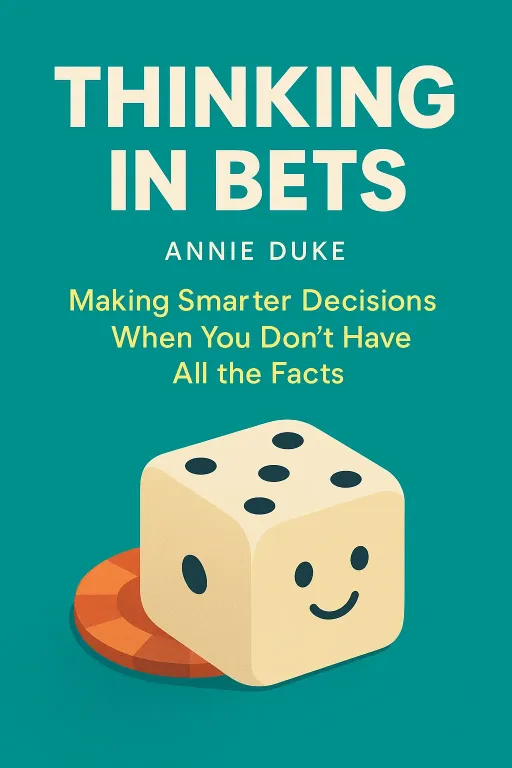
Nova: Exactly! And that brings us to our first big idea: 'Thinking in Bets,' from Annie Duke. She argues that every decision we make in life, especially as leaders, is a bet. We don't know the future with 100% certainty, so we need to think probabilistically. The world isn't black and white, it's a spectrum of likelihoods.
Atlas: Right, like, I get the poker analogy, but for aspiring leaders who are trying to guide complex teams, launch products, or make significant investments, that sounds... a bit abstract. How do you quantify probabilities when you're not holding a hand of cards? It feels like you're asking us to pull numbers out of thin air.
Nova: That's the beauty of it, Atlas. It's not about becoming a math wizard or a statistician; it's about a fundamental mindset shift. Imagine you're a leader considering launching a new product. Instead of declaring, 'This product succeed,' you consciously ask: 'What's the 60% chance of success given these market conditions, this team, and these resources? What's the 30% chance of moderate success, and the 10% chance of outright failure?' It's about acknowledging the spectrum of possibilities.
Atlas: Okay, so it's about acknowledging the possibility of different outcomes, not just a single 'yes' or 'no.' That's a huge shift from the typical 'go big or go home' mentality, where any talk of failure is almost taboo. It’s like admitting weakness.
Nova: Absolutely. Duke talks extensively about 'resulting' – which is judging a decision solely by its outcome, rather than the quality of the decision process itself. A good decision, made with sound probabilistic thinking, can still have a bad outcome due to pure luck. Conversely, a bad decision, based on faulty logic, can sometimes have a good outcome. Leaders need to separate the two. A leader might launch a product with an 80% chance of success, and it fails. That doesn't automatically mean it was a bad decision; it means the 20% scenario occurred.
Atlas: That's actually really liberating. It takes some of the immense pressure off, knowing you can make a good decision and still have things go south due to factors outside your control. But how do you train yourself to think this way? It feels so ingrained in our culture to want a 'right answer,' a definitive plan.
Nova: It starts with consciously listing alternative outcomes and assigning rough probabilities, even if they're just gut estimates initially. It's about actively seeking diverse perspectives, looking for information that might your initial hypothesis, and constantly updating your beliefs as new data emerges. It's not about being right all the time, but about being over time, and becoming more agile in your thinking. It's a continuous learning loop.
Antifragility & Black Swans: Building Resilience in an Unpredictable World
SECTION
Nova: And this concept of continuous learning naturally leads us to our second key idea, which often acts as a powerful, almost radical, complement: Nassim Nicholas Taleb's concept of 'Black Swans' and 'Antifragility.' If Annie Duke teaches us to bet wisely on the known unknowns, Taleb prepares us for the truly.
Atlas: Black Swans... sounds ominous. Are we talking about those highly improbable, high-impact events that nobody sees coming, but that completely change the landscape? Like the sudden rise of personal computing, or the 2008 financial crisis, or even the internet itself, which transformed everything far beyond anyone's early predictions?
Nova: Precisely. Taleb, coming from a background in options trading and risk analysis, saw firsthand how catastrophic these events could be. They're rare, unpredictable, and retrospectively explainable, but not prospectively predictable. But he didn't stop at just identifying the problem. He introduced the revolutionary idea of 'antifragility' – something that doesn't just resist shock, or even bounce back to its original state, but actually from stress, volatility, and chaos. It's beyond resilience; it's practically the opposite of fragility.
Atlas: Wait, stronger from chaos? That sounds almost paradoxical, Nova. Most systems, whether it's a company, a supply chain, or even a personal plan, break under stress, or at best, they endure and return to their baseline. How does something get from being hit?
Nova: Think of the human immune system. When exposed to pathogens, it doesn't just 'resist' them; it learns from the encounter and builds stronger, more specific defenses. Or consider a forest after a wildfire, often regenerating with greater biodiversity. In business, it could be a startup that, after a major product failure or market disruption, pivots, learns rapidly from its mistakes, and emerges with a more robust business model or a more innovative product. Taleb argues that many modern systems, especially large, highly optimized corporations or governments, are inherently fragile because they're designed for maximum efficiency in stable environments, making them incredibly vulnerable to Black Swans.
Atlas: So, if resilience is bending without breaking, antifragility is breaking, learning, and then growing new, stronger parts. That's a profound distinction for leaders, especially those trying to build sustainable growth. How do you design an organization or a strategy to be antifragile?
Nova: It involves building in redundancy, decentralization, and optionality. Instead of putting all your eggs in one basket, you diversify. Instead of optimizing for a single, perfect future, you create systems that can adapt and even exploit unexpected changes. It means having many small, low-risk experiments, so that when one fails, you learn from it quickly and cheaply. And when one succeeds unexpectedly, you have the optionality to scale it up massively. It's about having 'skin in the game' – taking small, manageable risks – and embracing small failures as invaluable learning opportunities, rather than trying to avoid all risk.
Atlas: Essentially, creating a system where mistakes or unforeseen events become fuel for growth, rather than just obstacles. That's a complete paradigm shift from trying to predict and control everything. Instead, you're designing for a world that surprise you.
Synthesis & Takeaways
SECTION
Nova: Exactly, Atlas. When you combine Annie Duke's 'thinking in bets' – mastering the known unknowns through probabilistic reasoning – with Nassim Nicholas Taleb's 'antifragility' – embracing the unknown, high-impact unknowns – you get an incredibly powerful framework for strategic foresight. It's not about having a crystal ball; it's about building robustness, adaptability, and even growth into your decision-making and your systems, so you can navigate and thrive in an inherently unpredictable world.
Atlas: So, it's about making better decisions by understanding the probabilities, and then building ourselves, our teams, and our strategies to thrive even when the truly unexpected hits. That's a powerful combination for any aspiring leader who wants to move beyond simply reacting to events.
Nova: Absolutely. The cold fact is the future is uncertain, but it's not entirely unknowable in terms of its probabilistic nature and the potential for shocks. The aspiring leader doesn't just react; they strategically position themselves to win, no matter what cards are dealt, or what unforeseen event reshuffles the deck.
Atlas: That's a fantastic insight, Nova. For our listeners who want to apply this immediately, what's one tiny step they can take this week to start practicing strategic foresight?
Nova: Here's your tiny step: Identify one key decision you need to make this week. Instead of just picking an option and hoping for the best, consciously list at least three possible future outcomes for that decision and assign rough probabilities to each. Just the act of thinking that way will start to rewire your brain for strategic foresight. It forces you to consider the full range of possibilities, not just the one you're hoping for.
Atlas: That's incredibly practical. It moves us from hoping for the best to preparing for all eventualities, and even getting stronger from them. What a way to approach leadership and personal growth. It’s about trusting your ambition, but also being smart about the journey.
Nova: It truly is. It's about trusting your ambition as a compass, but acknowledging the stormy seas ahead and designing a ship that can sail through anything.
Atlas: Well said, Nova. Thank you for another incredibly insightful discussion.
Nova: My pleasure, Atlas.
Atlas: This is Aibrary. Congratulations on your growth!