Stop Chasing Trends, Start Shaping Them: The Guide to Marketing Foresight.
Golden Hook & Introduction
SECTION
Nova: What if everything you've learned about 'risk management' in marketing is actually setting you up for failure?
Atlas: Hold on, are you saying the very strategies we use to protect ourselves are making us weaker? That's a bold claim, Nova. I imagine a lot of our listeners, especially those in high-pressure strategic roles, are thinking, "But how?"
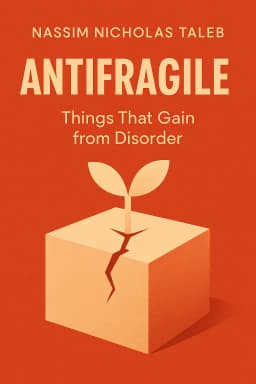
Nova: Exactly, Atlas! Because today we're diving into a paradigm shift, moving from merely reacting to market shifts to actively shaping them. We’re exploring the guide to marketing foresight, drawing insights from two phenomenal books: "Antifragile" by Nassim Nicholas Taleb, a former options trader and risk expert who truly thrives on volatility, and "Thinking in Bets" by Annie Duke, a former professional poker player who mastered decision-making under extreme uncertainty. Taleb, for instance, famously predicted the 2008 financial crisis, not through forecasting, but by understanding systemic fragility and how systems break.
Atlas: That context alone is fascinating. It’s not just theory then; these are people who lived and breathed risk in high-stakes environments. It makes me wonder if our current marketing frameworks are built on shaky ground. For our listeners who are focused achievers, always striving for mastery, this could be a game-changer.
Antifragility: Thriving on Disorder in Marketing
SECTION
Nova: They absolutely are, Atlas. And that leads us to our first core concept: antifragility. Taleb introduces this idea, and it's not just about being robust, which means you withstand shocks, or resilient, which means you bounce back. Antifragility means you from disorder. You get stronger. Many digital marketing strategies are reactive, chasing the latest trend, and that makes them, frankly, fragile.
Atlas: Wow, that’s a powerful distinction. I always thought robust or resilient was the goal. But gaining from disorder? That sounds almost… magical. Can you give an example of how a marketing strategy actually from disruption? How does it not just survive a market shift, but actually?
Nova: Think about a small, nimble e-commerce brand that built its entire customer base on a specific social media platform. Let's call them "TrendSetters Apparel." One day, that platform announces a massive algorithm change, drastically cutting organic reach for businesses. Most brands would panic, scramble for paid ads, or see their traffic plummet. That’s fragility. But TrendSetters, instead of just trying to survive the hit, had already experimented with a few new, emerging platforms, almost as a hobby. When the disruption hit, they rapidly shifted resources, doubled down on one of these nascent platforms, and started creating content specifically tailored to its unique audience and format.
Atlas: So they had optionality built in.
Nova: Exactly! They discovered a passionate, underserved niche on this new platform, significantly boosted their overall engagement and sales, and even attracted a new demographic of customers. Larger, slower brands were still trying to figure out the old algorithm, while TrendSetters was already thriving on the new landscape. They didn't just survive; they truly from the chaos.
Atlas: That’s a great example. But hold on, isn't that just being agile? Reacting quickly? What's the fundamental difference between agility and antifragility?
Nova: Agility is about reacting quickly to change. Antifragility is about being in such a way that change, even negative change, makes you better. It’s about building in redundancies, optionality, and exposure to small, non-catastrophic stressors that strengthen your system. It’s like how your muscles grow stronger after a workout – the stress makes them gain. For a strategic innovator, this sounds like a core principle, but it feels counterintuitive to deliberately court risk. Isn’t the goal to minimize risk? How do you even begin to design for that in marketing?
Thinking in Bets: Probabilistic Decision-Making for Marketing
SECTION
Nova: That question of 'how to design for that' naturally leads us to our second core idea, which is all about making smarter decisions in the face of uncertainty – Annie Duke's 'Thinking in Bets'. She argues that good decision-making isn't about being right every single time, but about thinking in probabilities and embracing uncertainty. It's about reducing cognitive biases that cloud our judgment.
Atlas: I can definitely relate to that. I imagine a lot of our listeners, especially ethical leaders, are constantly making decisions with incomplete information. What's a common marketing bias that trips people up, and how does probabilistic thinking help?
Nova: One of the biggest culprits is the "sunk cost fallacy." We’ve all seen it: a marketing team has invested months and a significant budget into a campaign. Midway, the data suggests it's not performing. But instead of cutting their losses, they continue to pour money into it, saying, "We've come too far to stop now!" The past investment, the "sunk cost," biases their decision about future probabilities of success.
Atlas: Oh, I've been there. It’s like watching a movie you hate just because you paid for the ticket.
Nova: Exactly! Probabilistic thinking forces you to ask: "Given what I know, what's the probability this campaign will succeed if I continue? And what's the probability of success if I reallocate those resources elsewhere?" It separates the quality of the decision from the outcome. Duke calls it "resulting" – judging a decision by its outcome rather than the quality of the decision process itself.
Atlas: That makes me wonder how you train a team to adopt this mindset. Especially in a fast-paced environment where everyone wants a 'sure thing' and is scared of admitting a past decision was flawed.
Nova: That's where a technique Duke champions, borrowed from intelligence agencies, comes in handy: the "pre-mortem." Before launching a campaign, imagine it has completely failed. Then, brainstorm all the reasons it failed. This isn't about being negative; it's about actively considering alternative outcomes, identifying potential disruptions, and building contingencies the fact. It helps you uncover vulnerabilities and blind spots that confirmation bias might otherwise hide. This directly addresses the "Tiny Step" from our guide: identify three potential disruptions and brainstorm how your strategy could not just survive, but benefit from each.
Atlas: That's brilliant. It's like stress-testing your strategy before it even leaves the ground. For a focused achiever, that's building robust understanding, not just hoping for the best. It’s about deliberately seeking out the weaknesses.
Synthesis & Takeaways
SECTION
Nova: Absolutely. Ultimately, antifragility gives us the mindset – the desire to gain from disorder. And probabilistic thinking gives us the tools – the framework for making robust decisions in that inherently uncertain world. Together, they provide a powerful framework for building marketing systems that are resilient, adaptive, and capable of long-term innovation. It's not about predicting every trend; it's about being prepared to thrive no matter what trends emerge.
Atlas: It’s a complete shift from chasing trends to actually shaping them, or at least being so adaptable that you’re always ahead. So that tiny step, the pre-mortem, identifying three potential disruptions for your next campaign and brainstorming how to benefit from each, feels incredibly actionable for anyone looking to build that strategic advantage. It shifts the focus from avoiding bad things to leveraging them.
Nova: Precisely. It’s about building a marketing muscle that gets stronger with every challenge. That’s true mastery.
Atlas: What an insightful deep dive today, Nova. This is Aibrary. Congratulations on your growth!