Stop Chasing Trends, Start Shaping Them: The Guide to Marketing Foresight.
Golden Hook & Introduction
SECTION
Nova: What if I told you that the secret to marketing success isn't avoiding failure, but actively seeking out chaos? That the best strategies aren't just resilient, but actually from disorder?
Atlas: Whoa, Nova. "Actively seeking chaos"? That sounds less like marketing strategy and more like... well, a recipe for disaster for most of our listeners, especially those in high-stakes environments trying to innovate. You're saying we should embrace the marketing equivalent of a meteor shower?
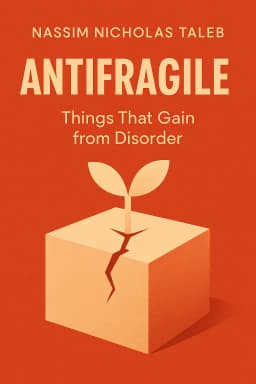
Nova: Precisely, Atlas! Today, we're dissecting a revolutionary idea, not from one, but two incredible minds: Nassim Nicholas Taleb's 'Antifragile' and Annie Duke's 'Thinking in Bets'. These aren't just books; they’re manifestos for how we approach risk and decision-making in a world that feels increasingly unpredictable. They fundamentally challenge the reactive mindset that leaves so many vulnerable.
Atlas: Okay, so we're talking about going from playing defense to... offense, in the most volatile conditions imaginable? That's a huge shift for anyone trying to build robust understanding and achieve impact. I'm intrigued. How do these authors even begin to suggest such a counterintuitive approach?
Antifragility in Marketing: Thriving on Disorder
SECTION
Nova: Well, let's start with Taleb and the concept of antifragility. Most things are fragile, meaning they break under stress. Think of a delicate vase. Then there are robust things, like a solid brick wall—they resist stress but don't get better from it. Antifragile, though, is something entirely different. It’s what from disorder, chaos, and volatility.
Atlas: Gains from disorder? That’s almost offensive to the way we're taught to manage risk. So, it's not just surviving a downturn, it's like a business superpower that gets stronger of the downturn?
Nova: Exactly! Think of the mythical Hydra: cut off one head, and two grow back. Or a muscle: it gets stronger by being stressed and torn. Taleb argues that many systems in life, including economic ones and yes, marketing strategies, can be designed to be antifragile. Instead of just trying to predict the next trend—which is often a fool's errand—you build a system that when your predictions are wrong.
Atlas: That's a mind-bender. For a strategic innovator, the idea of not just withstanding but actually from unexpected changes... it sounds like the ultimate competitive advantage. But how does that translate into a real-world marketing campaign? What does an antifragile marketing strategy even look like?
Nova: Let's imagine a company, let's call them 'Connective Hub.' Their primary marketing strategy relied heavily on a single, popular social media platform. Then, overnight, that platform announces a massive algorithm change that drastically reduces organic reach for businesses. Most competitors would panic, pour more money into paid ads on that same platform, or scramble to find an alternative. That's fragile or, at best, robust.
Atlas: And 'Connective Hub' didn't? How did they manage to not just survive but actually thrive?
Nova: Because they had an antifragile approach embedded from the start. Instead of putting all their eggs in one algorithmic basket, they had diversified their content creation and distribution. They were already experimenting with micro-communities on niche forums, interactive newsletters, and even local, in-person events that generated user-generated content. When the algorithm shifted, their competitors were scrambling to adapt. 'Connective Hub,' however, already had diverse, engaged audiences on channels.
Atlas: Oh, I see! So the "disruption" wasn't a problem, it was an opportunity. While others were trying to fix their broken strategy, Connective Hub was already engaging new, loyal communities who appreciated their multi-channel presence. They weren't just resilient; they actually gained market share and new audience segments that their competitors had ignored.
Nova: Precisely. The volatility didn't break them; it highlighted their strength and offered a path for growth. Their 'stressors' became their growth catalysts. It's about designing your marketing system with built-in optionality and redundancy, so that when one part is stressed, others can pick up the slack and even expand.
Atlas: So the 'chaos' wasn't about wishing for things to go wrong, but setting up your system so that when the inevitable 'wrong' happens, you're positioned to capitalize on it. That's a completely different way to think about vulnerability.
Probabilistic Thinking: Making Robust Marketing Decisions Under Uncertainty
SECTION
Nova: It absolutely is. And that naturally leads us to the second key idea we need to talk about, which often acts as the guiding light within an antifragile system: Annie Duke's 'Thinking in Bets.' Because even if you've built an antifragile system, you still need to make smart decisions within it.
Atlas: Right. If everything's so chaotic and unpredictable, how do you even make a 'smart' decision? Isn't it just a roll of the dice? For a focused achiever, the idea of 'making bets' sounds like pure speculation, not strategy.
Nova: That's the common misconception. Duke, a former professional poker player, argues that good decision-making isn't about being right every single time. It's about thinking in probabilities and actively embracing uncertainty. We often fall into the trap of 'resulting'—judging the quality of a decision purely by its outcome. If it worked out, it was a good decision. If it failed, it was bad.
Atlas: I know that feeling! You launch a campaign, it bombs, and everyone says, "Well, that was a terrible idea." Even if, at the time, all the data pointed to it being a good move.
Nova: Exactly. But a good decision, in Duke's view, is one that was made with the best available information, considering the probabilities of various outcomes, even if the outcome turns out to be unfavorable. It means separating the quality of the decision-making from the luck of the.
Atlas: So, how does a marketer actually apply this? How do we stop our brains from just seeing what we to see, or only focusing on the most optimistic outcome? That's a huge cognitive bias we all struggle with.
Nova: It starts with actively considering alternative outcomes and assigning probabilities, even if loosely. Instead of saying, "This campaign generate 10,000 leads," you say, "There's a 60% chance it generates 10,000 leads, a 30% chance it generates 5,000, and a 10% chance it generates only 1,000." And then you ask: "Given those probabilities, is this still a good bet?"
Atlas: That makes me wonder, it's like building a decision tree in your mind. But for someone driven by impact, isn't that just adding more steps to the process? How does this make us at shaping trends, rather than just reacting to them?
Nova: It makes you better because you're prepared for multiple futures. Let's say you're launching a new product. Instead of just planning for its success, you proactively identify three potential disruptions: maybe a competitor launches a similar product, a key supply chain breaks down, or consumer preferences suddenly shift due to a global event. For each disruption, you then brainstorm not just how your strategy could survive, but how it could.
Atlas: Ah, like the "Tiny Step" from the book! So, for the competitor launch, maybe you've already prepared a marketing campaign highlighting your unique differentiator, ready to deploy. For the supply chain issue, you've already identified alternative suppliers or even designed a product that uses more locally sourced materials. That's not reacting; that's pre-acting.
Nova: It absolutely is. It's about building a robust understanding of the landscape, and then making informed bets. Duke emphasizes creating 'pre-mortems'—imagining the campaign has failed, and then working backward to understand why. This helps expose blind spots and cognitive biases you've committed fully. It’s a powerful way to make more resilient decisions, ensuring you’re not just chasing trends, but actively shaping the future.
Synthesis & Takeaways
SECTION
Nova: So, bringing it all together: antifragility builds the system—the kind of marketing system that actually gets stronger from stress and surprises. Probabilistic thinking, guided by Annie Duke's insights, guides the decisions that system—helping you make informed bets, not just guesses, even when the future is uncertain.
Atlas: It’s about moving from a mindset of fear and reaction to one of proactive mastery. You're not just hoping for the best; you're designing for it, even when things go sideways. For our listeners who are focused achievers and strategic innovators, this isn't just theory—it's a tactical blueprint for long-term innovation and impact.
Nova: Exactly. It's about understanding that the world isn't going to get less volatile. So the competitive advantage goes to those who can not only withstand that volatility but leverage it. It empowers you to truly shape the future, rather than constantly being a victim of it.
Atlas: So, for our next marketing campaign, listeners, the tiny step is clear: identify three potential disruptions. And then, instead of just bracing for impact, brainstorm how your strategy could not just survive, but actively from each. Trust your intuition to guide that innovation, but back it up with a probabilistic lens.
Nova: That's it. It’s about cultivating foresight, not just chasing the rearview mirror.
Atlas: Absolutely. This is Aibrary. Congratulations on your growth!