Stop Chasing Trends, Start Shaping Them: The Guide to Marketing Foresight.
Golden Hook & Introduction
SECTION
Nova: Atlas, if I told you most digital marketing is like a hamster on a wheel, frantically chasing shiny objects and always a step behind, what would you say?
Atlas: I'd say, "Finally, someone understands my Monday mornings." And probably Tuesdays, Wednesdays...
Nova: Exactly! It's that feeling of constantly reacting, of being vulnerable to every market shift, every algorithm change. It's exhausting, and frankly, it leaves so much competitive advantage on the table.
Atlas: For sure. It's like we're always playing defense, trying to patch up holes instead of building something truly resilient.
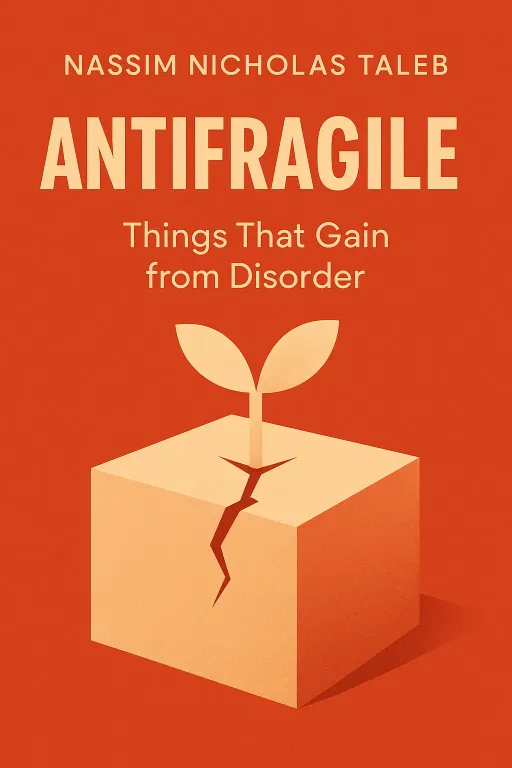
Nova: Well, today, we're diving into a guide that promises to flip that script. It’s called “Stop Chasing Trends, Start Shaping Them: The Guide to Marketing Foresight.” And it synthesizes some truly profound ideas from two brilliant minds: Nassim Nicholas Taleb, author of “Antifragile”, and Annie Duke, who wrote “Thinking in Bets.”
Atlas: Oh, Taleb and Duke! That’s a powerhouse combo. Taleb, the former options trader and risk analyst, who basically made a career out of understanding the unpredictable, and Duke, a world-class poker player who mastered high-stakes decision-making under uncertainty.
Nova: Exactly! Their unique backgrounds – Taleb navigating the chaos of financial markets, Duke thriving in the probabilistic world of professional poker – give them insights that are incredibly relevant to modern marketing. They’re not just theorizing; they’ve lived and breathed uncertainty. And their combined wisdom offers a profound framework for building marketing systems that aren't just resilient, but actually gain from volatility.
Atlas: That sounds like a dream for anyone trying to build something lasting in this ever-changing digital landscape.
Nova: It really is. And that leads us perfectly into our first big idea: how to move beyond just surviving disruption, to actually thriving because of it.
Deep Dive into Core Topic 1: Antifragile Marketing
SECTION
Nova: Many businesses strive for robustness – to withstand shocks. But Taleb introduces a concept beyond that: antifragility. It’s not just about resisting damage; it’s about growing stronger from disorder. Think of it like bones that get denser with stress, or a muscle that tears and rebuilds itself stronger.
Atlas: So, it’s not just about weathering the storm, but about coming out of it with bigger biceps?
Nova: Precisely! In marketing, this means designing strategies that don't just tolerate volatility, but actively benefit from unexpected changes and disruptions. Reactive marketing is fragile, breaking under pressure. Robust marketing endures. Antifragile marketing with pressure.
Atlas: That’s a fascinating distinction. But how do you even begin to design for that? For our listeners who are managing high-pressure teams, this concept might feel impossible to implement when they're already stretched thin just keeping up with the next big thing.
Nova: It starts with a mindset shift. Instead of viewing every market tremor or algorithm update as a catastrophe, an antifragile approach sees it as an opportunity for learning and adaptation. Imagine a small, agile e-commerce brand. A major social media platform suddenly tweaks its algorithm, severely cutting organic reach for many businesses. Most brands panic, scramble for paid ads, or just complain.
Atlas: I’ve seen that movie. It usually ends with a lot of frantic strategizing and not much actual strategy.
Nova: Right. But an antifragile brand, let's call them 'Innovate Goods,' had already built a culture of rapid experimentation. Instead of panicking, they saw the algorithm shift as a forced experiment. They immediately started testing a dozen new, low-cost content formats on that platform and others – short-form video, interactive polls, collaborative posts – without knowing which would work.
Atlas: So, they embraced the chaos instead of resisting it.
Nova: Exactly. The cause was the algorithm shift. Their process was rapid, low-stakes experimentation across multiple channels. They weren't trying to recover their old reach; they were trying to find new, unexpected pathways. What happened was, one of their new video series went viral on a different, smaller platform they hadn't prioritized before. This gave them unique data, a new engaged audience, and a much stronger, diversified content strategy.
Atlas: Wow. So, the disruption, which crippled larger, more rigid competitors, actually pushed Innovate Goods into a more innovative and ultimately more dominant position. They gained market share because they were structured to benefit from the unexpected.
Nova: Absolutely. Their old strategy was fragile; this new one was antifragile. They learned, adapted, and expanded their reach in ways they wouldn't have if the disruption hadn't occurred. It's about having redundant systems, small-scale experimentation, and a willingness to fail fast and learn faster.
Atlas: That makes me wonder, though. How do you differentiate between a disruption that makes you stronger and one that just… breaks you? Is it about the size of the disruption, or the way you’re prepared for it?
Nova: It’s less about the size of the disruption and more about the internal structure and mindset. Antifragile systems have optionality – they have many small bets, so if one fails, it’s not catastrophic, and if one succeeds, it can be scaled. They are not over-optimized for one specific future; they are optimized for future.
Deep Dive into Core Topic 2: Probabilistic Thinking for Marketing Decisions
SECTION
Nova: And that brings us perfectly to Annie Duke's work in "Thinking in Bets," which is all about making robust decisions in the face of uncertainty. If you want to be antifragile, you need to be good at making decisions when you can't predict the future.
Atlas: Oh, I love that. Because so often in marketing, we act like we predict the future. We launch a campaign, cross our fingers, and if it fails, we blame the market, not our process.
Nova: Precisely. Duke argues that good decision-making isn't about being right every time, but about thinking in probabilities and embracing uncertainty. It's about separating the quality of the decision from the quality of the outcome. You can make a great decision and still have a bad outcome due to luck, and vice-versa.
Atlas: That makes sense. For our listeners who are driven by impact, how do we balance this deep probabilistic thinking with the need for decisive action? Doesn't overthinking probabilities just lead to paralysis?
Nova: Not at all. It's actually about clarifying your decision. Let's take a marketing team preparing to launch a new product. The conventional approach is often: 'We believe this will be a hit!' based on some initial market research. But that's often tainted by confirmation bias – we look for data that supports what we already want to believe.
Atlas: Yeah, we all want our babies to be beautiful.
Nova: Right! A team applying Duke's probabilistic thinking would do a 'pre-mortem.' They'd imagine it’s a year from now, and the product launch failed spectacularly. Then, they'd brainstorm all the reasons it might have failed. This forces them to actively consider alternative outcomes.
Atlas: So, instead of just hoping for the best, they're preparing for the worst-case scenarios, too.
Nova: And the neutral-case, and even the unexpectedly-great-but-different-than-planned case. They'd assign probabilities to different market responses – say, a 60% chance of strong adoption, 30% of moderate, and 10% of poor. And crucially, they'd develop contingency plans for each.
Atlas: That’s a game-changer. So, if the initial response is, say, moderate instead of strong, they already have a playbook ready to pivot, rather than starting from scratch in a panic.
Nova: Exactly. Their 'bet' is still on the strong adoption, but they've acknowledged the uncertainty and prepared for it. This reduces cognitive biases because they’ve explicitly sought out reasons for failure and success beyond their initial assumptions. They're not just making a decision; they're making a calculated bet with defined upside and downside scenarios.
Atlas: That sounds like it would lead to much more robust strategies, especially for those of us striving for mastery in our marketing. It’s about being prepared for a range of futures, not just the one you hope for. It also makes me think about how many times a 'failure' was really just a good decision with an unlucky outcome, or a 'success' was a bad decision that got lucky.
Nova: Exactly. It shifts the focus from simply being 'right' to making the best possible decision given imperfect information, and then learning from every outcome to refine your probabilistic models. It's not about being a prophet; it's about being a shrewd strategist.
Synthesis & Takeaways
SECTION
Nova: So, when you combine Taleb's antifragility with Duke's probabilistic thinking, you get a powerful framework. Foresight isn't about perfectly predicting the future; it's about building systems and decision-making processes that thrive in an unpredictable world. It’s about shifting from seeking certainty, which is often an illusion, to embracing intelligent uncertainty.
Atlas: It’s a profound shift from a brittle, reactive stance to one that sees every disruption as a potential springboard for growth. It makes you realize that the real competitive advantage isn't in avoiding change, but in being the one who gains from it.
Nova: Absolutely. And the companies that do this aren't just surviving; they're innovating faster, adapting more effectively, and ultimately, shaping the very trends they were once chasing. It's the difference between being a leaf blowing in the wind and becoming the wind itself.
Atlas: That's a beautiful way to put it. And for our listeners, especially those focused on achieving meaningful impact and building robust understanding, there’s a tiny step you can take right now.
Nova: Yes, for your next marketing campaign, don't just plan for success. Identify three potential disruptions – maybe a new competitor, a sudden shift in consumer behavior, or an unexpected platform change – and brainstorm how your strategy could not just survive, but actively from each of them.
Atlas: Exactly. It's a small mental exercise that can profoundly change your strategic outlook. So, the real question isn't 'what's next?' but 'how will you react when 'next' isn't what you expected?'
Nova: We'd love to hear how you're applying these ideas in your own work. Share your thoughts with us online!
Atlas: This is Aibrary. Congratulations on your growth!