Mastering the Art of Decision-Making: Clarity in Complexity
Golden Hook & Introduction
SECTION
Nova: You know, Atlas, I was thinking about how often we make decisions, big and small, and how easily we can fall into the same old traps. It's like our brains are hardwired for inefficiency sometimes.
Atlas: Oh, I know that feeling. It’s like you’re trying to pick a restaurant for dinner, and suddenly it feels like you’re negotiating a peace treaty. The paradox of choice, right? But then you have these enormous, business-altering decisions, and the stakes are just… astronomical.
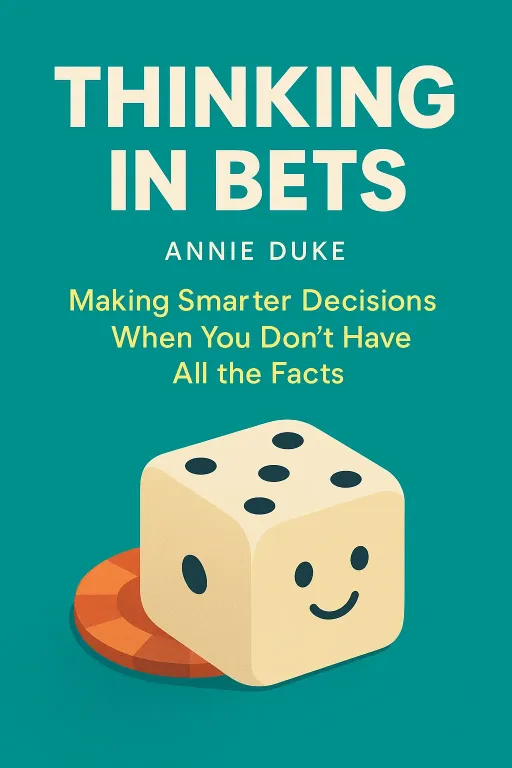
Nova: Exactly! And that’s why today, we’re diving into the fascinating world of decision-making, drawing insights from two incredibly impactful books: Chip Heath and Dan Heath’s "Decisive," and Annie Duke’s "Thinking in Bets." What's particularly interesting about the Heath brothers is their knack for taking complex behavioral science and distilling it into incredibly actionable frameworks, which they've done across multiple acclaimed books. They’re like the ultimate translators of academic wisdom into everyday practice.
Atlas: That’s a great way to put it. And Annie Duke, a former professional poker player, brings such a unique, pragmatic perspective to the table. You don’t often hear about high-stakes poker informing business strategy, but her approach to probability and outcomes is genuinely revolutionary.
Nova: It’s a powerful combination, really. Both books tackle the core challenge: how do we make better choices, especially when uncertainty is the only certainty?
Navigating Uncertainty with the WRAP Framework
SECTION
Nova: So, let’s start with "Decisive" by the Heath brothers. They argue that our decision-making process is often flawed because we fall prey to four common villains, as they call them. And to combat these, they propose a brilliant four-step process: WRAP.
Atlas: Oh, I like that. A memorable acronym usually means practical advice. So, what are these villains, and how does WRAP help us wrestle them down?
Nova: Well, the first villain is "narrow framing." We tend to see our options as binary – yes or no, this or that – when there's often a whole spectrum of possibilities. The 'W' in WRAP stands for. It’s about consciously looking for more choices, not just the obvious ones.
Atlas: That makes sense. It’s easy to get tunnel vision when you’re under pressure or just trying to get something done. But how do you actually widen your options? Is it just brainstorming?
Nova: It's more strategic than just a free-for-all brainstorm. They suggest techniques like the "vanishing options test"—if you couldn't choose any of your current options, what would you do? Or looking for "bright spots"—what's already working, even in small ways, that you can replicate? It forces you to think outside the box.
Atlas: That’s actually really inspiring. I imagine a lot of our listeners, especially those managing complex projects or teams, often feel stuck between two less-than-ideal choices. This is a mental shift.
Nova: Absolutely. The second villain is "confirmation bias"—we seek out information that confirms our existing beliefs. The 'R' in WRAP is. This means actively searching for disconfirming evidence, talking to people who disagree with you, or even running small experiments.
Atlas: Hold on, actively looking for reasons why you might be wrong? That sounds… uncomfortable for a lot of people, especially leaders who are expected to have all the answers.
Nova: It can be, but it’s crucial. Think about the famous case of the company that launched a product based on overwhelmingly positive focus group feedback, only to have it flop spectacularly in the market. They only asked questions designed to get positive reinforcement. A better approach might have been to ask, "What would make you buy this?"
Atlas: That’s a great way to put it. It’s like playing devil’s advocate with yourself, or setting up a small-scale pilot project to see if something truly works before committing fully. I can see how that would mitigate risk significantly for someone looking at process innovation.
Nova: Precisely. The third villain is "short-term emotion"—our feelings can hijack our decisions. The 'A' is for. This involves techniques like the "10/10/10 rule"—how will you feel about this decision in 10 minutes, 10 months, and 10 years? Or asking, "What would I tell my best friend to do?"
Atlas: Oh, I’ve been there. Making a snap decision in the heat of the moment, only to regret it later. It’s like when you send that email you shouldn’t have. But it’s hard to step back when you’re in the thick of it.
Nova: It definitely takes practice. But creating that psychological distance allows for a more rational assessment. The Heath brothers are masters at showing how these simple mental tricks can lead to profoundly better outcomes.
Atlas: So, what’s the final step in WRAP?
Nova: The final villain is "overconfidence"—we think we know more about the future than we actually do. The 'P' is for. This means conducting a "premortem," where you imagine the decision has failed, and then work backward to figure out why. Or, on the flip side, a "pre-parade" where you imagine a huge success and identify what factors contributed.
Atlas: That’s fascinating. Instead of just hoping for the best, you’re actively thinking about both failure and success scenarios. For anyone in strategic planning, that sounds like an indispensable tool. It’s not about being pessimistic, but being prepared.
Embracing Uncertainty with a Probabilistic Mindset
SECTION
Nova: Now, while the Heath brothers give us a superb framework for making better individual decisions, Annie Duke takes us deeper into the nature of uncertainty itself with "Thinking in Bets." She argues that almost every decision we make is a bet, and we need to adopt a probabilistic mindset.
Atlas: A probabilistic mindset. So, it’s not about being right or wrong, but about making the best possible call given the information you have, and then learning from the outcome, regardless?
Nova: Exactly! Duke, drawing from her background as a professional poker player, illuminates how we often confuse the quality of a decision with the quality of its outcome. A good decision can lead to a bad outcome due to luck, and a bad decision can sometimes get lucky and lead to a good outcome.
Atlas: That sounds like a tough pill to swallow for someone driven by a desire for mastery. If you’re constantly evaluating yourself by results, a bad outcome can feel like a personal failure, even if you did everything right.
Nova: It’s a huge mental shift. Duke's core message is that we need to de-link outcome from decision quality. She encourages us to think in terms of probabilities. What's the likelihood that this decision will lead to a good outcome, given what we know now? It’s about constantly refining our beliefs and our models, rather than just declaring victory or defeat based on a single result.
Atlas: So, it’s about the process, not just the prize. That aligns beautifully with the idea of cultivating potential and impact. You’re not just chasing one win; you’re building a system for repeatable good decisions.
Nova: Precisely. She talks about "resulting"—the tendency to judge a decision by its outcome rather than by the circumstances and information available at the moment the decision was made. This is a massive cognitive bias that hinders learning and growth.
Atlas: That’s a powerful insight. I can see how that would be incredibly valuable for someone in a leadership role, especially when reviewing team performance. It shifts the focus from blame to learning, fostering an experimentation culture where failures are data points, not condemnations.
Nova: And that’s where the "Tiny Step" from our content comes in. Before your next significant decision, consciously apply the 'WRAP' framework. It's not about being perfect, it's about building better habits. And then, once you've made that decision, observe the outcome through Annie Duke's lens: was it a good decision with a bad outcome, or a bad decision with a good outcome?
Atlas: That gives me chills, honestly. It's like these two books together offer a complete toolkit. "Decisive" gives you the steps to make a better initial choice, and "Thinking in Bets" gives you the mindset to evaluate and learn from that choice, regardless of what happens next. It's about continuous improvement, not just isolated victories.
Nova: For anyone who sees the bigger picture, who connects human behavior to operational success, and who is driven by mastery, this combination is gold. It’s about building robust processes that mitigate bias and embrace uncertainty, leading to genuine innovation and team effectiveness.
Synthesis & Takeaways
SECTION
Nova: So, what we’re really talking about here is moving beyond gut feelings and into a more structured, yet flexible, approach to decision-making. It’s about leveraging frameworks to mitigate cognitive biases, acknowledging that uncertainty is inherent, and adopting a probabilistic mindset to learn from every outcome.
Atlas: Yeah, I can definitely relate to that. The idea that vulnerability strengthens leadership, as our listener profile suggests, really comes through here. Admitting you don't have all the answers, actively seeking disconfirming evidence, and being open to being wrong—that’s vulnerability in action, and it leads to better decisions.
Nova: Absolutely. And dedicating time each week to strategic thinking, beyond the urgent, is exactly what these frameworks demand. It's not just about making a decision; it's about designing the of making decisions.
Atlas: It’s like these books are saying: don't just react to the world, proactively shape your interaction with it. Understand that every choice is a bet, and the best way to win isn't to always be right, but to always be learning.
Nova: Exactly. This is Aibrary. Congratulations on your growth!