Mastering Decision-Making: Beyond Intuition
Golden Hook & Introduction
SECTION
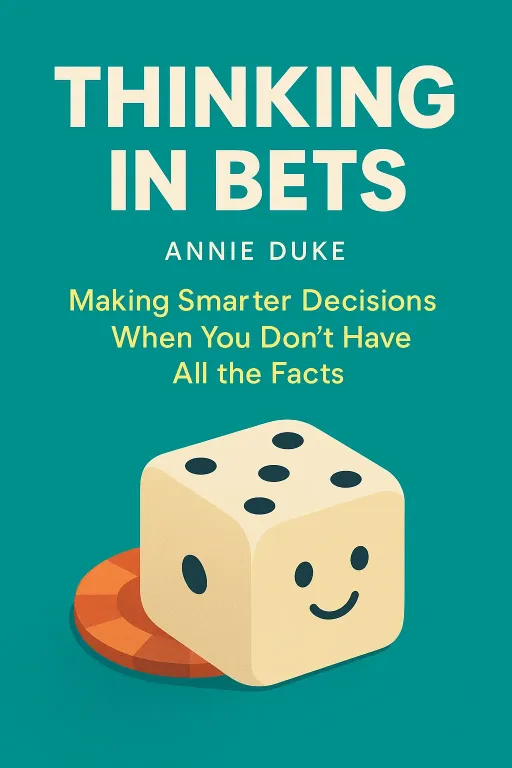
Nova: Alright, Atlas, quick game. We're talking decision-making today, two incredible books. I want your five-word review for Annie Duke's "Thinking in Bets." What comes to mind?
Atlas: Ooh, five words... "Poker insights, life-changing decision framework."
Nova: Solid! And it really is. Annie Duke, a former professional poker player—think about that, a world-class poker player—wrote this book that completely reframes how we think about risk and uncertainty. She didn't just play the game; she mastered the behind the game, which is what makes her insights so universally applicable, whether you're at a card table or in a boardroom.
Atlas: Okay, my turn for the five-word review for "Noise" by Daniel Kahneman, Olivier Sibony, and Cass R. Sunstein. I'd say: "Hidden inconsistency slays good judgment."
Nova: Perfect! And Kahneman, of course, a Nobel laureate, whose work has fundamentally reshaped our understanding of human judgment. "Noise" builds on that, revealing a pervasive problem we often overlook. The core of our podcast today is really an exploration of how to make more robust, less error-prone decisions by understanding the hidden psychological traps that plague our judgment. Today we'll dive deep into this from two perspectives. First, we'll explore how to judge our decisions by the process, not just the outcome, thanks to a former poker pro. Then, we'll unpack the subtle but pervasive problem of 'noise' that wreaks havoc on consistency, even among experts.
Probabilistic Thinking & Avoiding Resulting
SECTION
Nova: So, let's start with Annie Duke and a concept she calls "resulting." It’s our natural human tendency to judge the quality of a decision based solely on its outcome. If it turned out well, it must have been a good decision. If it turned out poorly, it must have been a bad decision. But that's a massive cognitive trap.
Atlas: Hold on, I mean, isn't marketing all about results? If a campaign bombs, doesn't that inherently mean the decision to launch it was bad? For someone looking to prove their worth in a dynamic marketing environment, the outcome feels like the only metric that matters.
Nova: That’s exactly the trap. Imagine a marketing team that launches a brilliant, data-driven campaign. They did all their research, targeted the right audience, crafted compelling messaging. Every indicator pointed to success. Then, a global pandemic hits, or a major competitor launches an unexpected, disruptive product on the same day. The campaign underperforms. Was the bad?
Atlas: No, I see what you mean. The process was sound, but external, unpredictable factors derailed the outcome. That’s a tough pill to swallow when you're on the hook for KPIs.
Nova: Exactly. Conversely, imagine a marketing manager who, on a whim, decides to dump a huge budget into a risky, untargeted social media stunt. By pure luck, it goes viral and brings in massive leads. Was that a good?
Atlas: Well, the outcome was great, but the was terrible. They just got lucky. I guess that makes sense in hindsight, but in the moment, it feels like you just want the win, however it comes.
Nova: And that's where probabilistic thinking comes in. Annie Duke, from her poker background, understands that you can make the absolute best decision given the information available, and still lose the hand. The goal isn't to be right 100% of the time; it's to consistently make high-quality decisions that of a good outcome over the long run. It’s about understanding that there’s a distribution of possible outcomes for any decision, not just a single, guaranteed result.
Atlas: So you're saying, for someone in marketing, it’s about meticulously documenting the rationale behind every strategic choice – the data, the assumptions, the risks considered – rather than just celebrating the wins and sweeping the losses under the rug? It sounds like an exercise in radical honesty with yourself and your team.
Nova: Precisely. It’s about creating a feedback loop that evaluates the, not just the. If you only look at outcomes, you might repeat bad processes that got lucky, or abandon good processes that just had bad luck. This allows you to learn and improve your decision-making muscle, regardless of short-term wins or losses.
Distinguishing & Reducing Noise in Judgment
SECTION
Nova: And that naturally leads us to the second key idea we need to talk about, which often acts as a counterpoint to what we just discussed: the concept of ‘noise.’ Have you ever noticed how two equally competent people, given the exact same information, can arrive at wildly different conclusions or make vastly different judgments?
Atlas: Oh, I've absolutely seen that. Especially in creative fields or strategic planning. You get two brilliant strategists, show them the same market research, and one says "Let's go after Gen Z with TikTok!" and the other says "No, we need long-form content for Gen X!" It’s baffling sometimes.
Nova: That’s noise. Daniel Kahneman, and his co-authors in "Noise," define it as unwanted variability in judgments. It’s not about, which is a systematic deviation in judgment – like always overestimating your own abilities. Noise is the random scatter, the inconsistency. Think of a target: bias is if all your shots are consistently off-center in one direction. Noise is if your shots are scattered all over the target, even if, on average, they hit the bullseye.
Atlas: Wow, that’s kind of heartbreaking. So it’s not just about systematic errors, but just... random inconsistency? How can we even trust expert opinions then? It implies that even highly trained professionals, like doctors diagnosing the same patient or judges sentencing the same crime, might make different calls based on factors that shouldn't matter, like the time of day, how hungry they are, or their mood.
Nova: Exactly! The book gives stark examples. In one study, experienced underwriters were asked to estimate insurance premiums for the same client, and their estimates varied by as much as 55% for identical cases. In another, judges gave vastly different sentences for similar crimes. This isn't about conscious bias; it's about the inherent variability in human judgment. In marketing, think about two different creative directors evaluating the same ad concept, or two different market researchers interpreting the same qualitative data. Their personal experiences, their current mood, the last meeting they had – all these 'noisy' factors can subtly sway their judgment, leading to inconsistent decisions.
Atlas: Okay, so if we can't eliminate the human element, which is full of noise, what hope do we have? How do we reduce this insidious inconsistency, especially when we're trying to build consistent brand messaging or evaluate campaign performance across a team?
Nova: That’s where the strategies to reduce noise come in. One powerful method is 'decision hygiene.' It’s about structuring the decision-making process to reduce variability. This means breaking down complex decisions into smaller, independent components, making judgments on each component separately, and then aggregating them. For example, instead of a team just giving a gut feeling on a new product launch, they might individually rate its market fit, competitive advantage, resource requirements, and risk factors, before coming together to discuss and combine those assessments.
Atlas: So, for a marketing team, this could mean creating standardized rubrics for evaluating creative briefs, or structured checklists for campaign launches, rather than just relying on amorphous "good judgment." It's about building guardrails.
Nova: Precisely. Another technique is using 'mediating assessments.' Instead of trying to make a final judgment all at once, you break it into intermediate judgments that are less susceptible to noise. For instance, rather than asking a team to directly estimate the potential ROI of a campaign, you might first ask them to estimate the reach, then the engagement rate, then the conversion rate, and then combine those to get to ROI. Each step is a more focused, less noisy judgment.
Atlas: That makes so much sense. It takes the pressure off making one big, potentially noisy judgment and breaks it into smaller, more manageable, and hopefully more objective pieces.
Synthesis & Takeaways
SECTION
Nova: So, bringing these two powerful ideas together – avoiding resulting and reducing noise – what we're really talking about is building a more robust, resilient decision-making system. It’s about understanding that the world is probabilistic, and outcomes are often a mix of good decisions and good luck, or bad decisions and bad luck.
Atlas: And also acknowledging that even with the best intentions, our judgments are inherently inconsistent if we don't actively build structures to reduce that 'noise.' It's a huge shift from just trusting your gut.
Nova: Right. If you can consistently make good decisions based on sound processes, and if you can reduce the random variability in those judgments, you dramatically increase your chances of long-term success, even if individual outcomes sometimes go against you. For any marketing professional, especially those starting out, mastering these two concepts isn't just about making better individual choices; it's about building a foundation for a career defined by strategic excellence and consistent, high-quality thinking.
Atlas: That’s actually really inspiring. It means even when a campaign doesn't hit its target, you can still learn from the process, not just beat yourself up over the outcome. And knowing that we can actively design systems to reduce judgment noise gives me a lot of hope for more consistent, fairer evaluations. I imagine a lot of our listeners are now thinking about a recent decision where the outcome was poor. How effectively did they separate the quality of their decision from the luck of the outcome?
Nova: It’s a profound question, and one we should all ask ourselves regularly. The journey to better decision-making is less about finding a magic formula and more about continually refining your process and understanding the subtle forces that shape your judgment.
Atlas: We'd love to hear your thoughts on this. Have you ever been 'resulted'? Or seen 'noise' derail a project? Share your experiences with us.
Nova: This is Aibrary. Congratulations on your growth!