Beyond Timelines: How History Shapes Your Present Decisions
Golden Hook & Introduction
SECTION
Nova: You think history is over. Done. Dusted. I'm here to tell you, it's not. It's actively shaping your next big decision, right now, without you even knowing it.
Atlas: Whoa, Nova. That's a bold claim. Most people think history is, well,. Like a textbook we passed in high school.
Nova: Exactly! And that's the precise blind spot we're talking about. Today, we're cracking open "Beyond Timelines: How History Shapes Your Present Decisions," a concept that argues history isn't just a record of the past, but a living, breathing force influencing every choice we make today. It's really about how we can transform our understanding of history from a dusty archive into a dynamic, predictive tool for making better decisions in our present and future.
Atlas: Okay, so you're saying the past isn't even past? That's a pretty big paradigm shift for anyone who's used to just looking forward.
The Blind Spot: Why History Isn't Just the Past
SECTION
Nova: It absolutely is, Atlas. And that's where we start: understanding this 'blind spot.' We often treat history like a static photograph, perfectly preserved but totally separate from our active, moving lives. But that photograph isn't just hanging on the wall; it's a blueprint for the house you're currently living in, and you just might not realize you're walking the same worn paths.
Atlas: So you're saying that "history repeats itself" isn't just a cliché, it's a warning sign we're actively ignoring? Like we're driving forward but only looking in the rearview mirror, and even then, we're not really seeing the patterns?
Nova: Even more than that, Atlas. It's like we're driving forward, but the car itself was designed based on decades-old assumptions about roads and traffic that no longer apply. We're running on outdated mental software. Consider the classic example of Blockbuster versus Netflix. Blockbuster had the historical data of physical rentals, which told them people loved browsing aisles. Netflix saw the historical of convenience and digital disruption. One saw static history, the other saw a dynamic force. And we know how that story ended.
Atlas: That's a powerful example. It makes me think about any industry, really, where people are stuck in "the way things have always been done." So, the blind spot isn't just about history, it's about its relevance?
Nova: Precisely. It's about seeing history as a series of isolated events rather than a continuous, evolving dataset that offers probabilities, not certainties. We miss emerging trends because we're too busy looking for exact historical parallels, which rarely exist.
Atlas: That's a profound thought. We're often taught history as a sequence of events, not as a living, breathing influence. It’s like being given a map of a city from a hundred years ago and expecting it to perfectly guide you through today’s traffic.
Nova: Exactly! And the danger is, when we fail to recognize history’s active role, we limit our ability to predict, adapt, and make truly informed choices. We end up repeating old mistakes, not because we’re doomed to, but because we’re operating with an incomplete picture.
Atlas: So, the "blind spot" isn't just a passive oversight; it's an active hindrance to progress and good decision-making. It actively prevents us from spotting emerging trends.
Nova: That’s a great way to put it, Atlas. Think of it like this: if you’re a business owner, and you only look at your sales data from last quarter, you might miss a decade-long shift in consumer behavior that's slowly eroding your market. You're too focused on the immediate past to see the larger historical current.
Atlas: Oh, I know that feeling. It's easy to get caught up in the immediate, the urgent, and forget to zoom out. It's almost like we're hardwired to prioritize the present, even if the past holds crucial clues.
Nova: We are, to some extent. Our brains love efficiency and shortcuts. But when it comes to complex decisions, those shortcuts can lead us astray. The challenge is to consciously override that instinct and engage with history in a more sophisticated way.
Atlas: So, how do we actually do that? How do we move beyond just "knowing" history to actually it as a tool?
The Probabilistic Lens: Turning History into a Decision-Making Superpower
SECTION
Nova: That's the million-dollar question, Atlas. And that naturally leads us to the second key idea we need to talk about, which often acts as a counterpoint to what we just discussed: turning history into a decision-making superpower. It's about shifting our perspective.
Atlas: Okay, so if we can't just ignore history, and we can't just blindly repeat it, how do we actually it? How do we turn this "blind spot" into a superpower?
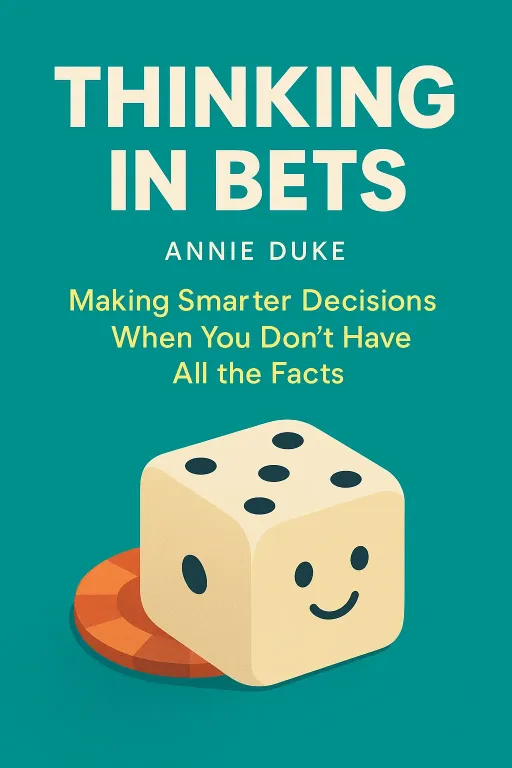
Nova: We do it by adopting what I call a "probabilistic lens." We turn to brilliant minds like Annie Duke, a former professional poker player and author of "Thinking in Bets." Duke teaches that good decisions aren't about being right every time, but about understanding probabilities and learning from outcomes.
Atlas: So, it's like history gives us a better set of odds, rather than a crystal ball? I imagine a lot of our listeners, especially those who love exploring new knowledge and deep thinking, might be trying to apply this to their own big life choices. How do Duke and Rosling help us actually that?
Nova: They show us how to upgrade our mental models. Duke demonstrates that good decisions aren't about being right every time, but about understanding the of possible outcomes and their likelihoods. History, in this context, becomes a vast dataset of past "bets" and their results. You look at similar situations, not identical ones, and ask: what were the variables? What were the typical outcomes?
Atlas: That's fascinating. So, we're not looking for exact replicas of past events, but rather for the underlying mechanisms and probabilities that played out.
Nova: Exactly. And then you bring in Hans Rosling, the incredible author of "Factfulness." Rosling adds the critical layer of our own historical biases. He reveals how our dramatic worldview, often shaped by sensationalized historical narratives or media, distorts our perception of present realities.
Atlas: Ah, so Rosling helps us challenge those "outdated echoes" you mentioned earlier. He's saying our perception of history can be fundamentally flawed, leading to inaccurate assessments of the present.
Nova: Precisely. Rosling uses global historical data – on health, poverty, education – to show that many things are significantly better than we perceive. He challenges our "doom and gloom" historical echoes by presenting cold, hard facts. He’s essentially saying, "Look at the data, not just the dramatic stories you've heard."
Atlas: That’s a powerful combination. When we combine Duke's probabilistic approach with Rosling's fact-checking, history becomes this incredible tool for navigating uncertainty. It's not about memorizing dates, it's about spotting patterns and correcting our internal narratives. But it feels like it takes a lot of mental work to overcome those ingrained biases.
Nova: It does take effort, but the payoff is immense. It's about moving from a "this happen" mindset to a "what are the this will happen, and what's my best strategy given those chances?" mindset. History provides the raw material for those probabilities. It's the ultimate learning laboratory, if we just know how to read the data correctly.
Atlas: So, instead of being a passive recipient of history, we become an active interpreter, using its vast dataset to make more informed "bets" in our own lives. That’s a true intellectual superpower.
Nova: And it’s not just for grand geopolitical decisions or market analysis. It applies to personal choices too. Maybe you’re deciding on a career change. Looking at the historical trends of various industries, the rise and fall of particular skill sets, can give you a much clearer picture of the probabilities involved.
Atlas: I can see that. It's about understanding the context, the forces at play, not just hoping for the best. It’s like a doctor using a patient's full medical history, not just their current symptoms, to make a diagnosis.
Nova: That’s a perfect analogy, Atlas. A doctor doesn't predict you get a certain disease, but they assess your based on your medical history and broader population data. That's exactly how we should approach history: as a record of probabilities and outcomes, not prophecies.
Synthesis & Takeaways
SECTION
Nova: Ultimately, what both these brilliant minds show us is that history, far from being a dusty relic, is an incredibly powerful, living dataset. It's like a grand, unfolding experiment, and we have the privilege of learning from all the past trials and errors.
Atlas: So, the real takeaway here isn't just about understanding history, it's about rethinking how we it. It's about applying a probabilistic, data-driven lens to our past to inform a more adaptable, more informed future. For anyone who enjoys challenging conventional thinking, this is a profound shift.
Nova: Absolutely. It's about empowering ourselves with a more accurate understanding of the world, past and present. It's shedding that "blind spot" and embracing the dynamic, active role history plays. It forces us to ask: What current belief do you hold that might be an outdated echo from a historical narrative, rather than a present reality?
Atlas: That's a question that could keep me up at night, in the best way possible. It's a call to continuous learning and self-reflection. And for our listeners who crave unique insights, that's what this episode is all about.
Nova: Indeed. It encourages us to constantly re-evaluate our mental models, to be open to new data, and to challenge those narratives that might be holding us back, simply because they've always been there.
Nova: This is Aibrary. Congratulations on your growth!