Beyond the Buzzwords: The Strategic Advantage of True Critical Thinking
Golden Hook & Introduction
SECTION
Nova: We often hear that strong convictions are a sign of strength, a hallmark of leadership. We're told to have a point of view, to stand firm. But Atlas, what if I told you that in the arena of true critical thinking, your strongest opinions might actually be your biggest blind spots?
Atlas: Oh man, that's a bit of a curveball, Nova. I imagine a lot of our listeners, especially those who are driven by growth and leadership, probably pride themselves on having strong opinions. It's almost seen as a prerequisite for making tough calls. Are you suggesting we should all just… waffle?
Nova: Not at all! In fact, it's the opposite. We're talking about moving beyond superficial conviction to cultivate a truly critical, probabilistic mindset that transforms decision-making for strategic advantage. Today, we're diving into the profound insights that help us achieve just that.
Atlas: Okay, so this isn't about being indecisive. It's about being at deciding. I like that. So, what's the core problem we’re tackling here? Where do these 'blind spots' come from?
Nova: Exactly. Many of us, myself included, often mistake having a strong opinion for actually. We collect facts, sure, but then we use those facts to reinforce what we already believe, rather than truly exploring the landscape of possibilities. This isn't just a minor oversight; it's a significant impediment to effective problem-solving and strategic edge.
Atlas: That makes sense. It’s like we gather evidence to win an argument, not to actually uncover the truth.
The Blind Spot: Opinion vs. Critical Thinking
SECTION
Nova: Precisely. And this isn't some abstract philosophical problem. This blind spot has real-world consequences. Think about a recent decision where the outcome was poor. Can you separate the quality of your decision-making process from the bad luck of the outcome? Most people struggle with that. We blame the outcome, or we blame ourselves for not being 'smart enough,' when the real issue might have been our process.
Atlas: Oh, I've been there. I totally know that feeling. It's easy to look back and say, "Well, was a terrible idea," but it felt like the best idea at the time.
Nova: Let’s paint a picture. Imagine a leader, let's call her Sarah, who runs a mid-sized tech company. Sarah has a strong opinion, a gut feeling, that the next big thing in her industry is a niche virtual reality application for corporate training. She’s read a few articles, seen some impressive demos, and she's incredibly passionate about it. Her conviction is palpable. She speaks about it with unwavering certainty in every board meeting.
Atlas: That sounds like a leader making a decisive move, which is often applauded.
Nova: It is, on the surface. Her team, impressed by her conviction, rallies behind her. They pour significant resources—millions of dollars, years of development time—into this VR project. They’re so focused on validating Sarah's strong opinion that they barely consider alternative market trends, or the low probability of mass adoption for VR in corporate settings at that specific time. They don't look at the competitive landscape with a truly open mind.
Atlas: So, they're not just executing her vision; they're almost her vision, rather than critically assessing it.
Nova: Exactly. Fast forward two years. The VR application launches to a lukewarm reception. The market isn't ready, the tech is still clunky for widespread use, and competitors have pivoted to more immediate, practical AI solutions that are gaining traction. Sarah’s company takes a huge financial hit, loses key talent who feel demoralized, and falls behind its rivals. The outcome was poor, but was the decision-making process truly?
Atlas: That’s kind of heartbreaking, actually. Because Sarah probably felt like she was being a strong leader. She had a clear vision. But the blind spot was that her conviction overshadowed a genuine exploration of probabilities and uncertainties. It sounds like the pressure to appear certain can be a real trap for "Future-Focused Leaders."
Nova: It absolutely is. The human brain is wired for narrative and certainty, not for probabilities and nuanced uncertainty. We prefer a clear story, even if it's a less accurate one, over a messy, probabilistic truth. This tendency, this "blind spot," is why we often struggle with effective problem-solving in complex, dynamic environments.
The Probabilistic Mindset: Separating Decision Quality from Outcome Quality
SECTION
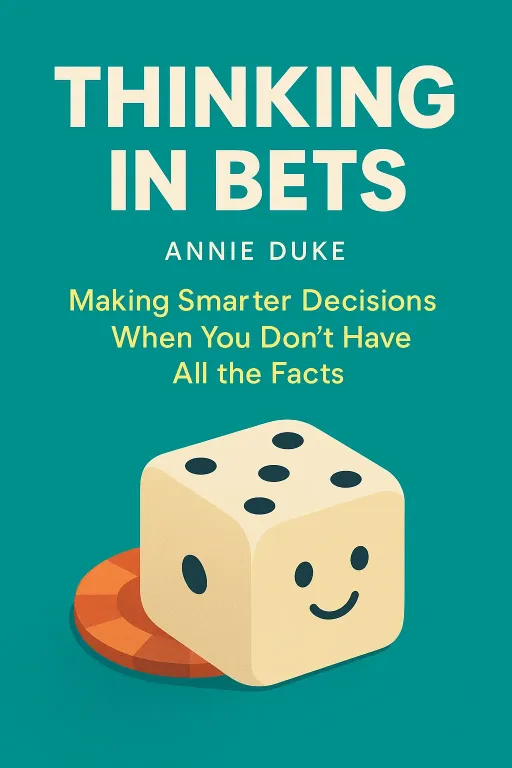
Nova: So, if strong opinions are a trap, what's the antidote? It's about cultivating a probabilistic mindset, a skill that's been brilliantly dissected by people like Annie Duke, a former professional poker player, in her book "Thinking in Bets," and by Philip Tetlock and Dan Gardner in "Superforecasting."
Atlas: Oh, I like that. "Thinking in Bets." That immediately sounds more practical for a "Practical Strategist" than just "having a strong opinion." But what does a poker player know about strategic business advantage?
Nova: Well, everything, as it turns out. Duke teaches us to separate the quality of a decision from the quality of its outcome. In poker, you can make the absolute best mathematical decision, with a 90% chance of winning, and still lose that hand because of sheer bad luck. That doesn't mean it was a bad decision. Conversely, you can make a terrible play, catch a lucky card, and win the hand. That doesn't make it a good decision.
Atlas: Wow, that’s actually really inspiring. So basically you’re saying, a good process, even if it sometimes leads to a bad outcome, is still a good process. And a bad process, even if it sometimes leads to a good outcome, is still a bad process.
Nova: Exactly! It frees you from the tyranny of results. If you consistently make high-probability decisions, over the long run, you will win. It shifts your focus from judging individual outcomes to evaluating the decision-making process itself. This fosters better long-term strategic choices because you're constantly learning and refining your approach, rather than just reacting to luck.
Atlas: So how do you actually this probabilistic mindset? Does it mean we can never be confident? For someone who's used to making quick, confident calls, this might feel a bit… wishy-washy.
Nova: Not wishy-washy at all. It's about being confidently uncertain. Think about the 'superforecasters' that Philip Tetlock and Dan Gardner studied. These are ordinary people who consistently make remarkably accurate predictions about geopolitical events, economic trends, and social issues. They're not psychics; they're just incredibly good at probabilistic thinking.
Atlas: Like how? Can you give an example?
Nova: Absolutely. A superforecaster approaches a question like "Will Country X join the trade agreement by next year?" They don't say "yes" or "no." Instead, they start with a base probability, say 60%. Then, they actively seek out diverse information, even contradictory evidence. They consider multiple perspectives, they're open to being wrong, and crucially, they constantly their probabilities as new information comes in. They might adjust from 60% to 55%, then to 70%, then back to 65%.
Atlas: So, it's a continuous, iterative process, not a one-and-done declaration. That makes me wonder, how would Sarah, our tech leader from before, have approached her VR project with this mindset?
Nova: She would have started by assigning probabilities. "What's the likelihood of mass adoption for corporate VR in three years? 30%? 50%?" She would have sought out dissenting opinions, actively looked for data that challenged her initial enthusiasm. She would have set clear metrics for when to update her probabilities and when to pivot. Instead of a single, all-in bet, she might have made smaller, staged bets, learning at each step, and adjusting her course based on evolving probabilities, not just her gut feeling.
Atlas: That’s a great way to put it. It’s like trading the comfort of a strong opinion for the resilience of a robust process. It empowers you to make more robust decisions even when information is incomplete or ambiguous, which is basically the definition of being a "Curious Explorer" in any complex field.
Nova: Precisely. It’s about understanding that the world is inherently uncertain, and our job isn't to eliminate that uncertainty, but to navigate it intelligently using the best available information and a flexible, probabilistic framework.
Synthesis & Takeaways
SECTION
Nova: So, what we're really talking about here, Atlas, is that true strategic advantage doesn't come from having the loudest opinion or the most unshakeable conviction. It comes from the humility to embrace uncertainty and the discipline to think probabilistically. It's separating our ego from the outcome, and focusing on the quality of our decision-making process itself.
Atlas: That’s actually really inspiring. It means that even if a decision doesn't work out, it doesn't mean you failed as a leader or strategist, as long as your process was sound. It encourages continuous learning, rather than just outcome-based judgment. For anyone looking to grow and prepare for success, this is a fundamental shift.
Nova: Absolutely. Cultivating this mindset allows you to make more robust decisions, even when information is incomplete or ambiguous. It’s about building a foundation of resilience and adaptability, which are invaluable traits in any high-stakes environment.
Atlas: That gives me chills, thinking about how many past decisions I've judged purely on their outcome, rather than the information I had at the time. So, for our listeners who are reflecting on their own decision-making, I'd challenge them to think about a recent decision where the outcome was poor. Can you truly separate the quality of your decision-making process from the bad luck or unexpected circumstances of the outcome? It's a tough but incredibly enlightening question.
Nova: A powerful question, Atlas. And one that starts us on the path to becoming truly critical thinkers.
Nova: This is Aibrary. Congratulations on your growth!