

Designing for Human Behavior: Beyond the Rational Actor
Golden Hook & Introduction
SECTION
Nova: Atlas, if I told you that the quality of your decision has absolutely nothing to do with whether the outcome was good or bad, what would you say?
Atlas: Oh, I like that! That sounds like something I’d tell myself after a particularly… stock trade. But seriously, it flies in the face of everything we're taught about cause and effect, doesn't it? Like, if the outcome was bad, the decision must have been flawed.
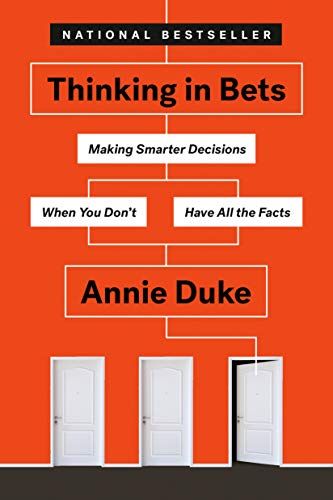
Nova: Exactly! And that's the core idea Annie Duke explores in her incredible book,. Duke, a former professional poker player and decision strategist, brings a fascinating blend of high-stakes experience and cognitive psychology to the table, arguing that we live in a world of probabilities, not certainties.
Atlas: Oh, I can definitely relate to that. For anyone trying to make strategic choices in unpredictable markets, the idea of separating decision quality from outcome quality feels incredibly liberating. It's like, finally, someone's acknowledging that we're not always playing with a full deck.
Nova: Exactly. And for an analytical mind like yours, and many of our listeners, who are constantly trying to understand the 'why' behind complex systems, moving beyond deterministic thinking to embrace probabilistic reasoning empowers more robust strategic choices in uncertain environments. It’s about building resilience, not just aiming for perfection.
Probabilistic Thinking: Embracing Uncertainty
SECTION
Atlas: So, Nova, let's unpack this. What do you mean by probabilistic thinking, especially in the context of Duke's work? Is it just about calculating odds, or is there more to it?
Nova: It's so much more! It’s about understanding that every decision we make exists on a spectrum of probability. Imagine a doctor making a diagnosis. They don't for certain what's wrong, but based on symptoms, tests, and experience, they assign probabilities to different conditions. It's about acknowledging inherent uncertainty and making the best decision given the information available, rather than waiting for perfect knowledge.
Atlas: I guess that makes sense. It’s like, in strategic analysis, we often chase certainty, creating elaborate models that promise definitive answers. But then the real world happens, and it rarely aligns. So, Duke is saying we should embrace that messiness?
Nova: Precisely. She brings in this brilliant concept from poker: you can play a hand perfectly, make all the right statistical decisions, and still lose to a lucky draw. Conversely, you can play terribly and get lucky. The of your decision is judged by the process and the information you had, not by whether you won or lost.
Atlas: Wow, that’s actually really inspiring. Because if you only judge by outcomes, you end up with "resulting," right? Where you retroactively declare a bad decision good if it worked out, or a good decision bad if it didn't.
Nova: Absolutely. "Resulting" is a cognitive trap. Duke argues that when we confuse a good outcome with a good decision, we learn the wrong lessons. We might repeat bad processes because we got lucky, or abandon good processes because we had bad luck. This is particularly critical for strategic analysts. If a major project fails, is it because the strategy was flawed, or because an unforeseen market shift occurred? Probabilistic thinking forces us to dissect the decision-making process itself, not just the end result.
Atlas: That makes me wonder, how does Duke suggest we actually this? How do we distinguish between a good decision and a good outcome in practice? Because it feels like our brains are hardwired to connect the two.
Nova: She suggests a few things, but a key one is retrospective analysis, or what she calls a "decision journal." It's about documenting your beliefs, the information you had, the probabilities you assigned, and your reasoning the outcome is known. Then, after the fact, you compare that to what actually happened. This helps you identify biases, flawed assumptions, and areas where your probabilistic estimates were off. It’s a continuous learning loop.
Atlas: That’s a great way to put it. For someone like me, who's always trying to understand the 'why' and improve systems, that journaling approach seems invaluable. It shifts the focus from blaming external factors to refining our internal process. It’s about continuous calibration.
Architecting Better Decisions: From Theory to Practice
SECTION
Nova: Now, taking that core idea, how do we move beyond just an individual mindset shift and actually architect better decisions within an organization? This is where our second core topic comes in: Architecting Better Decisions. It’s about building systems resilient to unforeseen challenges and guiding users toward beneficial choices.
Atlas: Okay, so how do we take this probabilistic mindset and embed it into the very fabric of how we operate? For a strategic analyst, it’s not enough to just probabilistically; we need to for it.
Nova: Exactly. Duke, along with other behavioral economists, emphasizes the power of what she calls "tiny steps." It’s about making the abstract concrete. For example, before making your next significant decision, explicitly list the knowns, unknowns, and potential outcomes, assigning probabilities where possible. It’s not about perfection, but about making the implicit explicit.
Atlas: So you’re saying, instead of just gut-feeling a major product launch, I should actually sit down and say, 'Okay, what's the 70% chance this happens, the 20% chance that happens, and the 10% chance of a black swan event?'
Nova: Precisely. And then, for each of those potential outcomes, what are your contingency plans? What signals would indicate you're heading down the 20% path versus the 70% path? This isn't just about risk assessment; it's about building adaptability into your strategy from the outset. It’s about designing for robustness.
Atlas: That makes sense. It’s kind of like, for our listeners who are navigating complex digital landscapes, this isn't just about targeting consumer psychology; it's about building ethical marketing systems that anticipate user behavior, even when it's irrational, and guide them responsibly.
Nova: Absolutely. It ties into the "deep question" we posed: How can a strategic analyst use probabilistic thinking to design systems that are resilient to unforeseen challenges and guide users toward beneficial choices, even in complex scenarios? It’s about creating an environment where the default is a good decision, even under uncertainty. Think of it like a well-designed user interface. It subtly nudges you towards the desired action without you even realizing it.
Atlas: So, it's not just about me as an individual making better choices, but about creating systems – whether it's a new AI platform or a marketing funnel – that inherently lead to better outcomes because they account for the probabilistic nature of human behavior.
Nova: That’s the profound insight. It’s about moving from a reactive stance to a proactive architectural one. Instead of hoping people make the "right" choice, you design the environment so that the most probable outcome is the one you desire, while also building in mechanisms to adapt when less probable outcomes occur. It’s about understanding the human element of technology and designing for it.
Atlas: That’s actually really inspiring. It’s like, if we’re going to leverage AI and automation for future competitive advantage, we need to embed this probabilistic, human-centric design at its core, not just bolt it on later. Otherwise, we're just automating our biases.
Nova: Exactly. It's about designing for the human, not just for the ideal rational actor. And that means acknowledging our inherent biases, our tendencies, and the fact that we operate in a world of probabilities.
Synthesis & Takeaways
SECTION
Nova: So, Atlas, as we wrap up, what's the biggest takeaway for you from exploring Annie Duke's and the power of probabilistic thinking?
Atlas: For me, it's the liberation from "resulting." The idea that I can make a meticulously thought-out decision, and it can still lead to a less-than-ideal outcome, without that invalidating the quality of my initial decision. It shifts my focus from outcome obsession to process mastery. It’s about trusting my insightful perspective, as our growth recommendations suggest, and continuously refining my process.
Nova: And that's so crucial for anyone in a strategic role. It's about building resilience, not just chasing a single, perfect outcome. It gives you the mental fortitude to keep pushing forward, to keep learning, even when things don't go your way. It's about recognizing that the world is inherently uncertain, and our job is not to eliminate that uncertainty, but to navigate it with greater skill and foresight.
Atlas: Absolutely. And the practical application of listing knowns, unknowns, and probabilities before a big decision—that's a tiny step with massive potential impact. It’s a direct bridge from theory to practice, connecting those deep dives to tangible applications.
Nova: It truly is. It's about embracing uncertainty not as a weakness, but as the fundamental nature of reality, and then learning to thrive within it. It’s an invaluable lesson for anyone seeking to drive meaningful impact and positive change in a complex world.
Atlas: That’s a hopeful way to look at it. Especially when so many things feel out of our control.
Nova: This is Aibrary. Congratulations on your growth!