The Mind's Operating System: Hacking Your Decisions for Tech and Life
10 minGolden Hook & Introduction
SECTION
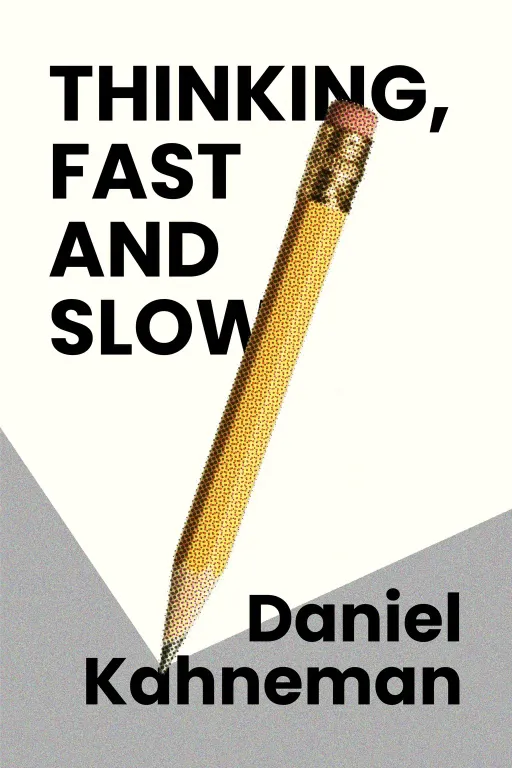
Dr. Celeste Vega: Imagine you’re a senior executive. Your company has already sunk 50 million dollars into a high-stakes project. Now, the forecasts are grim, and it’s clearly failing. Your team comes to you with a choice: invest another 60 million to try and save it, or cut your losses. What does your gut tell you? Most of us feel a powerful urge to double down, to not let that initial investment be a 'waste.' Today, we're diving into Daniel Kahneman's masterpiece,, to understand why that gut feeling is so often wrong. With us is Shiray Han, a tech innovator and analytical thinker. Welcome, Shiray!
Shiray Han: Thanks for having me, Celeste. That opening scenario is uncomfortably familiar for anyone in tech.
Dr. Celeste Vega: Exactly. And Kahneman's work is like a user manual for that discomfort. It reveals the mind's hidden 'operating system.' Today we'll dive deep into this from two perspectives. First, we'll explore the 'Endowment Effect'—the psychological trap that makes us overvalue our own ideas and possessions. Then, we'll tackle that exact 'Sunk-Cost Fallacy' and reveal a powerful strategy called 'broad framing' to help us cut our losses and make smarter choices, both in our careers and our finances.
Shiray Han: I'm ready. It feels like we're about to debug the human brain.
Deep Dive into Core Topic 1: The Endowment Effect
SECTION
Dr. Celeste Vega: I love that framing! Debugging the brain. Well, that attachment to a failing project is so powerful, and Kahneman argues it starts with a much simpler bias, something he calls the 'Endowment Effect.' It's this weird quirk where, the moment we own something, our brain secretly inflates its value.
Shiray Han: So just by possessing an object, we think it's worth more?
Dr. Celeste Vega: Precisely. And the experiment that proved this is brilliantly simple. Kahneman and his colleagues went into a classroom. They divided the students into two groups. The first group, the 'Sellers,' were each given a coffee mug, a nice one with the university logo on it. They were told the mug was theirs to keep. The second group, the 'Buyers,' were given nothing. They were just told to examine their neighbor's mug.
Shiray Han: Okay, so one group is endowed with the mug, the other isn't.
Dr. Celeste Vega: Exactly. Then, they set up a market. The Sellers were asked for the lowest price they’d sell their mug for. The Buyers were asked for the highest price they’d pay for one. Now, rationally, you'd expect the prices to be pretty similar, right? It's the same mug. But the results were staggering. The Sellers, on average, wouldn't part with their mug for less than about seven dollars.
Shiray Han: And the Buyers?
Dr. Celeste Vega: They wouldn't pay more than about three dollars. The Sellers valued the mug they owned more than twice as much as the Buyers did. Kahneman explains this isn't about logic; it's about our two systems of thinking. Our fast, intuitive System 1 is wired for loss aversion. For the Sellers, giving up the mug is a, and our brain registers losses much more painfully than it registers gains. For the Buyers, it's just a potential gain, so they're less emotional about it.
Shiray Han: That's fascinating, Celeste. And it's so much bigger than just coffee mugs, isn't it? In the tech world, we see this constantly with ideas. A product manager who first conceptualized a feature, or an engineer who wrote a brilliant but now obsolete piece of code—that's mug. They are endowed with that idea.
Dr. Celeste Vega: That's a perfect analogy.
Shiray Han: So when user data comes back and shows the feature is confusing, or a new technology makes the code redundant, they'll fight to keep it. They'll argue for its potential, they'll defend it in meetings. And it's not because they're irrational in general; it's because letting that idea go feels like a tangible, personal loss. They're experiencing the Endowment Effect for an intangible asset.
Dr. Celeste Vega: It's the pain of giving up something that feels like a part of you. This is why it's so hard for creators and innovators to 'kill their darlings.' The idea has become part of their endowment.
Shiray Han: It's a cognitive status quo bias. We anchor to what we have, whether it's a physical object, a stock in our portfolio, or an idea we've championed. And that makes it incredibly difficult to pivot or innovate, because every change away from what we 'own' feels like a loss.
Deep Dive into Core Topic 2: The Sunk-Cost Fallacy & The CEO's View
SECTION
Dr. Celeste Vega: Exactly. And that irrational attachment to our 'endowed' ideas is the gateway to an even more expensive bias: the Sunk-Cost Fallacy, which brings us back to that 50-million-dollar failing project from the beginning.
Shiray Han: Right, the urge to throw good money after bad.
Dr. Celeste Vega: It's the same mechanism, just scaled up. The Sunk-Cost Fallacy is our tendency to continue with an endeavor not because it's likely to succeed, but because we've already invested time, money, or effort. That initial investment becomes an endowment, a mental account we don't want to close at a loss. Kahneman describes a classic business scenario: a company has a project that's already consumed $50 million. It's now behind schedule and the market has changed, making its prospects poor. The choice is to either invest another $60 million to complete it or to abandon it and invest that same amount in a new, far more promising project.
Shiray Han: And the new CEO, who isn't attached to the original decision, would almost certainly pick the new project. But the manager who championed the first one…
Dr. Celeste Vega: …feels the immense pressure of that $50 million sunk cost. Admitting failure means closing that mental account with a massive loss, which is emotionally painful. So, they often convince themselves and the board to invest the extra $60 million, escalating their commitment to a failing course of action. It's System 1 screaming, "Don't accept the loss!"
Shiray Han: We see this in personal finance all the time. People hold onto a losing stock, waiting for it to 'come back' to what they paid for it, even when all evidence suggests it's a bad investment. They're refusing to close that mental account at a loss.
Dr. Celeste Vega: It's a perfect example. But Kahneman doesn't just leave us with the problem; he offers a powerful solution. He calls it 'broad framing' or adopting a 'risk policy.' He tells a story about consulting with the CEO of a large company. He asked the 25 division managers if they would take on a project that had a 50% chance to make $2 million and a 50% chance to lose $1 million.
Shiray Han: Let me guess. Because of loss aversion, most of them said no. The fear of losing a million dollars loomed larger than the prospect of gaining two million.
Dr. Celeste Vega: Not a single one of them was willing to take the gamble. They were all using a 'narrow frame'—looking only at this one, isolated decision. Then Kahneman turned to the CEO and asked him what he thought. The CEO, without hesitation, said, "I would want them all to take it."
Shiray Han: Of course! Because he's not looking at one gamble. He's looking at a portfolio of 25 gambles.
Dr. Celeste Vega: That's the 'broad frame.' The CEO understood that with 25 independent ventures, the law of averages would almost guarantee a massive profit for the company as a whole. The risk of any single division losing money was statistically insignificant from his portfolio perspective. He had a risk policy.
Shiray Han: Okay, that is a game-changer. 'Broad framing' is the perfect term. It’s about shifting your perspective from a single project's P&L to the portfolio's overall ROI. In personal finance, it's the difference between agonizing over one losing stock versus managing the performance of your entire portfolio. You're not making 25 individual, emotional decisions; you're making one rational, statistical one.
Dr. Celeste Vega: You've nailed it. It's a mental model for overriding System 1's narrow, loss-averse panic by engaging System 2's broader, more analytical view.
Shiray Han: It's the kind of thinking that separates a manager from a true leader or a savvy investor. A manager worries about the one project failing on their watch. A leader or an investor understands that if you take enough smart risks, the wins will far outweigh the losses.
Synthesis & Takeaways
SECTION
Dr. Celeste Vega: So we have these two powerful, linked biases. The Endowment Effect makes us fall in love with what we have, whether it's a coffee mug or an idea.
Shiray Han: And the Sunk-Cost Fallacy makes us stick with it even when it's clearly failing, because we can't bear to close that mental account at a loss. And both are driven by our intuitive System 1's deep-seated fear of loss.
Dr. Celeste Vega: But the solution is just as powerful. The key takeaway for me is the power of that 'CEO's view' or broad framing. It's a conscious choice to zoom out.
Shiray Han: It really is. It’s a practical way to engage your logical System 2. So I think the question for our listeners is this: Where in your life—be it your finances, your career, or even a relationship—are you using a narrow frame? What would happen if you zoomed out and looked at it as just one part of a larger portfolio of your life's decisions? That simple shift in perspective might be the most valuable decision you make all week.
Dr. Celeste Vega: A perfect thought to end on. Shiray, thank you so much for bringing your sharp insights to this.
Shiray Han: It was my pleasure, Celeste. This was a fantastic conversation.