Uncover Your Blind Spots: Why Your Mental Maps Might Be Leading You Astray.
8 minGolden Hook & Introduction
SECTION
Nova: What if I told you that your most confident, gut-instinct decisions, the ones you feel most certain about, are often the very choices leading you astray?
Atlas: Whoa, hold on a second, Nova. That's a pretty bold claim! My gut has gotten me out of a few tight spots, I'll have you know. Are you saying my intuition is actually... a liability?
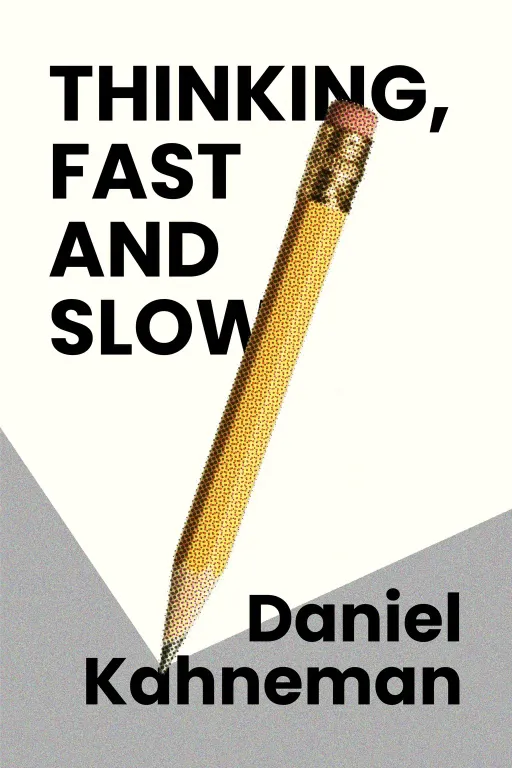
Nova: Not always a liability, Atlas, but definitely something we need to understand better. Today, we're diving into the groundbreaking ideas from two seminal works: Daniel Kahneman's, and by Richard H. Thaler and Cass R. Sunstein. What's truly remarkable about Kahneman's work is how a psychologist won a Nobel Prize in Economic Sciences, fundamentally reshaping our understanding of human rationality and decision-making by blending these two fields. He literally changed how we think about thinking.
Atlas: A psychologist winning a Nobel in economics? That's incredible. It sounds like he wasn't just observing human behavior, but proving its economic impact. So, if my gut isn't always right, what exactly is going on in there? How do these mental blind spots even form?
Unmasking Your Mental Blind Spots: The Hidden Power of System 1 Thinking
SECTION
Nova: That's the million-dollar question, and it brings us right to our first core idea: Unmasking Your Mental Blind Spots, or understanding the hidden power of System 1 thinking. Kahneman introduced us to two systems that govern our minds. Think of System 1 as your brain's autopilot. It’s fast, intuitive, emotional, and operates automatically, often without conscious effort. It’s the system that lets you slam on the brakes when a car swerves, or instantly recognize a friend's face in a crowd.
Atlas: Okay, so System 1 is basically my brain's efficient, subconscious manager. It sounds pretty useful for not getting hit by cars. But you said it can lead me astray?
Nova: Exactly. While incredibly efficient, System 1 is also prone to systematic errors, or cognitive biases. It loves shortcuts, and sometimes those shortcuts lead us down the wrong path. Imagine you're a strategic leader in a fast-paced AI company. You've just heard a compelling presentation about a new AI integration strategy. Your gut tells you, "This is brilliant! It just right." You're confident, you move quickly. But what if that 'feeling right' was actually your System 1 falling for something like the 'availability heuristic'?
Atlas: The availability heuristic? Hit me with it.
Nova: It’s the tendency to overestimate the likelihood of events that are easily recalled or vivid in our memory. Let's say that compelling presentation included a single, dramatic success story from a competitor who implemented a similar AI strategy. A single, powerful narrative of a competitor's triumph. You remember that story vividly, it's emotionally resonant, and suddenly, your System 1 tells you this new strategy is a surefire win. You might overlook the dozens of other companies who tried similar things and failed, because their stories aren't as dramatic or readily available in your memory.
Atlas: Oh man, I can totally see that. It's like when you hear about one person winning the lottery, and suddenly you think your chances are much higher than they actually are. So, in that AI strategy example, my brain is taking a powerful, anecdotal success story and using it to paint an overly optimistic picture, making me confident in a decision that might be far riskier than I perceive?
Nova: Precisely. Your System 1, in its efficiency, prioritizes emotional impact and vividness over statistical likelihood or a comprehensive data analysis. And the dangerous part is, you're often completely unaware it's happening. You genuinely like you've made a rational, data-driven choice, when in reality, an unseen bias has subtly skewed your perception. This is why, for strategists in the AI wave, understanding these internal biases is paramount. If you don't know your own mental operating system, how can you truly shape your future within this complex landscape?
Atlas: That's actually really insightful. It highlights why 'trusting your gut' isn't always good advice, especially when the stakes are high. But in a fast-paced AI environment, aren't quick decisions sometimes necessary? How do we balance speed with accuracy if our gut is often wrong? It sounds like we're all just victims of our own brains, then. Is there any way out, or are we just doomed to make biased decisions?
Beyond Bias: How 'Nudges' Can Reshape Your Decisions and Strategies
SECTION
Nova: Not at all! And that naturally leads us to our second core idea: Beyond Bias, or how 'Nudges' Can Reshape Your Decisions and Strategies. This is where Thaler and Sunstein's work in becomes incredibly powerful. They show us that while our biases are inherent, the environments we operate in can be designed to 'nudge' us towards better choices, without taking away our freedom.
Atlas: So, it's not about forcing people, but subtly guiding them? Can you give me an example that's not about, like, healthy eating in a cafeteria? I'm thinking about how this applies to a team, or an organization trying to implement new tech.
Nova: Absolutely. Think about how many companies struggle with employees adopting new software or AI tools. Often, they'll roll out a new system with a big announcement, maybe some training, and then wonder why adoption rates are low. A 'nudge' approach would be different. Let's say your company wants everyone to use a new AI-powered project management tool. Instead of just introducing it, you make it the option for all new projects.
Atlas: So, when a team member creates a new project, the AI tool is already selected, and they have to actively to use the old system?
Nova: Exactly. That's a classic nudge. Most people, faced with a default, will stick with it. It leverages our System 1's tendency towards inertia and the path of least resistance. The choice is still there—they switch—but the default option subtly encourages the desired behavior. It's not about coercion; it's about choice architecture that makes the easier, more convenient path the one that aligns with the strategic goal.
Atlas: That's fascinating. It's not about forcing people, but about understanding human behavior to design systems that make the 'right' choice the easiest one. It's about shaping the environment, not just reacting to it. In the context of the AI wave, I can see how that's huge. It's about proactively designing for success rather than just hoping people make the 'rational' choice on their own. It really speaks to shaping your future, rather than just reacting to change.
Nova: And that's the profound insight. When you combine the awareness of your own mental blind spots with the understanding of how context influences decisions, you move from being a passive participant to an active architect of your own choices and the systems around you. It empowers you to build more robust strategies, anticipate pitfalls, and design environments that encourage better outcomes, whether it's for personal productivity, team collaboration, or broader organizational strategy. It’s about creating a more predictable and purposeful path in an unpredictable world.
Synthesis & Takeaways
SECTION
Atlas: So, it's about building resilience by knowing ourselves, and then innovating by intelligently shaping the world around us. It's not just about avoiding mistakes, but about actively creating conditions for success. It sounds like a continuous journey of self-awareness and strategic adaptation.
Nova: It truly is. The journey of uncovering your blind spots and understanding nudges is a continuous process of self-improvement and strategic refinement. It offers a profound sense of security and purpose, knowing you're not just swept along by cognitive currents, but actively steering your ship.
Atlas: I love that image. It gives us a framework for approaching complex decisions, especially in fields like AI where the landscape is constantly shifting. Knowing that our brains can play tricks, and that external factors can sway us, makes us more vigilant, more intentional.
Nova: Absolutely. So, for our listeners today, think of a recent decision you made quickly. Maybe it was a small one, or a significant one related to your work. How might your System 1 biases, or even subtle nudges in your environment, have influenced that choice? What could you do differently next time, now that you're armed with this awareness?
Atlas: That's a great reflective question. It makes you pause and actually think about those unconscious processes. It's not just theory; it's a call to action for smarter living and leading.
Nova: Indeed. And it's a powerful way to future-proof your professional path and navigate societal impacts with wisdom.
Nova: This is Aibrary. Congratulations on your growth!