The Behavioral Nudge: How to Design Products People Can't Resist
12 minGolden Hook & Introduction
SECTION
Nova: Atlas, I was today years old when I realized that all those 'choices' we make online, in apps, even when we're interacting with public services, are actually meticulously engineered traps.
Atlas: Traps? Whoa, Nova, you're starting strong! Are we talking about the 'do you accept cookies' button or something deeper? Because that button definitely feels like a trap sometimes.
Nova: Much, much deeper than cookies. We're talking about the invisible architecture of our decisions, the subtle forces that guide us, often without us even realizing it. And it's all thanks to the revolutionary ideas from thinkers like Richard Thaler, a Nobel laureate for his pioneering work in behavioral economics, and Daniel Kahneman, another Nobel winner whose groundbreaking research with Amos Tversky fundamentally changed how we understand the human mind. Today, we're diving into the principles behind designing products so compelling, so intuitive, people literally can't resist them.
Atlas: Okay, so this isn't just about good user interface or sleek aesthetics. This sounds like it's about understanding the human operating system itself, and how to program it for success. I'm definitely in. That's the kind of disruption an architect like me needs to understand.
Nova: Exactly. It's about moving from simply options to the environment in which those options are chosen. And the first cold, hard truth we need to confront, the bedrock of all this, is why even brilliant products can fail without understanding human choice.
The Inevitable Irrationality of Human Choice
SECTION
Nova: The cold fact is, people often make irrational decisions. We like to think of ourselves as logical, analytical beings, carefully weighing pros and cons. But the reality, as behavioral economics has shown us, is far messier. Our brains are wired for shortcuts, for ease, for following the path of least resistance.
Atlas: Oh man, I feel that. Every time I tell myself I'm going to start a new habit, and then... I don't. Is that what you mean by irrationality? It feels more like a lack of willpower.
Nova: It’s more profound than just willpower. It’s about how our environment, how choices are to us, can override our best intentions. Think about something as vital as organ donation. In some countries, if you want to be an organ donor, you have to actively tick a box, an 'opt-in' system. In others, you're automatically a donor unless you actively untick a box, an 'opt-out' system.
Atlas: Okay, I see where this is going. I'm guessing the opt-out countries have way higher donation rates.
Nova: Vastly higher. We're talking donation rates that skyrocket from single digits to over 90%. The choice is the same – you can be a donor or not. But the setting, the path of least resistance, makes a monumental difference. It’s not about people consciously deciding not to donate; it’s about the friction involved in making an active choice. Our inherent cognitive laziness, our tendency to stick with the default, means we often just don't act.
Atlas: That's incredible. So, we're not necessarily making a decision to not donate; we're just... not making a decision at all. We're letting the system decide for us. For someone building products, that's a huge insight. It’s not enough to build a great feature; you have to make it brain-dead simple to use, or people just won't bother.
Nova: Precisely. And this isn’t about being manipulative; it’s about understanding human behavior and designing for it. If the goal is to increase beneficial outcomes – like health, or financial security, or product adoption – then designing the 'choice architecture' becomes paramount.
Atlas: But wait, looking at this from a disruptor's perspective, isn't there a risk of being paternalistic? Like, shouldn't people just what's good for them? We're trying to empower users, not micromanage their decisions.
Nova: That's a really important distinction, Atlas, and it's where the ethics of nudging come in. Thaler and Sunstein are very clear: a 'nudge' influences choices without restricting options. If you can still easily make the other choice, it's a nudge. If the choice is removed entirely, that's coercion. The goal is to gently guide users towards beneficial outcomes, not to force them. It respects their autonomy while acknowledging their human foibles.
Designing for Choice Architecture: The 'Nudge' Principle
SECTION
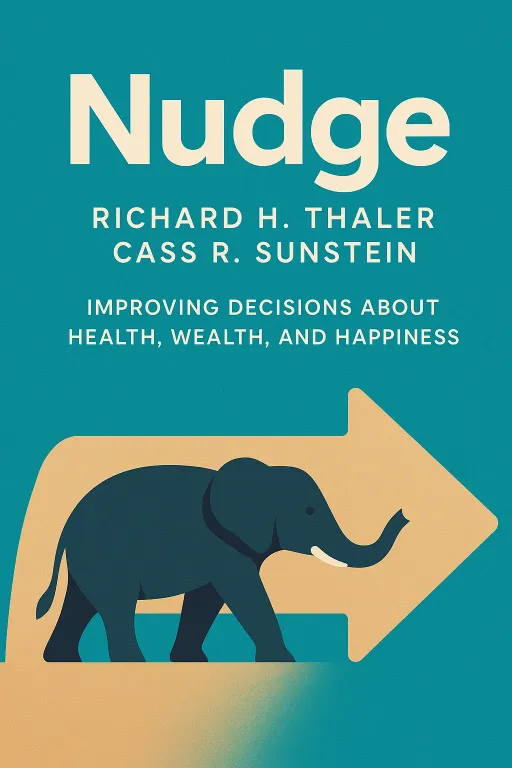
Nova: And that naturally leads us to the elegant solution for this inherent human quirk: the 'nudge' principle itself. Thaler and Sunstein's book, 'Nudge,' which became a New York Times bestseller and influenced policy globally, really brought this concept into the mainstream. They define a nudge as any aspect of the choice architecture that alters people's behavior in a predictable way without forbidding any options or significantly changing their economic incentives.
Atlas: So, it's like a gentle tap, not a shove. I'm curious, what's a classic, almost invisible example of a nudge that just? Because for an architect, those tiny, impactful changes are gold.
Nova: One of my favorites, and it's almost legendary in behavioral science circles, comes from Amsterdam's Schiphol Airport. They had an issue with men's restrooms, specifically with 'spillage' around the urinals. Instead of putting up signs or demanding better aim, they simply etched the image of a small housefly into the porcelain of each urinal, right near the drain.
Atlas: A fly? Seriously? What happened?
Nova: Spillage dramatically decreased. The theory is that men, seeing a target, instinctively aim at it. It’s a completely unconscious act, a playful visual cue that subtly guides behavior without anyone explicitly being told what to do, or even realizing they're being influenced. No options were removed, no penalties were introduced, just a tiny, almost imperceptible change in the environment.
Atlas: That's brilliant! It's so simple, yet so effective. That's the kind of hidden leverage a disruptor craves. It makes me wonder, how does a product builder actually this? Is it just about setting defaults, like the organ donation example? Or are there other types of 'flies' we can put in our digital urinals?
Nova: It goes far beyond just defaults, though defaults are incredibly powerful. You can use 'framing effects,' for instance. How you describe an option matters. Is it '90% fat-free' or '10% fat'? Same product, very different perception. In product design, this could be how you frame a premium feature's value or the benefits of a subscription. Another powerful nudge is 'social proof.' Showing how many other users have adopted a feature, or how many people in their network are doing X, can subtly encourage adoption.
Atlas: That’s going to resonate with anyone who struggles with user onboarding or feature adoption. But for a well-being advocate like me, the question becomes: how do we ensure these nudges are used for good? For helping people live better, more productive lives, rather than just getting them to click more ads or spend more money?
Nova: That's the ethical imperative. The original concept of nudges was rooted in 'libertarian paternalism' – guiding people towards choices that are demonstrably better for them, while preserving their freedom to choose otherwise. For product designers, it means aligning your nudges with genuine user benefit. If your product helps people save money, or learn a new skill, or connect meaningfully, then nudging them towards those actions is a benevolent use of these principles. It's about designing products that truly integrate into people's lives in a positive way.
Dual Systems of Thought: Fast vs. Slow Decisions in Product Use
SECTION
Atlas: So, we've talked about irrationality and how to gently guide it. But what's going on inside our heads when we respond to these nudges, or when we make any decision, for that matter? Is it all just subconscious flies in urinals?
Nova: That brings us directly to Daniel Kahneman's groundbreaking work, especially with his collaborator Amos Tversky, which he details in 'Thinking, Fast and Slow.' Kahneman introduces us to the idea that our minds operate with two distinct systems of thought. He calls them System 1 and System 2.
Atlas: Okay, so the brain has two operating systems? Tell me more.
Nova: Exactly. System 1 is fast, intuitive, emotional, and largely unconscious. It's what kicks in when you instantly recognize an angry face in a crowd, or when you know the answer to "2 + 2." It's effortless. System 2, on the other hand, is slow, deliberate, logical, and effortful. It's what you use to solve a complex math problem, or to consciously choose what to have for dinner based on your health goals.
Atlas: I guess that makes sense. Like when you're driving a familiar route, that's System 1. But if you're navigating a new city with a map, that's System 2 working overtime.
Nova: Perfect analogy. And understanding these two systems is absolutely crucial for product design. You need to design for both. For the initial 'aha!' moment, for the seamless onboarding, for the instant gratification that hooks users, you're designing for System 1. It needs to be intuitive, visually appealing, and require minimal cognitive effort.
Atlas: So, for an architect building a new platform, you're saying we need to nail that System 1 experience first to get them in the door, to make it feel frictionless and obvious? But then what? What about the deeper engagement, the complex features?
Nova: Then you need to design for System 2. Once they're hooked, and they're ready to engage with more complex tasks, you need to support their deliberate thinking. This means clear information, logical workflows, and tools that help them analyze and make considered decisions. A good product anticipates when users will switch between systems and designs accordingly. For instance, making the 'buy now' button prominent and easy, but then providing detailed product comparisons and reviews for those who want to research.
Atlas: That makes me wonder, how can we reduce cognitive load for those System 2 tasks? Because even when people to be deliberate, if it’s too hard, they’ll just revert to System 1 and maybe abandon the task altogether.
Nova: Absolutely. It's about breaking down complex tasks into smaller, manageable steps, providing clear feedback, and offering intelligent defaults that can be easily overridden if a user wants to engage their System 2. The goal isn't to eliminate System 2, but to make its work as effortless as possible, or to guide users to engage it only when truly necessary. It's about respecting both the impulsive and the reflective aspects of human nature.
Synthesis & Takeaways
SECTION
Nova: So, what we've really explored today is that the secret to designing products people can't resist isn't about magic or coercion. It’s about deeply understanding the human decision-making process—our inherent irrationality, the power of subtle nudges, and the interplay between our fast and slow thinking. It's about designing with empathy for our human quirks.
Atlas: Honestly, that's actually really inspiring. It means that building truly impactful products, products that genuinely improve lives, requires a sophisticated understanding of psychology, not just technology. It’s about being a better human, not just a better coder.
Nova: Exactly! It’s about creating an intuitive design that ensures your innovations are not just used, but truly integrated into people's lives, gently guiding them towards more beneficial choices. It transforms the product builder into a choice architect.
Atlas: So, if I'm an architect building something new, or a disruptor trying to get my innovation adopted, what's my very first tiny step, one concrete action I can take after listening to this?
Nova: Identify one key decision point in your product or service. Just one. Then, ask yourself: How could you reframe the options or change the default to gently 'nudge' users towards a more beneficial choice? Start there. It’s a tiny step, but the impact can be immense.
Atlas: That's brilliant. Design with empathy, build with insight. Guide, don't force.
Nova: Exactly. This is Aibrary. Congratulations on your growth!