Stop Overthinking, Start Deciding: The Guide to Cognitive Clarity.
10 minGolden Hook & Introduction
SECTION
Nova: Most of us think we're rational decision-makers. We like to believe we're in control, charting a clear course through life's complexities. But what if I told you your brain is actually running two completely different operating systems, and one of them is constantly trying to trick you?
Atlas: Whoa, trick me? That sounds less like a personal assistant and more like a mischievous saboteur! I mean, I'm always trying to optimize for clarity and foresight. How can my own brain be working against that?
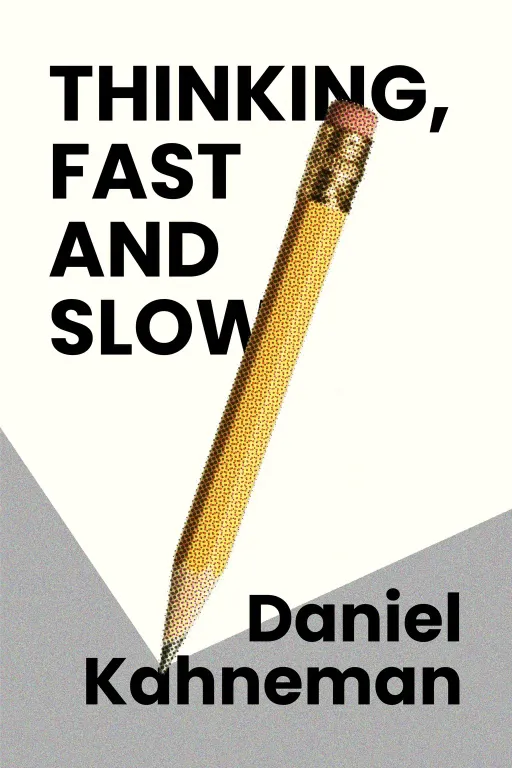
Nova: It's less 'against' and more 'differently wired,' Atlas. And that's exactly what we're unraveling today, drawing heavily from the insights in "Stop Overthinking, Start Deciding: The Guide to Cognitive Clarity." This book stands on the shoulders of giants, most notably Daniel Kahneman's groundbreaking work, "Thinking, Fast and Slow." Kahneman, a psychologist, famously won the Nobel Memorial Prize in Economic Sciences for his revolutionary work on prospect theory. He fundamentally challenged the long-held assumption that humans are purely rational economic agents. His insights reshaped our understanding of how we make choices.
Atlas: That's a huge claim, especially for those of us constantly making high-stakes decisions. So, if even Nobel laureates are telling us our internal logic might be flawed, how does this actually apply to my day-to-day, or to someone trying to build the future and lead with purpose?
Nova: That's the million-dollar question, isn't it? It applies by giving us a roadmap to understand these internal forces. Today we'll dive deep into this from two perspectives. First, we'll explore the two powerful, often conflicting, systems that govern our minds. Then, we'll discuss how we can actually leverage this knowledge to 'nudge' ourselves towards clearer, more strategic decisions, especially for those driven by impact and innovation.
The Dual Operating System of Your Mind
SECTION
Nova: So, let's pull back the curtain on these two systems. Kahneman called them System 1 and System 2. Think of System 1 as your brain's autopilot. It's fast, intuitive, emotional, and automatic. It operates with little to no effort, and you have no sense of voluntary control over it. It's what allows you to recognize a familiar face instantly, or slam on the brakes if a car swerves in front of you.
Atlas: Oh, I get that. My gut reaction, that immediate flash of insight or alarm. So, it's the efficient, rapid responder.
Nova: Exactly. But it also relies on heuristics, or mental shortcuts, which can be prone to errors or biases. Then there's System 2. This is your brain's deliberate, effortful mode. It's slow, logical, and requires conscious attention. It's what you engage when you're solving a complex math problem, or carefully weighing the pros and cons of a major life decision.
Atlas: Okay, so System 1 is the flash, System 2 is the deep dive. But wait, are you saying our intuition, our System 1, is always wrong? Because sometimes my gut feeling is spot on, especially in high-pressure situations. I mean, innovators often talk about trusting their instincts.
Nova: That's a great point, Atlas. System 1 isn't inherently 'wrong'; it's incredibly efficient and often accurate. The challenge comes when System 1 takes over in situations where System 2 be engaged, or when its shortcuts lead us down a biased path without us realizing it. It prefers a coherent story, even if it's not the most probable one.
Atlas: Tell me more about that. Give me an example where System 1 leads us astray, especially for someone who values foresight and impact, and needs to avoid those kinds of cognitive traps.
Nova: Let's consider a classic example from Kahneman's work, often called the "Linda problem." Imagine Linda. She's 31 years old, single, outspoken, and very bright. She majored in philosophy. As a student, she was deeply concerned with issues of discrimination and social justice, and she participated in anti-nuclear demonstrations. Now, which of these two statements is more probable? Is Linda a bank teller, or is Linda a bank teller and active in the feminist movement?
Atlas: Hmm. Well, given her background, her passions for social justice, anti-nuclear demonstrations... I'd say she's definitely a bank teller and active in the feminist movement. That just right, it fits her description perfectly.
Nova: And that's exactly what most people say, Atlas. Your System 1 is constructing a vivid, plausible story. It's creating a representative picture of Linda based on the information you were given. But here's the logical truth: it is statistically impossible for "Linda is a bank teller and active in the feminist movement" to be more probable than "Linda is a bank teller." Every feminist bank teller is, by definition, also a bank teller. So the group of bank tellers be larger than, or at least equal to, the group of feminist bank tellers.
Atlas: That's wild! It's like our brains prefer a good story over cold, hard logic, even when the logic is staring us in the face. How many times do we make business decisions, or even personal ones, based on a compelling narrative or a vivid anecdote rather than the actual numbers or probabilities? Someone pitching a new idea might tell a fantastic story, and our System 1 just runs with it.
Nova: Exactly. Your System 1 creates coherence from limited information, and it's notoriously bad at statistics or probability. It jumps to conclusions. This cognitive bias, the "representativeness heuristic," can make us overlook the base rate, the fundamental statistical likelihood. For someone building the future, relying solely on a compelling narrative without engaging System 2 to check the underlying data can lead to significant missteps.
Hacking Your Decision-Making: Nudging Towards Clarity
SECTION
Nova: That tendency to favor a compelling story over logic is exactly why understanding these systems isn't just academic; it's practically essential. And that naturally leads us to our second big idea: how we can actually 'nudge' ourselves and others towards better decisions, even when our System 1 is shouting. This is where Richard Thaler and Cass Sunstein's work on "Nudge" becomes incredibly powerful. They explore how subtle changes in "choice architecture" can guide decisions without restricting freedom.
Atlas: Okay, 'nudge' – I like that. For someone always looking for integrated solutions and impact, this sounds powerful. It's not about forcing change, but making it easier. But how does that work in a real-world, high-stakes scenario? Give me an example where a 'nudge' actually made a difference, especially for something that feels complex or resistant to change.
Nova: Let's look at something as profound as organ donation or something as financially critical as retirement savings. These are decisions most people agree are important, but action rates can be surprisingly low. In some countries, citizens are automatically enrolled in organ donor programs. You are an organ donor by default, and you have to actively if you don't want to be. In other countries, you have to actively to become a donor.
Atlas: And I'm guessing the difference is dramatic. My System 1 is already telling me that the default option is going to have a massive effect.
Nova: It's astonishingly dramatic. In opt-out countries, donation rates can be as high as 99%. In opt-in countries, they often hover around 10-20%. The same goes for retirement savings. When employees are automatically enrolled in 401 plans and have to opt-out if they don't want to participate, participation rates skyrocket compared to systems where they have to actively sign up.
Atlas: Wow, that's incredibly simple yet profound. It's not about forcing people; it's about designing the environment, setting that default. It highlights how much our System 1 is influenced by the path of least resistance. So, for those of us trying to optimize our own cognitive processes, or even lead teams more mindfully, this isn't just about 'thinking harder,' it's about 'thinking smarter' about the environment we're making decisions in. It's about designing our choices.
Nova: Precisely. It’s about understanding that our System 1 loves defaults, loves the easy way out. So, if we want to make better choices, we can consciously design our environment to make the 'better' choice the default, or the easiest one. It’s a subtle shift from relying purely on willpower to leveraging behavioral science.
Atlas: That's a game-changer. It means we don't just have to battle our biases head-on, we can actually sidestep them by creating a better decision-making landscape. It sounds like a secret weapon for anyone who's trying to innovate or lead with more intentionality.
Synthesis & Takeaways
SECTION
Nova: It really is, Atlas. When you combine Kahneman's deep understanding of our cognitive biases – how our System 1 can lead us astray – with Thaler and Sunstein's insights into 'nudging,' you get a powerful framework. True cognitive clarity comes from both internal awareness of our thinking processes and external architectural adjustments to our choice environments. It's about designing for success, rather than just hoping for it. It helps you sustain peak performance and lead with presence and purpose.
Atlas: So, it sounds like the ultimate growth hack isn't just about having a clearer vision, it's about understanding the invisible forces at play in our own minds and then subtly redesigning our world to work them, not against them. It’s about building the future by making smarter choices, almost effortlessly. What's a tiny step we can take today to start applying this, especially if we're constantly having to make quick judgments?
Nova: Exactly. So, for our tiny step today, before you make your next important decision – whether it's a strategic move at work, or even something personal – pause. Just for a moment. Ask yourself: Am I letting my fast, intuitive System 1 take the wheel, or am I engaging that slower, more rational System 2? Just that pause, that moment of self-awareness, can be a powerful nudge towards a better outcome. It’s about recognizing when to slow down.
Atlas: That’s a tangible action. It’s about trusting your instincts, but also knowing when to question them. I imagine a lot of our listeners, especially those building something new, will find that invaluable. It helps you embrace the journey with more intentionality.
Nova: Absolutely. It's about leading with presence and purpose, and making every decision count.
Atlas: Fantastic. A simple yet profound shift in perspective. Thank you, Nova.
Nova: My pleasure, Atlas.
Nova: This is Aibrary. Congratulations on your growth!