Beyond Brainstorming: Structuring Your Creative Process for Breakthroughs
Golden Hook & Introduction
SECTION
Nova: Forget what you think you know about creativity. It's not some lightning bolt from the muses, striking only the 'gifted' few. In fact, that very idea is probably holding you back from your own breakthroughs.
Atlas: Whoa, that's a bold claim, Nova. I think a lot of our listeners, myself included, have definitely felt like creativity is this elusive, sometimes frustrating, wellspring that just... appears. Or doesn't. You're saying that's a myth?
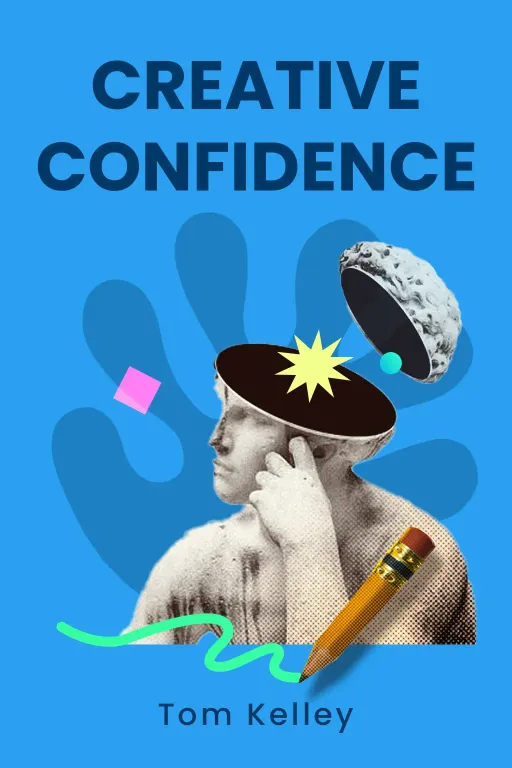
Nova: Absolutely, Atlas! And it's a myth we're here to bust wide open today, drawing inspiration from the powerful insights in a book we're calling 'Beyond Brainstorming: Structuring Your Creative Process for Breakthroughs.' It's built on foundational works like "Creative Confidence" by Tom and David Kelley, and "Thinkertoys" by Michael Michalko. What's particularly fascinating about the Kelley brothers, especially David, is his background as a co-founder of IDEO, a global design firm. He didn't just theorize about creativity; he built an empire on systematically applying it. He saw firsthand how ordinary people could be taught to innovate, day in and day out.
Atlas: So, it's coming from someone with actual dirt-under-the-fingernails experience, not just abstract philosophy. That immediately makes me curious. For so many of us who consider ourselves curious learners, we're always looking for new ways to approach problems. But I imagine the first hurdle is believing you even be creative. How do these books help us jump that initial, daunting barrier?
Demystifying Creativity: Skill, Not Spark
SECTION
Nova: That's precisely where we start, Atlas. Tom and David Kelley, in "Creative Confidence," make a compelling case that everyone possesses creative potential. Their work is a direct challenge to the notion that creativity is a trait you're either born with or not. They argue it's a skill, like playing an instrument or learning a language. The biggest barrier isn't a lack of talent; it's often the fear of judgment, the fear of looking foolish, or the fear of failure.
Atlas: Oh, I know that feeling. I imagine a lot of our listeners do too. You have an idea, and immediately that internal critic starts whispering, "That's stupid," or "Someone's already done that." How do you even begin to 'unlearn' that kind of self-doubt? What does 'design thinking,' which they champion, actually look like for someone trying to activate their creative muscle?
Nova: It starts with empathy, Atlas. Design thinking isn't just about coming up with clever solutions; it's about deeply understanding the problem and the people experiencing it. They tell stories of people who never considered themselves creative, like a healthcare worker who redesigned a hospital waiting room to be less stressful for children. This wasn't about artistic genius; it was about observing, asking questions, prototyping simple solutions with cardboard and sticky notes, and getting feedback. The process itself builds confidence. It's iterative, meaning you learn from small failures and keep refining.
Atlas: That's actually really inspiring. So, it's not about waiting for a flash of genius, it's about a systematic approach to understanding a problem and then trying out solutions, even if they're imperfect. But wait, is this just for "big" problems? Or can a curious learner apply this to, say, organizing their chaotic digital files, or finding a new way to learn a complex subject? It feels almost too simple for something we've always seen as so profound.
Nova: That's a perfect question, and it highlights a common misconception. The beauty of design thinking is its universality. I remember a story about a team tasked with reducing energy consumption in a large office building. Instead of immediately installing smart thermostats, they applied design thinking. They interviewed employees about their daily routines, observed how they interacted with their workspaces, and even held workshops where employees sketched their ideal "eco-friendly" office. They discovered that a huge amount of energy was wasted simply because people forgot to turn off lights or monitors at the end of the day, not because they didn't care.
Atlas: So the core, the cause of the problem, wasn't a lack of technology, but human habit and forgetfulness.
Nova: Exactly. Their solution wasn't a complex tech installation but a series of small, empathetic interventions: visual cues on light switches, friendly reminders from "energy ambassadors," and even a gamified system where departments competed to save the most energy. The process involved understanding the human behavior, prototyping small changes, and seeing the outcome. It wasn't about a groundbreaking invention, but about a breakthrough in understanding and nudging behavior. It demonstrates that creativity can be applied to seemingly mundane problems, leading to impactful, repeatable change.
Structured Innovation: Tools for Breakthroughs
SECTION
Nova: Once you accept you creative, and you've got that confidence brewing, the next step is having the to channel that potential. This is where Michael Michalko's "Thinkertoys" comes in. It's like a mental gym, packed with exercises to systematically generate novel ideas.
Atlas: Okay, so if "Creative Confidence" gives us permission to be creative, then "Thinkertoys" sounds like the instruction manual. I'm curious, how do these "thinkertoys" differ from just, well, sitting down and trying to think of ideas? We've all done brainstorming, right? What's the upgrade here?
Nova: That's a great distinction! Traditional brainstorming can often fall flat because it lacks structure. Michalko provides specific frameworks. Take SCAMPER, for example. It's an acronym: Substitute, Combine, Adapt, Modify, Put to another use, Eliminate, Reverse. Instead of just "think of new ideas for a coffee mug," you'd systematically ask: What can we ubstitute in a mug?. What can we ombine with it?. How can we dapt it?. What can we odify?. What can we ut it to another use?. What can we liminate?. What can we everse?.
Atlas: Wow, that's incredibly structured. It forces you to look at every aspect and challenge assumptions. It’s like a checklist for innovation. So, if I'm a curious learner trying to figure out a new way to structure my study routine, I could SCAMPER my current routine? What could I substitute in my study environment? What could I combine with my learning?
Nova: Exactly! Imagine you're struggling to stay focused while studying. You could SCAMPER your "study session." your usual desk for a standing desk or a different location. your study time with a short walk or a podcast related to the topic. your note-taking method from linear to mind-mapping. the length of your study blocks. your phone as a timer for focused sprints instead of a distraction. notifications or social media during study. your learning approach—teach the material first, then learn it. The power is in the systematic questioning, forcing your brain out of its usual ruts.
Atlas: That's a fantastic real-world application. It's not just about inventing a new product; it's about innovating your own life and processes. I've been thinking about a friend who's an aspiring writer, struggling with writer's block. How does this go beyond just 'thinking outside the box' to systematic problem-solving for something as seemingly abstract as creativity itself?
Nova: For writer's block, Michalko would offer another powerful tool: Random Word Association. You pick a completely random word – let's say "umbrella." Then you force connections between "umbrella" and your writing project. What does an umbrella do? It protects, it opens, it closes, it's colorful, it's used in rain. How can these attributes relate to your story? Maybe a character needs protection, or a secret is about to be revealed. This seemingly absurd connection often sparks entirely new plot points or character traits. It bypasses the logical, blocked part of your brain and forces novel pathways.
Atlas: That's such a brilliant way to trick your brain into fresh thinking. It's like you're not waiting for inspiration; you're actively generating it through a structured play. It's a gamechanger for anyone who feels stuck.
Synthesis & Takeaways
SECTION
Nova: Absolutely. What these two books and our 'Beyond Brainstorming' approach teach us is a profound truth. Creativity isn't a mystical, random event; it's a learnable, systematic process. First, you cultivate the confidence that you creative, then you equip yourself with the tools to consistently produce novel ideas.
Atlas: It's a powerful journey from feeling like you're at the mercy of inspiration to actively driving your own innovation. The biggest challenge, I think, is just taking that first step, believing you can do it. But the most rewarding aspect must be the sheer liberation of knowing you have a method for solving problems, big or small.
Nova: Precisely. The true breakthrough isn't just an idea; it's the liberation of realizing you can generate ideas. You never have to stare at a blank page or a daunting problem feeling helpless again. You have a process. You have the tools.
Atlas: That's such a hopeful way to look at it. So, for all our curious learners out there, our tiny step for you today is this: Choose one creative problem you're facing – big or small – and apply a 'Thinkertoy' technique, like SCAMPER, to generate at least five new ideas. Tell us what you came up with! We'd love to hear about your creative breakthroughs.
Nova: We absolutely would. Share your stories and let's keep this conversation going.
Atlas: This is Aibrary. Congratulations on your growth!