

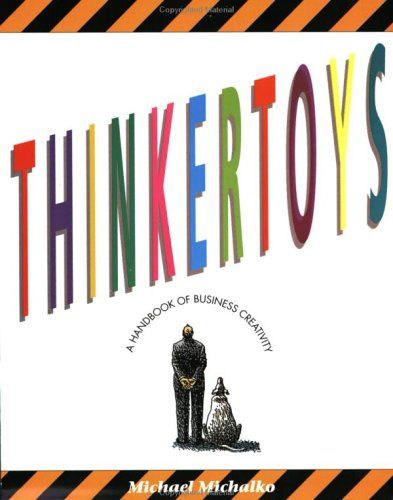
Thinkertoys
Introduction
Nova: Have you ever felt like creativity was this mysterious lightning bolt that only strikes a lucky few? Like you are either born with the creative gene or you are just destined to be a spreadsheet person for the rest of your life?
Nova: That is exactly the myth Michael Michalko wants to bust in his book, Thinkertoys. He argues that creativity isn't a divine gift. It is a functional skill, like typing or driving, that you can actually train through specific exercises. And he should know. He didn't start out as an artist or a poet. He was a high-level intelligence officer in the U. S. Army.
Nova: It is exactly like code-breaking! Michalko was stationed in Frankfurt, Germany, where he organized a team of NATO intelligence specialists and international academics. Their mission was to research and categorize every known inventive-thinking method in the world. He later took those techniques to the CIA to facilitate think tanks. Thinkertoys is essentially the declassified manual for how to force your brain to be brilliant on command.
Nova: Exactly. Today we are diving into the best tools from his handbook to see how we can turn our brains into idea-generating machines. We are going to look at everything from linear checklists to intuitive dream-work. By the end of this, you will see why he calls these techniques toys. They are meant to be played with.
Key Insight 1
The Linear Powerhouse
Nova: Michalko divides his techniques into two main categories: Linear and Intuitive. Let's start with the Linear ones because they are the most accessible. The crown jewel of this section is a technique called SCAMPER.
Nova: It is an acronym that stands for Substitute, Combine, Adapt, Modify, Put to another use, Eliminate, and Reverse. It is basically a checklist for your brain. When you are stuck on a product or a problem, you run it through these seven filters.
Nova: Anything! You could substitute the material, the process, the person involved, or even the place. Think about the transition from glass bottles to plastic ones for soda. That was a substitution of material that changed the entire shipping industry because plastic is lighter and doesn't break. Or think about a restaurant substituting a waiter for a touch-screen kiosk. You are just swapping one element for another to see what happens.
Nova: Combine is where some of the biggest inventions come from. Think about the smartphone. It is a combination of a phone, a camera, and a computer. Or even something as simple as a pencil with an eraser on the end. Before that, they were two separate tools. Michalko suggests looking at two unrelated things and forcing them together to see if they create a new value.
Nova: That is one of my favorites. It is about taking something that already exists and finding a completely different context for it. A classic example is the Post-it Note. The adhesive was originally a failed attempt at making a super-strong glue. It was weak and useless for its intended purpose. But then someone realized it was perfect for a temporary bookmark that wouldn't damage the page. They put a failure to another use and created a multi-billion dollar product.
Nova: Actually, elimination is often the key to innovation. Think about the original iPod. It eliminated almost all the buttons that were standard on MP3 players at the time. By removing the clutter, they created a better user experience. Or think about a budget airline. They eliminate the meals, the assigned seating, and the fancy lounges to provide a cheaper ticket. Sometimes, the best idea is what you take away, not what you add.
Nova: It is! And that is the point. You don't have to be in a creative mood to use SCAMPER. You just have to be willing to go through the list. Michalko says that by forcing yourself to answer these questions, you bypass the part of your brain that says I don't have any ideas.
Key Insight 2
Reversing the World
Nova: Now, if SCAMPER is about tweaking what exists, the next technique, False Faces, is about completely flipping it on its head. This is the Reverse part of SCAMPER but on steroids.
Nova: It starts with listing all your assumptions about a problem. Every single one, no matter how obvious. Then, you take each assumption and write down the exact opposite. You basically create a world where the opposite is true.
Nova: Okay, assumption one: Restaurants have menus. Assumption two: Restaurants serve food. Assumption three: You pay for the food you eat. Now, let's flip them. A restaurant with no menu. A restaurant that doesn't serve food. A restaurant where you don't pay for the food.
Nova: Well, look at the rise of ghost kitchens or shared commercial spaces. Or think about a place where you pay for the time you spend there, like a board game cafe, and the food is just a side thing you bring yourself. By reversing the assumption that the restaurant must provide the food, you might stumble onto a co-working space model or a community kitchen.
Nova: Exactly! That is called Omakase in Japanese dining. It turned a lack of choice into a premium, luxury experience. The point of False Faces is that our assumptions act like walls. We don't even realize they are there until we intentionally try to walk through them. Michalko points out that Henry Ford reversed the assumption that workers should go to the car. Instead, he brought the car to the workers via the assembly line. That one reversal changed the world.
Nova: Precisely. Michalko uses the term Slice and Dice for a similar linear technique. You break a problem down into its smallest possible attributes. If you are looking at a screwdriver, you don't just see a screwdriver. You see the handle, the shaft, the tip, the material, the weight. Then you change one tiny attribute at a time. It is about granular focus. Most people try to innovate on the whole thing at once, which is overwhelming. Michalko says, don't look at the forest, look at the bark on one specific tree.
Key Insight 3
The Intuitive Playground
Nova: So far we have been very logical, very left-brain. But Michalko knows that sometimes the best ideas come from the subconscious. This is where the Intuitive techniques come in. These are designed to tap into the part of your brain that thinks in symbols and patterns rather than words.
Nova: Not necessarily, but you might need some crayons. One of his most famous intuitive tools is called Ideatoons. Instead of writing down words to describe your problem, you create little abstract symbols or doodles for each part of it.
Nova: Because your brain processes images differently than text. When you look at a word like shipping, your brain has a very fixed, narrow definition of what that means. But if you draw a symbol for shipping, maybe a bird or a flowing river, your brain starts making new associations. You might look at the river doodle and think about constant flow, which leads you to an idea about a continuous delivery system instead of batch shipping.
Nova: Exactly. He also talks about a technique called Blue Roses. It is based on the idea that in the 19th century, a blue rose was considered impossible. To find a blue rose, you have to imagine the impossible as if it were already real. You spend time visualizing the perfect solution without worrying about the how. It is a form of guided imagery. By convincing your brain that the solution exists, you become much more sensitive to clues in the real world that might lead you there.
Nova: It is very much about selective perception. If I tell you to look for red cars today, you will see them everywhere. If you tell your brain to look for the solution to a blue rose problem, you start noticing things you would have ignored before. Michalko also suggests a technique called Psychodrama, where you pretend to be the object you are studying. If you are trying to improve a lightbulb, you imagine you are the filament. What does it feel like to be hot? To be fragile? To be trapped in glass?
Nova: It is all about breaking the rigid patterns of adult thinking. Children are naturally creative because they haven't learned all the rules yet. They don't know that a box is just a box; to them, it is a spaceship or a fort. Michalko's intuitive toys are designed to give us back that childlike flexibility. He says that the genius is simply someone who has managed to keep their childhood curiosity alive.
Key Insight 4
The Mindset of a Creative
Nova: One of the most important parts of Thinkertoys isn't actually a technique. It is the section on mindset. Michalko argues that you can have all the tools in the world, but if you don't believe you are creative, they won't work. He calls this the Tick-Tock method.
Nova: Sort of. Tick represents the negative, self-sabotaging thoughts that pop up when we try to be creative. Things like, this is a stupid idea, or my boss will hate this, or I am not an expert in this field. These are the thoughts that kill ideas in the cradle.
Nova: We all do! The Tock part is the conscious effort to replace those thoughts with positive, constructive ones. Instead of saying this is a stupid idea, you say, what is one interesting thing about this idea? Instead of I am not an expert, you say, my fresh perspective might see something the experts missed. It is about monitoring your internal dialogue and realizing that your beliefs actually dictate your creative output.
Nova: That is a huge part of it. Michalko shares a story about how Thomas Edison had thousands of failed attempts at the lightbulb. He didn't see them as failures; he saw them as successfully identifying ways that didn't work. Michalko also talks about the difference between kittens and monkeys. When a mother cat moves her kittens, they are passive; they just hang there. But when a mother monkey moves, the baby monkey has to grab on and participate.
Nova: Exactly. You can't just wait for the book to change you. You have to use the toys. He emphasizes that the act of generating ideas is a numbers game. Most of your ideas will be bad. That is fine! If you generate a hundred ideas and ninety-nine are terrible, but one is a breakthrough, you are a genius. The mistake people make is stopping after the first five ideas because they aren't perfect yet.
Nova: Precisely. Quantity leads to quality. That is the fundamental law of creativity that Michalko wants everyone to understand. The more you play with the toys, the more likely you are to find the one that changes everything.
Conclusion
Nova: We have covered a lot of ground today, from the systematic checklists of SCAMPER to the abstract world of Ideatoons and the vital importance of the Tick-Tock mindset. The big takeaway from Michael Michalko's Thinkertoys is that creativity is a muscle. If you don't use it, it withers. But if you exercise it every day using these tools, there is no limit to what you can imagine.
Nova: That is the spirit. Remember, the goal isn't to be right; the goal is to be prolific. Use the False Faces, try a little Psychodrama, and don't let the Ticks in your head stop you from finding the Tocks. The world needs your unique perspective, and these toys are just the way to help you find it.
Nova: My pleasure. And to everyone listening, go out there and start breaking some assumptions. This is Aibrary. Congratulations on your growth!