

The Unbreakable Mind: A Leader's Guide to Thinking Straight After Crisis
Golden Hook & Introduction
SECTION
Dr. Celeste Vega: Imagine being at the top of the world. The penthouse of a skyscraper, holding the highest positions, defined by power and success. Now, imagine losing it all. In weeks. Finding yourself in the subsoil, with nothing left. The big question hits you: Who am I now?
CESAR NADER: That question... it's not just a question. It's a void. Everything you used to introduce yourself, to define your value to the world and to yourself—your title, your assets, your network—it's all gone. The silence is deafening.
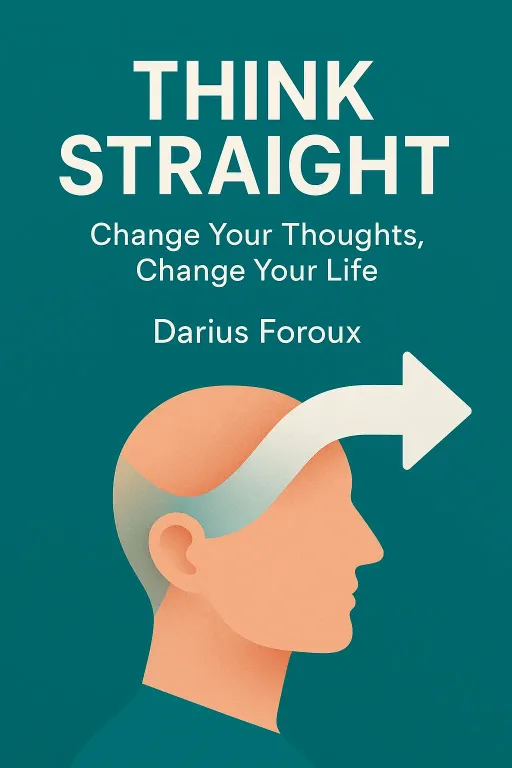
Dr. Celeste Vega: That's the profound territory we're exploring today with our guest, Cesar Nader, whose life is a testament to the power of the mind in crisis. Using Darius Foroux's book 'THINK STRAIGHT' as our guide, we'll dive deep into this from two powerful perspectives. First, we'll explore the 'Stoic Pivot'—what happens when you're forced to redefine what you can and cannot control. Then, we'll discuss 'Pragmatic Reframing,' the crucial mental shift from asking 'Why me?' to 'What is this for?' Cesar, welcome. It's an honor to have you.
CESAR NADER: Thank you, Celeste. It's a critical conversation to have.
Deep Dive into Core Topic 1: The Stoic Pivot
SECTION
Dr. Celeste Vega: Cesar, your story is so powerful. The book 'THINK STRAIGHT' opens with this fundamental idea, rooted in Stoic philosophy, of separating what's inside our control from what's outside. For most people, that's an intellectual exercise. For you, it became your reality. When you were in that 'subsoil' moment, what did you realize was truly, and perhaps only, within your control?
CESAR NADER: In the beginning, nothing. It felt like absolute freefall. The thoughts were a storm, a chaos of blame, regret, fear. 'I should have seen this coming.' 'My life is over.' These are the thoughts that try to drown you. But the turning point, for me, wasn't about stopping the storm. It was the realization that I couldn't control the storm, but I could control how I faced it. I could control my thoughts the thoughts. And that's when I decided not to run from the pain, the desperation, the suffering. I had to feel it. That was the first thing I could truly control: the choice to confront my own internal reality.
Dr. Celeste Vega: The choice to confront it, not escape it. That's incredibly powerful. And it's exactly what the author, Darius Foroux, describes, almost like a premonition of your journey, in a chapter called 'From Chaos To Clarity'. He tells a story, on a much smaller scale of course, about moving to London. He'd found an apartment, his family flew over from Holland to help him move, and the day before, the landlady calls and cancels. Everything is in a van, he has no place to live, and his first reaction is pure panic.
CESAR NADER: The chaos. I know that feeling.
Dr. Celeste Vega: Exactly. He describes his thoughts spiraling: "I'm an idiot. I have no place. I've failed." He's blaming himself, dwelling on the problem. But then, his family helps him shift his focus. He realizes the only useful thought is to find a solution. He stops the chaotic spiral and tells himself to "THINK STRAIGHT." Within minutes, he's on Airbnb and books a temporary place. The problem isn't solved permanently, but the chaos is replaced with clarity and action. He took control of the only thing he could: his thinking.
CESAR NADER: And the mechanism is identical, isn't it? The scale is different—a lost apartment versus a lost life as you knew it—but the mental pivot is the same. The external event happens. It's outside your control. The storm of useless thoughts begins. And you have a choice. Do you let that storm rage and consume you with self-blame and panic? Or do you find the one, single, useful thought that leads to action? For him, it was 'book an Airbnb.' For me, it was 'breathe, and face this feeling without running.' It's the same muscle.
Dr. Celeste Vega: The same muscle. I love that. It's not about being emotionless; it's about directing your thoughts productively, even when emotions are high. The book's foundational idea is that you become what you think. In that moment, you chose not to become the chaos.
CESAR NADER: I had to. Because when you've lost everything else, your thoughts are the only thing left that are truly yours. They are your last and most powerful asset.
Deep Dive into Core Topic 2: Pragmatic Reframing
SECTION
Dr. Celeste Vega: And that choice, to focus on clear, controlled thoughts, naturally leads to the second key idea we need to talk about, which is the of questions we ask ourselves. You mentioned, Cesar, a shift from asking 'why me?' to 'what is this for?'. This is the essence of pragmatic thinking that Foroux champions throughout 'THINK STRAIGHT'.
CESAR NADER: It's the difference between being a victim and being a student. 'Why me?' casts you as the victim of circumstance. 'What is this for?' makes you a student of life, and the circumstance becomes your teacher.
Dr. Celeste Vega: Precisely. And in the book, there's a chapter called 'Don’t Ask Why,' which is so relevant here. The author shares this painful story about a massive business mistake he made. He was managing two clients, both named Wim. One was a loyal, long-term client, Wim A, who he was giving a discount. The other was a new prospect, Wim B, who was about to sign a huge, $150,000 deal.
CESAR NADER: I have a bad feeling about this.
Dr. Celeste Vega: You should. In a moment of haste, he accidentally emailed the discounted contract for Wim A to the new prospect, Wim B. Wim B saw he was being charged a higher price than the other client, felt he was being treated unfairly, and immediately pulled out of the $150,000 deal. Just like that, it was gone.
CESAR NADER: A devastating, simple mistake. The kind that haunts you.
Dr. Celeste Vega: And his point is that the worst thing he could do afterward was to sit there and ask, "Why was I so lazy? Why did I make that mistake?" He says that's a useless thought. It leads nowhere. The pragmatic approach, the 'what for,' was to extract the lessons. And he lists them: One, always double-check. Two, small things can become big things. And three, don't play favorites in business. He didn't dwell on the 'why'; he focused on the 'what for'—the rules for the future.
CESAR NADER: That resonates so deeply. Asking "Why did the financial crisis happen?" or "Why me?" was a complete dead end. It's a loop of blame and powerlessness. The moment I started asking, "What is this for?", the world opened up. What was this for? It was for me to learn that my identity wasn't my job title. It was for me to develop a level of empathy I never could have had in the penthouse. It was for me to build a resilience that is real, not theoretical. The pain didn't go away, but it gained a purpose. It became fuel.
Dr. Celeste Vega: You're essentially describing another key idea from the book: 'Filter Your Thoughts.' Foroux argues we need a mental filter, and the best one is pragmatism, or simply, "what works." The question "Why me?" doesn't work. It's useless information that keeps you stuck. The question "What is this for?" works. It's useful information that generates growth, learning, and action. You filtered out the noise and focused on the signal.
CESAR NADER: Exactly. It's about turning a tragedy into a curriculum. The pain is the tuition fee for the most important lessons you'll ever learn.
Synthesis & Takeaways
SECTION
Dr. Celeste Vega: So, when we put it all together, it's a powerful two-step process for navigating any crisis. First, the Stoic Pivot: recognize that your thoughts and your responses are the only things you truly control, especially when the external world is crumbling.
CESAR NADER: You anchor yourself in your own mind.
Dr. Celeste Vega: And second, the Pragmatic Reframing: use that control to consciously filter your thoughts. Discard the useless, backward-looking questions like 'why,' and actively ask the useful, forward-looking ones, like 'what is this for?'
CESAR NADER: And if you practice this, you eventually arrive at what the author calls the ultimate prize: 'Inner Calm.' It's not the peace of a life with no problems. That's a fantasy. It's the deep, unshakable confidence that you possess the mental tools to face any problem that comes your way. It's a calm that, as I learned, you can't buy in the penthouse. You have to earn it in the subsoil.
Dr. Celeste Vega: What a perfect, powerful place to end. So for everyone listening, the next time you face a setback, big or small, try this. Catch yourself asking 'Why is this happening to me?' and consciously replace it. Ask yourself, as Cesar did, 'What is this for? What can I learn?' That simple shift might just change everything. Cesar, thank you for sharing your wisdom with us.
CESAR NADER: It was my pleasure, Celeste. Thank you.









