

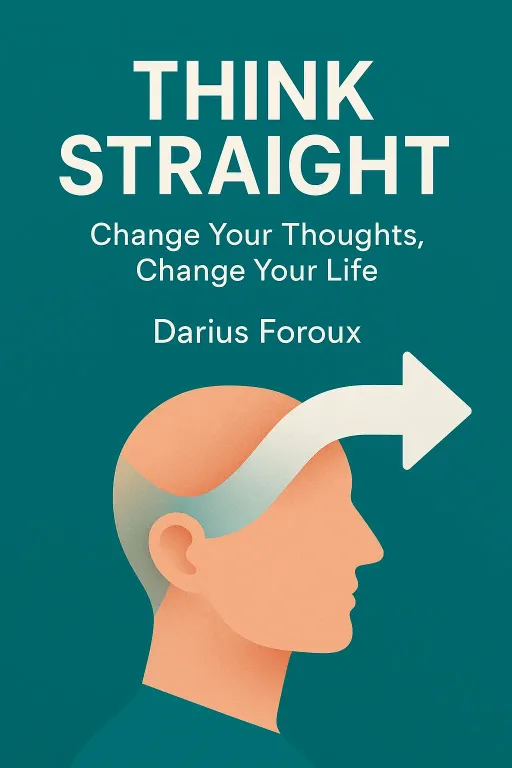
The Analyst's Operating System: Upgrading Your Mind with 'Think Straight'
Golden Hook & Introduction
SECTION
Nova: As a data analyst, your entire world is about finding the signal in the noise. You build models, you clean data, you hunt for objective truth. But what happens when the most chaotic, biased, and unreliable dataset isn't on your screen, but right between your ears? What if your own mind is the system that needs debugging most? That's the provocative question at the heart of Darius Foroux's book,, and it's what we're exploring today with data analyst Pout chop Jal. Welcome, Pout chop!
Pout chop Jal: Thanks for having me, Nova. That opening question hits close to home. It’s a bit unsettling to think the main tool I use every day might be fundamentally flawed.
Nova: It's unsettling for all of us! And that's why this book feels less like philosophy and more like a user manual for the brain. Today we'll dive deep into this from two perspectives. First, we'll explore the startling idea that we can't trust our own minds, a concept we're calling 'Debugging the Mind.' Then, we'll discuss the solution: how to build a practical set of rules for life, which we've termed 'Building a Pragmatic OS.'
Pout chop Jal: I like that framing. Problem and solution. It’s a very analytical approach. I'm ready.
Deep Dive into Core Topic 1: Debugging the Mind
SECTION
Nova: Alright, let's jump right into that first idea, 'Debugging the Mind.' The book makes a bold claim, quoting the behavioral economist Dan Ariely, who says, "We usually think of ourselves as sitting in the driver's seat, with ultimate control over the decisions we made... but, alas, this perception has more to do with our desires... than with reality." The book argues our thinking is just riddled with bugs, or what psychologists call 'cognitive biases.'
Pout chop Jal: And these aren't just small glitches, right? The book suggests they're systematic errors.
Nova: Exactly. They are features, not bugs, of the human brain. Foroux points out that scientists have identified over a hundred of these biases. One he highlights is 'attentional bias.' It basically says our thoughts dictate what we perceive. The book puts it simply: "If you think your life is bad, you will look for things that confirm your beliefs." You're not seeing reality; you're seeing a reality filtered through your current mindset.
Pout chop Jal: Hmm.
Nova: As a data analyst, hearing that our brains are hardwired with over 100 biases... what's your gut reaction to that? It feels like a massive professional hazard.
Pout chop Jal: It's terrifying, honestly. Confirmation bias, which is a cousin of attentional bias, is the cardinal sin of data analysis. You have a hypothesis—say, that a certain stock is undervalued—and you can subconsciously start looking only for the data that proves you right, while ignoring or downplaying the data that proves you wrong. It’s why processes like peer review and model validation are so critical in my field. We have to build external systems to protect us from... well, from ourselves.
Nova: That's a perfect bridge! You build external systems to check your work. The book argues we need to build systems to check our. But before we get to the 'how,' the author shares a powerful story about how this kind of flawed, default thinking plays out in a huge life decision.
Pout chop Jal: I'm curious to hear this.
Nova: So, picture this: the author, Darius Foroux, is living in London. The conventional wisdom, the 'heuristic' as he calls it, is that a massive city like London means massive opportunities. It's the default social programming, right? Go to the biggest city for the biggest career.
Pout chop Jal: Makes sense. That’s the common assumption.
Nova: But he's miserable. He talks about the crowds, the high cost of living, the pollution... it's all draining him. He had a great professional opportunity, but his overall quality of life was suffering. He was running on this default program—'big city equals success'—without ever stopping to ask, "Is this actually for me?" He was accepting a common 'truth' without validating it against his own data.
Pout chop Jal: So the 'big city' idea was a faulty assumption in his personal dataset. He had to stop and re-evaluate the 'truth' based on his own experience, not a common belief. That's a very analytical way to approach a life choice. He was essentially debugging his own life plan.
Nova: He was! He realized the conventional path wasn't his 'truth.' So he made a pragmatic choice and moved back to his much smaller hometown, Leeuwarden. And he found he was happier, worked less, and earned more. He filtered out the noise of 'what you should do' and focused on the signal of 'what works for me.'
Pout chop Jal: That's powerful. It’s about defining your own metrics for success. For him, the KPI wasn't 'prestige of city,' it was 'personal well-being.' And by that metric, London was failing.
Deep Dive into Core Topic 2: Building a Pragmatic OS
SECTION
Nova: Exactly! And that brings us perfectly to our second idea: if our default thinking is buggy, we need to install a new, more practical operating system. The book calls this 'pragmatism,' and its core rule is beautifully simple: 'The true is that which works.'
Pout chop Jal: It’s not about what’s theoretically perfect, but what’s practically effective. I can get behind that.
Nova: Right. This isn't about getting lost in abstract philosophy. It’s about creating simple, effective rules to guide your life. And the book gives us a fantastic, concrete example of this in the chapter "My Money Rules." It's like a pre-built 'app' for this new operating system, especially relevant for someone in finance like you.
Pout chop Jal: Okay, I'm listening. Financial systems are my language.
Nova: So let's look at his system. It’s designed to devalue the importance of money to stop it from controlling you. Rule #1 is: 'Don't worry about money.' Now, that sounds nice, but how do you actually do it? His system is to have a buffer—a savings account with at least six months of living expenses. This isn't just a savings goal; it's a system designed to eliminate an entire category of useless, anxious thoughts. It buys you freedom from fear.
Pout chop Jal: It’s an anxiety firewall. By having that buffer, you’re not forced to make decisions out of desperation. You can leave a toxic job, or take a calculated risk, because your basic needs are secured. It’s a system for maintaining rationality.
Nova: Precisely. Then there's Rule #2: 'See your skills as your biggest asset.' He says he'd rather invest a thousand dollars in a course to learn a new skill than on a vacation, because the skill pays dividends forever. He sees knowledge and abilities as his primary capital.
Pout chop Jal: From a finance and data perspective, these rules feel very systematic. They're not just goals, they're algorithms for decision-making. How does that resonate with you?
Nova: It resonates completely. It's like what James Clear, who I know you're interested in, talks about in —you don't rise to the level of your goals, you fall to the level of your systems. The author's money rules are a system. They automate good financial decisions and reduce the cognitive load of having to decide over and over again.
Pout chop Jal: And the rule about investing in skills is especially powerful. In tech and finance, your skills have a half-life. If you're not constantly learning, you're depreciating as an asset. He’s essentially arguing for investing in your own human capital, which almost always has a higher ROI than any stock. It's a tangible return on investment.
Nova: And it's a perfect example of what another chapter calls 'Take Thinking Out of The Equation.' Once the system is in place, you don't have to debate whether to save or to learn; the system decides for you. You just execute. It frees up all that mental energy for more important problems.
Pout chop Jal: It’s about efficiency. You automate the recurring, important decisions so your active thinking—your processing power—can be allocated to novel challenges. It’s like writing a script to automate a repetitive data-cleaning task so you can focus on the actual analysis.
Nova: I love that analogy. You're building a script for your life. You're not leaving it up to the whims of your tired, biased, Tuesday-afternoon brain.
Pout chop Jal: Exactly. You're trusting the well-rested, clear-thinking version of yourself who designed the system in the first place.
Synthesis & Takeaways
SECTION
Nova: So, when we put it all together, it really feels like a clear, two-step process. First, we have to be humble enough to admit our minds are inherently biased—we have to be willing to debug our own thinking, just like you’d clean a dataset.
Pout chop Jal: Acknowledge the flaws in the source code. That's step one.
Nova: And second, we build simple, practical systems—like the author's money rules—to guide our actions and get us out of our own heads. We build a better operating system to run on.
Pout chop Jal: It's about shifting from being a passive user of your mind to being its architect. You're designing the system you want to run on. You're defining the rules and parameters for a better output.
Nova: I love that. 'Be the architect.' That’s such a powerful and active stance. So for everyone listening, especially those of you who love building things, here's a challenge from the spirit of this book: This week, identify one area where you overthink. It could be what to eat for lunch, whether to exercise, or how to answer a certain type of email.
Pout chop Jal: A recurring decision point that drains your energy.
Nova: Yes! Then, try to create just one simple, binary rule to automate it. For example: "If it's a weekday, I will walk for 30 minutes during my lunch break." Or "If an email can be answered in two minutes, I will do it immediately." Don't think, don't debate—just execute the rule. See if you can become the architect of your own clarity.
Pout chop Jal: Test the system. Gather the data. See if it works. I think that's a challenge Darius Foroux would approve of.
Nova: I think so too. Pout chop Jal, thank you so much for helping us architect this conversation today.
Pout chop Jal: It was a pleasure, Nova. A lot to think about—or rather, a lot to build systems for.









